Defying ban, hilsa fishing and selling continue in Shibchar
 Collected Image
A 22-day nationwide ban on catching hilsa has been in force since 8 October to protect spawning mother hilsa.
However, despite ongoing enforcement drives by the administration in the Padma River, illegal sale of hilsa is taking place openly along the riverbanks in Shibchar upazila.
The trade turns into a daily festive gathering at dawn and in the afternoon, drawing crowds of buyers from near and far who return home with bags full of fish.
Apart from general consumers, fish traders from various parts of the upazila are purchasing hilsa from these riverbank spots to sell in rural village markets.
Over the past few days, open fish sales have been reported along the Padma bank adjacent to Kazirsura market in Bandarkhola union, as well as in remote char areas including Charjanajat and Kathalbari.
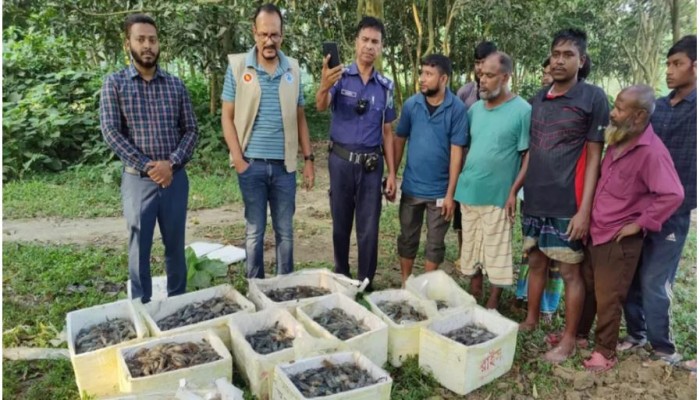
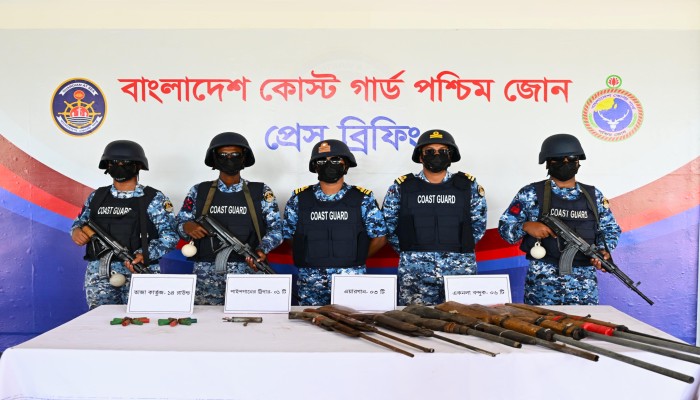
Drives in the Padma River are being conducted by the upazila fisheries office, the administration, and naval police to safeguard mother hilsa. Multiple teams are operating in allocated time slots, detaining fishermen and seizing lakhs of metres of current net.
Open-air trade from trawlers
Despite ongoing river drives, temporary hilsa markets have re-emerged along the riverbanks, mirroring previous years.
A section of dishonest fishermen catch hilsa and sell them on the riverbank, prompting crowds of men and women carrying bags to rush to the banks upon hearing news of fish arrivals.
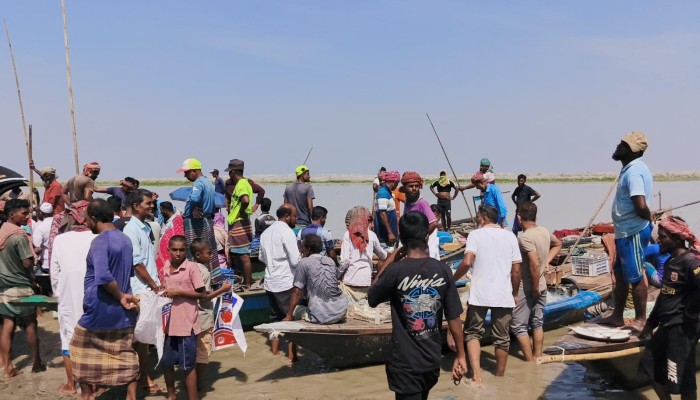
An on-the-spot observation on Tuesday afternoon (13 October) revealed a temporary open-air market operating on the Padma bank near Kazirsura market, at the edge of Bandarkhola union.
Trawlers docked one after another at the riverbank, where fishermen sold fish directly from the vessels, while other vendors sat in rows on the riverbank bargaining with buyers.
Due to relatively lower prices, the market remains crowded, with most of the larger fish on sale full of roe.
One-kilogram hilsa fish sell on the riverbank for Tk 1,500 to Tk 2,000, while smaller hilsa fetch between Tk 500 and Tk 1,000. Buyers are able to negotiate prices according to convenience, leading many who travel long distances to purchase larger quantities.
Night catches, dawn markets
According to local residents of Kazirsura area, buyers gather on the riverbank every year during the ban season, drawn by the temptation of fresh Padma hilsa. Fishermen do not halt fishing, and catches made at night are brought for sale starting at dawn.
Gathering increases immediately after the Fazr prayer call, with the morning market dispersing around 8am to 9am.
Fish caught during the day are sold from after Asr prayer until 8pm or 9pm. In addition, hilsa is available at night across various char areas of the Padma, where fishermen scatter to sell their catches to evade drives.
Shah Alam Munshi, who travelled from Shekhpur to purchase hilsa, said he came despite the distance because he could inspect fresh fish and choose according to preference, adding that fishermen bringing catches and people buying them are seen daily.
Another buyer, Md Maruf Faraji from Sadarpur, noted that fresh hilsa is readily available on the riverbank and seeing neighbours purchase fish prompted his visit, though he observed that prices are not significantly lower than standard market rates.
Speaking on condition of anonymity, several fish sellers asked what they would eat if they refrained from fishing, noting that even if they stopped, others would not, and new fishermen also enter the river during this period.
They added that nets cast at midnight yield the highest catches from various Padma areas.
Because there is no opportunity to sell in regular fish markets during the ban, sales take place on the riverbank early in the morning and from afternoon into the evening, where prices are currently slightly lower.
In addition to Kazirsura in Bandarkhola union, temporary hilsa markets operate at four to five spots across Padma char areas, including the Banglabazar-Charjanajat border area and the riverbank adjacent to Hirakhar market.
As soon as fishing boats dock at the ghats, ordinary buyers rush over and return home with bags full of fish.
‘Manpower shortage’
Satyajit Majumder, Shibchar upazila fisheries officer, said manpower shortages make 100 per cent surveillance across the entire area difficult, but drives are launched quickly upon receiving specific information.
He added that regular operations, net destruction, and fisherman detentions have been ongoing since the ban began.
HM Ibne Mizan, Shibchar upazila nirbahi officer (UNO), said regular drives are underway to protect mother hilsa, and a major coordinated operation will soon be conducted to dismantle the illegal temporary markets along the Padma banks.

 Collected Image