Country’s largest solar project eyes ECNEC nod tomorrow
 Symbolic Image
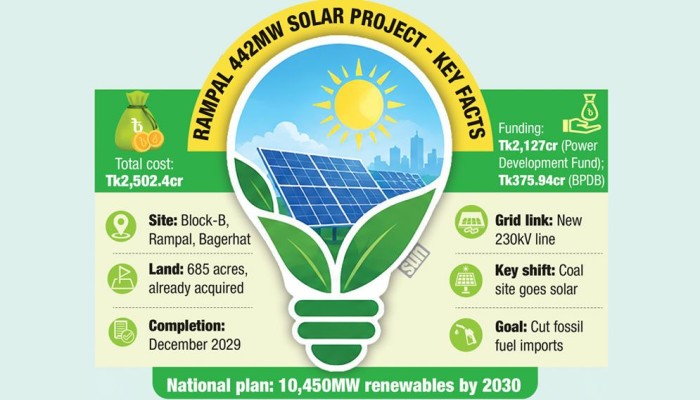
A 442MW solar power plant, proposed as Bangladesh's largest, will go before the Executive Committee of the National Economic Council (ECNEC) tomorrow at an estimated cost of Tk2,502.4 crore, on a site in Rampal, Bagerhat, originally earmarked for a coal-fired power project.
The Bangladesh Power Development Board (BPDB) has proposed the plant for Block-B at Rampal, officials said.
If ECNEC approves it, the project is scheduled for completion by December 2029.
Of the total cost, Tk2,127 crore will come from the Power Development Fund and the remaining Tk375.94 crore from BPDB's own resources.
According to the Development Project Proposal (DPP), the 442MW peak DC grid-connected solar photovoltaic plant will be built on 685 acres of already acquired land within BPDB's 918.5-acre Block-B site.
Land development and boundary protection work has been completed, which could reduce the time and cost involved.
The adjacent Block-A houses the 1,320MW Bangladesh-India Friendship coal-fired power plant.
The project will include solar panels, inverter stations, substations, power evacuation facilities and other supporting infrastructure.
Electricity will be supplied to the national grid through a new 230kV transmission system connected to the substation of the neighbouring Bangladesh-India Friendship Power Company Limited (BIFPCL).
Planning Commission officials said the project is aligned with the government's target of raising renewable energy's share of the national energy mix to 20% by 2030. By increasing renewable generation, cutting carbon emissions and reducing dependence on imported gas, oil and coal, it is also expected to contribute to Bangladesh's commitments under the Paris Agreement and the Sustainable Development Goals, as well as the Integrated Energy and Power Master Plan (IEPMP) 2023.
Nur Ahmed, additional secretary (planning wing) at the Power Division, described it as an important step in the clean energy transition.
"The project will make productive use of already developed land, reduce dependence on imported fossil fuels and strengthen the country's long-term energy security," he said, adding, "Once implemented, it will add clean electricity to the national grid, help lower carbon emissions and support Bangladesh's fuel diversification strategy while contributing to a more sustainable and resilient power system."
He said the plant could also serve as a model for future utility-scale solar investment by showing that large renewable projects can be delivered successfully in the public sector.
"We believe this initiative will encourage greater private sector participation in renewable energy and accelerate Bangladesh's transition towards a cleaner and more diversified energy mix," he added.
Shafiqul Alam, lead energy analyst at the Institute for Energy Economics and Financial Analysis (IEEFA), said the project marked a significant change in energy policy, as land once designated for a coal-fired plant was being repurposed for renewable energy.
He said the availability of developed land was a major advantage, since fresh land acquisition often delays large infrastructure projects.
Because the plant would be built on BPDB-owned land, he added, generation costs were also expected to be lower than those of many comparable projects.
The project would also help BPDB gain valuable experience in developing large-scale solar facilities, he said.
"Most importantly, the project will contribute to Bangladesh's long-term energy security by reducing its reliance on imported fossil fuels," Shafiqul said. "It is a positive step towards building a cleaner, more sustainable and more resilient power sector."
The Rampal proposal comes as Bangladesh works to finalise its National Renewable Energy Development Strategy 2026-2030, which aims to add about 10,450MW of renewable capacity by 2030 and meet 20% of annual electricity demand from clean sources.
The strategy envisages a bigger role for private investment through rooftop solar, merchant power projects, public-private partnerships and utility-scale solar parks.
The Rampal plant would add a major public-sector utility-scale project to that planned expansion.

 Symbolic Image