Urgent reforms needed to create jobs: WB
 Collected Image
Bangladesh’s GDP growth projected at 3.4% in FY26 and FY27
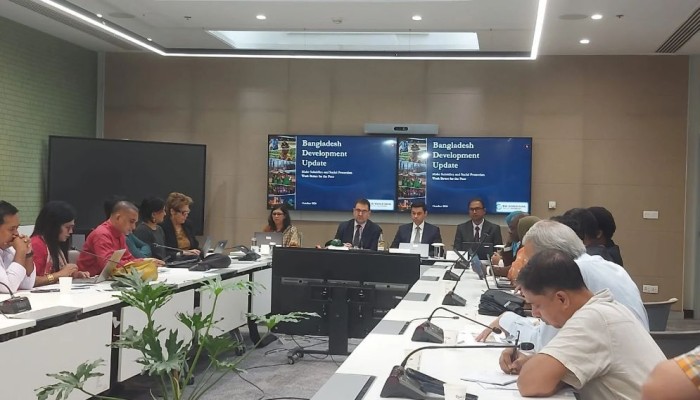
Bangladesh needs urgent and bold reforms in the banking, energy and domestic revenue sectors to revive economic growth, attract private investment and create more jobs, the World Bank said in its latest Bangladesh Development Update released on Tuesday.
The World Bank projected Bangladesh’s GDP growth at 3.4% in both FY26 and FY27, citing persistent structural constraints and global uncertainties that are weighing on investment and economic activity.
It said growth could improve to 3.9% in FY28 if energy supply gradually eases and the government accelerates its reform drive.
“Bangladesh needs to respond with urgency and speed up the reforms essential for protecting the poor and creating more and better jobs. The time to act is now,” said Jean Pesme, World Bank Division Director for Bangladesh and Bhutan.
He said fast and bold reforms in the banking sector, domestic revenue mobilisation and energy sector are needed to avert an economic downturn and return the country to an inclusive growth path driven by private investment.
According to the report, investment activity has softened, exports have lost momentum and inflation has remained elevated, reducing household purchasing power and increasing business costs.
Weaknesses in the financial sector have continued to affect credit intermediation and investor confidence, while limited fiscal space has constrained public investment.
Despite these challenges, the external sector remained resilient, supported by strong remittance inflows and improving foreign exchange reserves, the World Bank said.
The report also highlighted growing pressure on poverty and employment. In FY26, about 2.1 million more people fell into poverty compared with the previous year, while job creation stalled and women lost jobs.
Banking sector vulnerabilities also intensified, with the non-performing loan ratio rising to 33.2% in June 2026 from 30.6% in December 2025.
Revenue collection stood at 8.3% of GDP, among the lowest levels in the world, limiting the government’s ability to increase public spending where it is needed. The fiscal deficit widened to 3.9% of GDP in FY26 from 3.5% in FY25.
The World Bank also called for better targeting of social protection programmes. It said about half of the poorest households remain outside any social protection programme.
Better targeting and implementation of the government’s Dynamic Social Registry would be critical to addressing gaps in coverage, it said.
According to the report, consolidating multiple food subsidies and combining the Family Card with better-targeted existing cash programmes could lift an additional 2.85 million people out of poverty.
Meanwhile, the World Bank’s regional South Asia Economic Update projected the region’s growth at 6.9% this year, slowing to 6.7% in 2027 as global headwinds increase.
“South Asia has demonstrated remarkable resilience in a challenging global environment. But the region needs to invest in new drivers of growth to sustain momentum and create more jobs,” said Johannes Zutt, World Bank Vice President for South Asia.
He said countries should invest in skills, infrastructure and an enabling environment to allow workers and businesses to benefit from rapidly growing AI-related global value chains.
The report said AI adoption is increasing across South Asia, although it remains well behind advanced economies. Businesses are using AI to identify new market opportunities, while governments are increasingly applying the technology to improve public services.
Franziska Ohnsorge, World Bank Group Chief Economist for Asia, said AI could transform South Asia’s development trajectory by boosting labour productivity, expanding export opportunities and improving public service delivery.
However, governments need to address foundational gaps to fully benefit from the technology, she said.

 Collected Image