Hostile leaflets found beside portrait
Khulna Bureau:
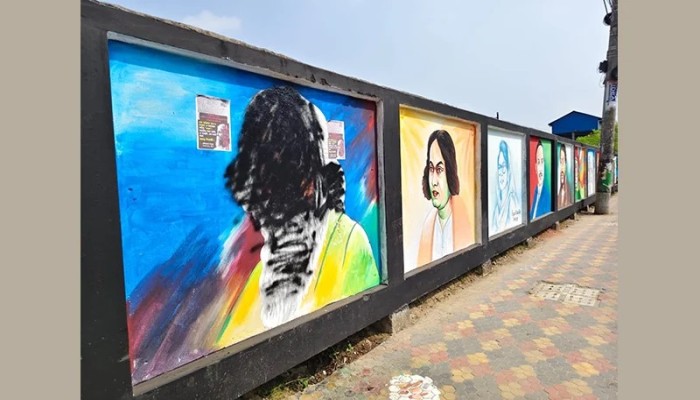
A graffiti portrait of Nobel laureate Rabindranath Tagore on a wall at Khulna Railway Station has been defaced with black ink, triggering widespread condemnation and anger among local residents.
The incident came to light on Friday afternoon.
The graffiti, created at the initiative of Khulna City Corporation (KCC) ahead of Prime Minister Tarique Rahman's visit to Khulna, featured images depicting the July uprising, the Sundarbans, the Sixty Dome Mosque and the jute industry, alongside portraits of Tagore, Kazi Nazrul Islam and other prominent figures who contributed to the art, literature and culture of the Khulna region.
The artworks had drawn positive reactions on social media for their visual appeal and representation of the region's heritage. However, the defacement of Tagore's portrait has sparked criticism and resentment among local people.
A visit to the site revealed that portraits of Fakir Lalon Shah, painter SM Sultan, Rabindranath Tagore, Kazi Nazrul Islam, former Prime Minister Khaleda Zia, former President Ziaur Rahman and Michael Madhusudan Dutt had been painted on a wall beside the Old Jessore Road.
Of these, only Tagore's portrait was covered with black ink. Two leaflets containing what appeared to be hostile messages were also found pasted beside the defaced artwork.
The leaflets carried the headline "Opposition to the Establishment of Dhaka University" and included several quotations, followed by the message: "There is no place for anti-Muslim and anti-East Bengal Tagore in Titumir's Bengal; there is no place for glorifying India."
As businesses across the road remained closed on Friday, it was not possible to determine who defaced the portrait or when the incident took place.
Officer-in-Charge of Khulna Sadar Police Station Lokman Hossain said police began looking into the matter after learning about it in the afternoon.
"We have started making inquiries, but so far we have not found any information worth sharing," he said.
KCC Administrator Nazrul Islam Manju expressed strong resentment over the defacement, saying the murals and portraits had been created on prominent walls to familiarise visitors with the history and heritage of the region.
"The purpose was to introduce visitors to Khulna's history and heritage. These artworks will also help develop the free-thinking of our children and adolescents. By defacing them with black ink, those responsible have exposed their narrow-mindedness and intolerance," he said.
Kajol Islam, convener of the Sammilito Sanskritik Forum Khulna, said there had recently been a growing tendency to view Tagore's work through a political lens.
"No one can reasonably question his poetic brilliance. His literature and philosophy have taught generations the values of free thought, secularism and human dignity," he said.
He alleged that some young people were being misled into engaging in such acts and called on people from all sections of society to unite against them.
Earlier, on October 10, a similar incident took place in Dhaka, where black ink was applied to the face of a graffiti portrait of Rabindranath Tagore. Police detained four people, including Al Nur Mohammad Ayash, member secretary of the Rashtra Sanglap Forum, in connection with that incident.

 Collected Image