Tk5,905 crore project marred by substandard work, incomplete schemes and questionable payments; former project director faces ACC cases
A government project worth nearly Tk6,000 crore, undertaken to rehabilitate rural road infrastructure damaged by Cyclone Amphan and floods, has come under scrutiny over allegations of widespread irregularities, corruption and misuse of public funds.
An audit report by the Local Government and Rural Development Audit Directorate has exposed a troubling picture of alleged financial misconduct, including payments for incomplete work, substandard construction materials, abandoned projects and expenditure beyond approved allocations.
In several cases, contractors allegedly received full payments after showing projects as 100 per cent complete on paper, although less than half of the actual work had been carried out. Elsewhere, guide walls of bridges and protective structures along roads reportedly collapsed shortly after construction.
The audit findings also raised questions over additional expenditure in the Pirojpur and Barishal regions without proper approval under the project's Development Project Proposal (DPP).
Former project director and Local Government Engineering Department (LGED) Executive Engineer Md Rafiqul Hasan has also come under scrutiny. The Anti-Corruption Commission (ACC) has filed two separate cases against him and his wife over allegations of acquiring assets beyond their known sources of income.
Project approved without feasibility study
The project, titled 'Rehabilitation of Rural Road Infrastructure Damaged by Cyclone Amphan and Floods', was undertaken in 2020 during the previous government's tenure.
According to the audit findings, the project was approved without a pre-feasibility or feasibility study, despite the requirement under government planning guidelines for such assessments for new projects costing more than Tk50 crore.
The absence of a proper feasibility assessment reportedly contributed to implementation delays and weaknesses in project planning.
The project covered the construction and rehabilitation of rural roads, bridges and culverts across several districts. However, allegations of irregularities have emerged at different stages, including contractor selection, construction quality, measurement of completed work and bill payments.
One example cited in the audit report involves a road from Mandura Bazar to Bharatkhali in Saghata upazila of Gaibandha.
Although the renovation of the approximately 1.5-kilometre road was shown as fully completed, only around half a kilometre was actually renovated. Yet the contractor reportedly received the full payment of Tk52 lakh.
Over Tk3,479 crore spent in six years
According to Annual Development Programme (ADP) data, the project was launched in the 2020-21 fiscal year with an original allocation of Tk5,905.59 crore.
By April 2026, Tk3,542.61 crore had been released against the project, of which Tk3,479.53 crore had reportedly been spent at the field level.
Despite the substantial expenditure over nearly six years, a significant number of schemes remain incomplete.
The project period has been extended until December 2028, even after audit findings highlighted financial and implementation irregularities.
The project is currently being implemented in 355 upazilas across 55 districts in all eight divisions of the country.
Substandard materials raise questions over construction quality
The audit report also raised serious concerns over the quality of construction materials and workmanship.
It found that several roads were constructed using thinner-than-specified layers of brick chips and sand in the carpeting sections. Inadequate compaction with rollers or vibrators reportedly caused the seal coat and carpeting layers to deteriorate within a short period.
As a result, potholes have developed on several newly renovated roads, while bituminous surfaces have begun to crumble.
Under the contractual conditions, the reconstructed roads and bridges were supposed to maintain durability for at least three years after completion. However, damage has reportedly appeared at several locations well before the stipulated period.
The collapse of guide walls and protective structures shortly after construction has also raised questions about engineering supervision and quality control.
Work on 488 schemes yet to begin
The audit review identified significant delays in project implementation, with 14 audit objections remaining unresolved.
Delays were also reported in the implementation of 22 per cent of the schemes.
Work on 488 schemes has yet to begin, including a substantial number of road and culvert projects. Meanwhile, hundreds of other schemes remain partially completed at different stages of implementation.
The Implementation Monitoring and Evaluation Division (IMED), in its intensive monitoring report, identified slow fund release and expenditure, prolonged implementation delays and irregular meetings of the Project Implementation Committee and Steering Committee as major management challenges.
The project was originally designed to repair roads and culverts damaged by Cyclone Amphan, which struck on May 20, 2020, affecting infrastructure in Dhaka, Khulna, Barishal and Chattogram divisions.
Although the project period has been extended several times, concerns over field-level irregularities and construction quality remain unresolved.
Incomplete bridges and collapsing protective walls
Several incidents have highlighted alleged negligence in project implementation.
In Nangalkot upazila of Cumilla, a contractor, Messrs Shams Engineering, was fined Tk10 lakh and its tender was cancelled for leaving incomplete a bridge construction project worth approximately Tk2.17 crore.
In different road rehabilitation schemes in Barishal and Rangpur, evidence of incomplete work beyond contractual deadlines and the use of substandard materials has reportedly been found.
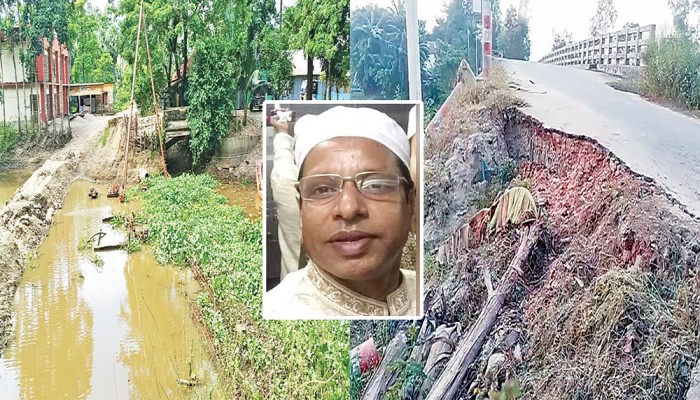
The collapse of guide walls of newly constructed roads and bridges in parts of Gaibandha and Kurigram has further raised concerns over construction supervision.
LGED Executive Engineer in Kurigram Md Saiful Islam attributed the damage to strong river currents and assured that the protective walls would be repaired through piling work as soon as possible.
However, local residents have expressed dissatisfaction over the quality and durability of the infrastructure.
Tk124.33 crore in additional expenditure questioned
Financial irregularities have also been reported in the Pirojpur and Barishal regions.
According to audit-related information, an additional Tk124.33 crore was released and spent in previous fiscal years without prior approval from the Planning Commission, allegedly in violation of the approved DPP provisions.
The findings have raised questions about compliance with financial rules, approval procedures and the justification for additional expenditure.
There have also been allegations that proposals for bridges and culverts were submitted in some locations without adequately assessing their necessity, potentially leading to unnecessary public expenditure.
Former project director faces ACC cases
Former project director Md Rafiqul Hasan, an LGED executive engineer, is facing two separate cases filed by the ACC over allegations of acquiring assets beyond his known sources of income.
According to the allegations, he acquired assets worth more than Tk1.37 crore beyond his known sources of income, including a flat at Japan Garden City in Dhaka.
His wife, Mosammat Kaniz Fatema, has also been named in a separate case.
The allegations are subject to investigation and judicial proceedings.
Meanwhile, current project director Ahsan Kabir has questioned the effectiveness of some audit objections, alleging that unnecessary audits are being conducted to create administrative pressure. He has also offered explanations regarding the project's overall progress and disparities in implementation.
Expert calls for accountability
Calling for strong legal action over the alleged irregularities, Dr Touhidul Haque, an associate professor at the Institute of Social Welfare and Research of Dhaka University and an expert on crime, said allegations of collusion between officials and contractors to misappropriate public funds allocated for disaster rehabilitation were deeply concerning.
He stressed the need for an impartial investigation and exemplary punishment for those found responsible.
Experts say ensuring transparency in public expenditure, strengthening construction supervision and taking effective action against those involved in irregularities are essential to achieving the project's original objectives.
Otherwise, despite the expenditure of thousands of crores of taka, communities affected by natural disasters may continue to remain deprived of durable rural infrastructure.

 Collected Image