Giant bamboo ‘Bhodum’ likely to replace as timber
 Collected Image
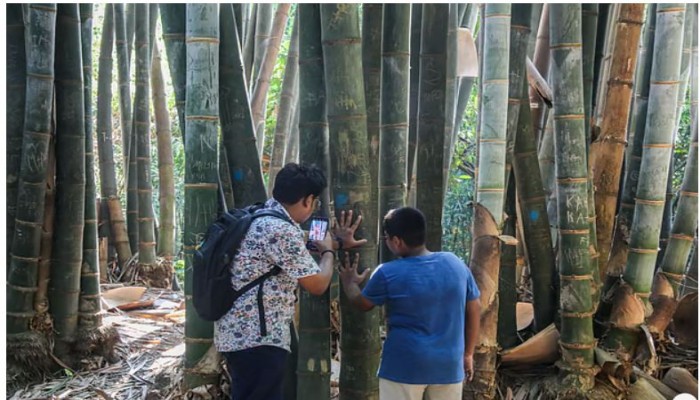
Several clusters of unusually thick bamboo in the bamboo garden of the National Botanical Garden in Mirpur, Dhaka, are drawing the attention of visitors. Their exceptionally large stems stand out from ordinary bamboo, prompting many visitors to stop, admire them and take photographs.
Known locally as ‘Bhodum’, the giant bamboo is not only remarkable for its size but also holds potential as an alternative to timber in furniture production and construction.
According to Abdul Alim, a gardener at the botanical garden, the bamboo's scientific name is Dendrocalamus giganteus. Its stems are considerably thicker than those of most other bamboo species, although the inside remains hollow. The absence of lower branches also gives its clusters a relatively neat appearance.
Visitors entering through the main gate of the National Botanical Garden can reach the bamboo garden by walking straight towards the director's office and turning left along the road. Several clusters of Bhodum bamboo grow beside the pathway.
During a visit on October 13, the unusually thick stems were found attracting considerable attention. Sumon Gazi, a resident of Mohammadpur, was visiting the garden with his young son, Nahid Gazi. He was taking photographs of his son standing beside one of the giant bamboo stems.
"I have visited the garden before and have seen these thick bamboo plants here. I have not noticed anything like them elsewhere. Every time I visit, these bamboo stems catch my attention. They are fascinating because of their extraordinary thickness," Sumon said.
Garden officials said the National Botanical Garden houses 18 bamboo species, including Bhodum. Other varieties include Barak, Ghoti, Lata and Dolua bamboo. Their clusters are located in sections 35, 48 and 50 of the garden.
Bangladesh ranks eighth globally in bamboo diversity
According to the Food and Agriculture Organization (FAO) report Global Bamboo Resources, Bangladesh ranks eighth in the world in terms of bamboo species diversity, with 33 recorded species.
China tops the list with 500 species, followed by Brazil with 232.
Bamboo has a wide range of uses in Bangladesh, particularly in rural areas, where it remains an important construction material for both traditional and semi-permanent houses. It is also used to make furniture, building materials, handicrafts and paper.
In hilly areas, bamboo shoots are consumed as food. Its use in decorative structures, restaurants and modern architectural designs is also increasing.
Among the country's bamboo varieties, Bhodum is particularly distinctive for its size. It generally grows to a height of around 25 metres, while the diameter of its stem near the base is approximately 19 centimetres.
A study conducted by the Bangladesh Forest Research Institute (BFRI), published in the Journal of Biodiversity Conservation and Bioresource Management in 2017, documented the structural characteristics of the species.
The study found that the basal stem diameter of Bhodum bamboo was 18.72 centimetres, with a wall thickness of 3.45 centimetres. Towards the middle, the stem diameter decreases to around 11 centimetres, while its wall thickness falls to approximately 0.70 centimetres.
The species is found mainly in the Chattogram, Sylhet and Cox's Bazar regions. However, commercial cultivation has yet to develop in the country. Most existing plantations have been established by individuals as hobby projects or to enhance the aesthetic appeal of gardens.
Potential to reduce pressure on timber resources
Experts believe wider cultivation of Bhodum bamboo could help reduce pressure on timber resources by creating opportunities for its use in furniture and construction.
Its thick stems and hollow structure make it suitable for producing different types of furniture and potentially various construction materials.
The bamboo also has ecological benefits. Its extensive root system spreads deep into the soil and across surrounding areas, helping prevent soil erosion.
Raihan Iqbal, a researcher and assistant professor at the Department of Botany at Jahangirnagar University, said Bangladesh's climatic conditions were suitable for cultivating the species.
He said expanding its production could reduce dependence on timber while also contributing to environmental conservation through soil protection.
However, the difficulty of producing new seedlings remains a major obstacle to its wider cultivation. Conventional propagation is relatively challenging, limiting the expansion of commercial plantations.
Tissue culture offers a breakthrough in propagation
A research team comprising three researchers from the Department of Botany at Jahangirnagar University has studied ways to produce Bhodum bamboo seedlings.
Their findings, published in the Bangladesh Journal of Botany in 2023, demonstrated a successful method of producing new seedlings through tissue culture.
The researchers used nodal stem sections of the bamboo to develop new plants under laboratory conditions.
According to the study, seedlings can also be produced from bamboo rhizomes and seeds. However, bamboo flowering occurs after long intervals, making seed collection and propagation difficult.
Against this backdrop, tissue culture could provide a more practical way to produce seedlings in sufficient quantities for wider cultivation.
Raihan Iqbal, one of the researchers involved in the study, told Prothom Alo that commercial cultivation of Bhodum bamboo was possible in Bangladesh.
He said the first priority should be to produce an adequate supply of seedlings and make them available to farmers and commercial growers.
The difficulty of producing seedlings through conventional methods has so far prevented the species from spreading widely, he added.
Iqbal also stressed that expanding cultivation could reduce pressure on timber resources and help protect soil from erosion, noting that Bangladesh's climate was favourable for growing the species.
Bangladesh exports bamboo to foreign markets
Bangladesh also exports bamboo to several countries, although the scale of exports remains relatively modest.
According to data from the World Bank's World Integrated Trade Solution (WITS), the country exported a total of 394 tonnes of bamboo in 2023 and 2024, earning approximately US$133,000.
In 2023, Kuwait, Pakistan, the United Arab Emirates and the United States imported 245.77 tonnes of bamboo from Bangladesh, worth around US$71,740.
In 2024, exports to Pakistan, Kuwait, the United Kingdom, India and Japan totalled 148.35 tonnes, generating approximately US$61,630.
Rural homesteads and privately owned bamboo gardens are among the country's major sources of bamboo production. Protected forest areas also contribute to domestic supply.
According to a 2014 survey by the Bangladesh Bureau of Statistics (BBS), approximately 6.027 million bamboo stems were produced annually from homestead and other privately owned forests. Production from protected forest areas stood at around 2.2655 million stems.
The combined annual production from the two sources was approximately 8.2925 million stems, according to the survey. However, updated comprehensive data on total national production are not readily available.
Commercial cultivation could open new opportunities
Despite its considerable size, potential economic value and ecological benefits, Bhodum bamboo remains largely absent from commercial agriculture in Bangladesh.
Experts believe that overcoming the challenges of seedling production could create opportunities to develop plantations, diversify the bamboo industry and reduce dependence on conventional timber.
If the tissue culture technique developed by researchers can be successfully scaled up and made accessible to commercial growers, Bhodum bamboo could emerge as a valuable resource for furniture manufacturing, construction and environmental conservation.
The challenge now is to translate laboratory research into practical seedling production and ensure that farmers and entrepreneurs have access to planting materials.

 Collected Image