Bangladesh eyes comprehensive transformation to become $1T economy by 2034
 Collected Image
Bangladesh is pursuing a comprehensive economic transformation to become a US$1 trillion economy by 2034, focusing on investment, productivity, employment generation and equitable economic opportunities, according to the FY2026-27 budget document.
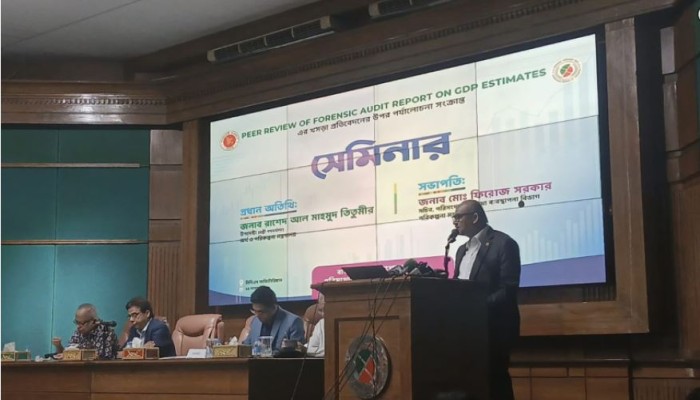
"The government is working towards transforming Bangladesh into a global manufacturing and export hub through an integrated approach involving investment, production and exports," Prime Minister's Finance and Planning Adviser Dr Rashed Al Mahmud Titumir told BSS.
At the same time, initiatives have been undertaken to build a skills-based Bangladesh, he said.
Through these efforts, the government aims to break away from the existing vicious cycle and establish a positive and sustainable virtuous cycle of investment, production and exports, the adviser added.
To achieve this vision, the government is prioritising improvements in the business environment, reducing the cost of doing business and removing unnecessary restrictions and regulatory controls through deregulation, Titumir said.
He also highlighted the importance of sustainable energy and infrastructure development, policy support for promising economic sectors, adequate financing for investment and production, and improved multimodal rail and road connectivity.
The government is also working to improve logistics efficiency and reduce transportation costs to strengthen the country's manufacturing and export competitiveness, he added.
According to the budget document, the government aims to reduce inflation to 7.5 percent and raise GDP growth to 6.5 percent in the coming fiscal years by harnessing demographic and longevity dividends and ensuring broader economic participation.
Bangladesh's economy has experienced volatility in recent years amid external shocks, corruption, financial-sector mismanagement, energy shortages and declining investor confidence.
GDP growth declined from 6.78 percent in FY2005-06 to 5.78 percent in FY2022-23, 4.22 percent in FY2023-24 and 3.49 percent in FY2024-25.
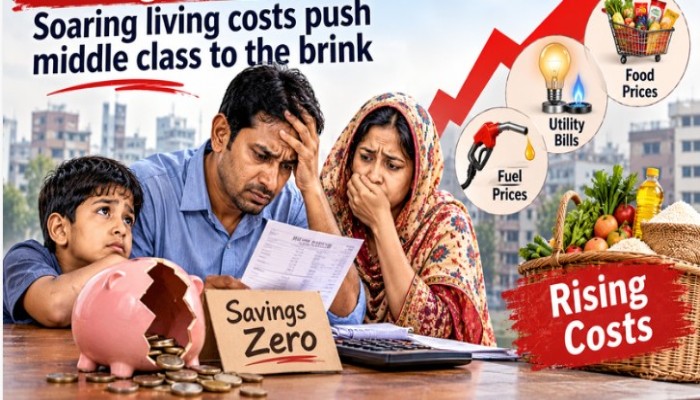
The budget document attributes the slowdown to structural weaknesses, high interest rates, governance challenges and persistent inflation. General inflation reached 11.66 percent in July 2024, while food inflation stood at 14.10 percent, significantly eroding household purchasing power.
For FY2030-31, the government has set targets of 8.5 percent GDP growth, five percent inflation, foreign direct investment equivalent to 2.7 percent of GDP and total investment of 40 percent of GDP.
Three-phase economic strategy
The government will implement its three-phase 3R Strategy: Recovery and Stabilization, Restoration, and Reconstruction for Acceleration.
The first phase, spanning one year, will focus on macroeconomic stability, protecting vulnerable communities, expanding social protection, improving public services, simplifying business procedures and strengthening institutional coordination.
The second phase, covering three years, will concentrate on revenue reforms, domestic resource mobilisation, reviving private investment, strengthening the banking and financial sectors, diversifying exports and developing human capital, alongside investment in agriculture, energy and infrastructure.
The five-year third phase aims to establish a technology-driven and innovative economy through skills development, digital transformation, stronger institutions, global economic integration, energy security and climate-resilient inclusive growth.
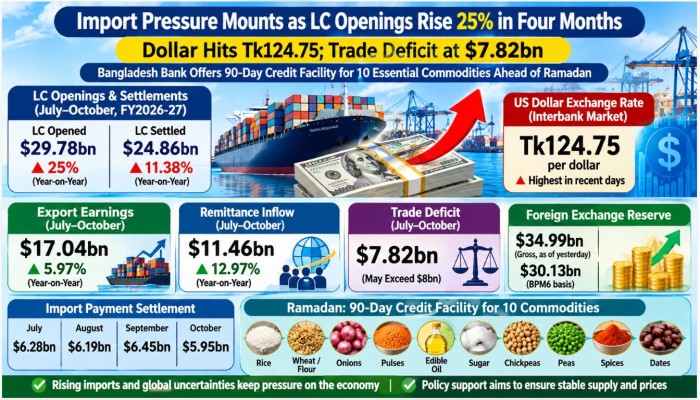
To stabilise the economy, the government also plans to strengthen foreign exchange reserves, stabilise the taka, expand exports and remittances, manage non-essential imports and improve coordination between monetary and fiscal policies.
10 development priorities
Under its broader development agenda, the government has prioritised industrial revival, social protection, agricultural support, water-resource management, public safety, energy security, renewable energy and infrastructure development.
As part of efforts to revive the jute industry, production has resumed at nine of the 17 state-owned jute mills leased by the Bangladesh Jute Mills Corporation (BJMC), reportedly creating 9,500 jobs. Three more mills are being prepared for reopening, while the broader initiative could generate 50,000 to 60,000 additional jobs.
Lease agreements involving National Jute Mills and Star Jute Mills with PRAN-RFL Group and Platinum Jubilee Jute Mills with Hamco Group envisage investment of Tk 619 crore and annual revenue of Tk 1,175 crore. The government is also encouraging investment in diversified jute products and overseas market development.
Under the Family Card programme, around 41 lakh vulnerable families are expected to receive assistance in FY2026-27. Preparations are underway for nationwide data collection and phased distribution, with approximately 72,000 volunteers expected to support the programme.
The Farmer Card initiative targets around 43 lakh farmers in the next fiscal year, with a longer-term objective of supporting 2.4 crore landless, marginal and small farmers. Eligible beneficiaries will receive Tk 2,500 annually to help meet agricultural input costs and sustain production.
The government has also undertaken an ambitious programme to excavate or re-excavate 14,000 kilometres of rivers, canals and water bodies over four years. A total of 377 kilometres were completed during the previous six months, exceeding the target of 360 kilometres.
Support for religious service providers, including imams, muezzins, Hindu priests and temple attendants, is another priority. The programme could cover around 60,000 beneficiaries in FY2026-27.
Strengthening law and order through police recruitment, training and improved operational capacity is also part of the government's agenda. The measures aim to combat murder, robbery, abduction and other crimes while restoring public confidence in law enforcement.
In the energy sector, the government plans to increase domestic gas production through the development of around 150 gas wells, upgrades to LNG terminals and enhanced supplies to the national grid.
Renewable energy development, particularly solar power, is also receiving attention. Proposed incentives include tax concessions on solar equipment, financial support, low-interest loans and opportunities to sell surplus electricity at Tk 10.50 per unit. Solar installations at public offices and suitable government-owned land are also being considered.
Meanwhile, investment in roads, bridges, transport networks and energy infrastructure is expected to improve connectivity, reduce logistics costs and strengthen links between rural producers and industrial markets.
The overall development strategy seeks to integrate industrial expansion, agricultural productivity, social protection, energy security, infrastructure and institutional reforms to create a more resilient and inclusive economy.
The government believes that coordinated implementation of these initiatives, alongside improved governance, investment mobilisation and productivity, will be crucial to achieving its long-term ambition of building a $1 trillion economy by 2034.
-BSS

 Collected Image