Hatikumrul Interchange:
A landmark in northern Bangladesh’s connectivity
 Photo: TDS
A major transformation in road connectivity across northern Bangladesh is on the horizon as the construction of the Hatikumrul Interchange, a mega project costing around Tk 743 crore, approaches completion, raising hopes of smoother journeys, faster transportation and fresh economic opportunities for the region.
Scheduled for completion by December, the project is expected to address longstanding traffic congestion at the Hatikumrul intersection, one of the country’s busiest transport hubs. Beyond easing road travel, the interchange is set to strengthen regional connectivity, facilitate trade, improve agricultural supply chains and contribute to the economic development of northern Bangladesh.
The development comes at a crucial time as the Elenga-Rangpur four-lane highway project is reshaping road communication between Dhaka and the northern districts. With increased traffic expected along this corridor, an efficient interchange at Hatikumrul has become essential to managing the growing pressure on the road network, particularly during Eid and other peak travel periods.
A STRATEGIC GATEWAY TO 22 DISTRICTS:
Hatikumrul is a strategically important transport junction connecting 22 districts across the northern and south-western parts of the country. Situated at the intersection of three national highways—D-5, D-405 and D-507—the interchange also provides connectivity to 10 major land ports, four airports and four river ports, according to project officials.
Roads and Highways Department (RHD) sources said, the modified cloverleaf interchange, designed to meet international standards, is being constructed under Work Package-13 of the South Asia Subregional Economic Cooperation (SASEC) Road Connectivity Project-II.
Once operational, the structure will enable vehicles travelling in different directions to move without having to navigate the existing congested roundabout. This is expected to reduce traffic bottlenecks, improve road safety, shorten journey times and enhance the efficiency of passenger and freight transportation.
BOOST FOR AGRICULTURE AND TRADE:
The project’s economic significance extends well beyond improved road communication. Northern districts, including Rajshahi, Natore, Pabna and Rangpur, are major producers of agricultural commodities such as mangoes, lychees and vegetables. Faster and more reliable transportation will help these perishable products reach wholesale markets in Dhaka and Chattogram with less delay.
Project officials expect transportation costs to decline by around one-third, potentially improving farmers’ returns, reducing post-harvest losses and making agricultural products more competitive in major markets.
The improved connectivity is also expected to benefit businesses, traders and freight operators by facilitating the movement of goods between northern Bangladesh and other parts of the country.
The project is being implemented by Chinese contractor China Railway Construction Bridge Engineering Bureau Group Co. Ltd.
Dr Md Waliur Rahman, additional chief engineer of the RHD and project director of SASEC-II, said the interchange would bring an end to prolonged traffic congestion at the Hatikumrul roundabout and significantly reduce travel times on several major routes.
“Travel time from Dhaka to Rajshahi, Pabna, Nagarbari or Rangpur will be cut nearly in half,” he said, adding that the second-largest interchange of its kind in the country is expected to open on December 16.
However, he stressed that maintaining construction quality was more important than meeting a deadline. “We do not want to rush the process just to meet a deadline. Our priority is to complete the work carefully and maintain high quality. If this requires another month or two of additional effort, we are willing to do so,” he added.
Md Sharfaraz Hossain, project manager of the Hatikumrul Interchange under SASEC Road Connectivity Project-II, echoed the emphasis on quality, saying the authorities would not compromise construction standards to accelerate completion.
“Even if it takes a little longer, we are committed to ensuring a high-standard completion. We need everyone’s cooperation in this regard,” he told The Daily Sky.
As the project approaches its final stage, expectations are growing that the Hatikumrul Interchange will emerge as more than just a modern road structure. Its successful completion and operation could mark an important step towards a better-connected northern region, stronger agricultural supply chains and more balanced economic development across the country.


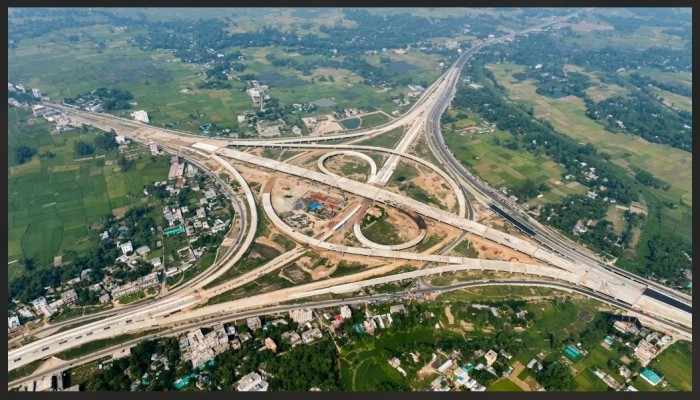 Photo: TDS