
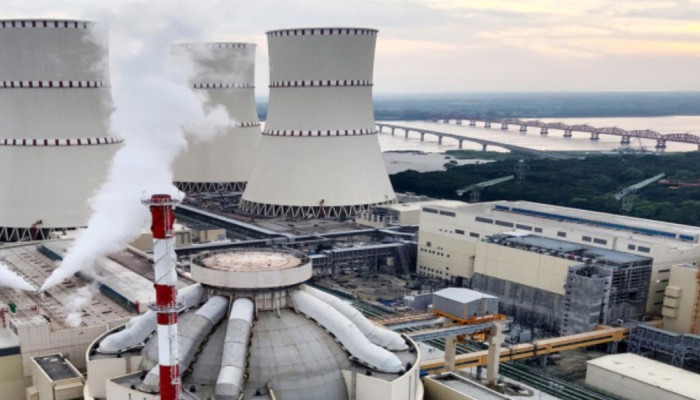
The Rooppur Nuclear Power Plant has achieved its first-ever nuclear reaction, marking a significant milestone in the commissioning of Bangladesh’s first nuclear power facility.
Science and Technology Secretary Anwar Hossain confirmed the development on Sunday afternoon, October 11, saying the first nuclear reaction in Unit 1 took place at 3:34pm.
He said all operational parameters were within the required limits and there was no cause for concern over radiation levels.
Earlier, on Thursday, October 8, the Bangladesh Atomic Energy Regulatory Authority (BAERA) granted final approval for power generation from the first unit of the country’s maiden nuclear power plant.
The reactor uses Russia’s third-generation VVER-1200 technology, which incorporates advanced safety systems. Science and Technology Minister Fakir Mahbub Anam has said the authorities are working towards beginning electricity supply to the national grid by the end of November.
According to guidelines of the International Atomic Energy Agency (IAEA), Stage B1 of the first unit’s commissioning process, developed with Russian assistance, has been completed largely successfully.
The project has also overcome complications related to testing the automatic pressure-relief valve. The next stage, known as B2, involves preparing the reactor for initial operation before proceeding to criticality.
Criticality is the stage at which a self-sustaining nuclear fission chain reaction is established inside the reactor. This allows the plant to gradually increase reactor power under controlled conditions, paving the way for electricity generation.
The unit’s output will be increased gradually as it progresses through the commissioning stages. Once it reaches the required level—reportedly up to 300 megawatts in the initial phase—the plant is expected to begin supplying electricity to the national transmission grid on a commercial basis.
The successful initiation of the nuclear reaction marks an important step towards bringing Bangladesh’s first nuclear power plant into operation, although further testing and commissioning work will be required before regular electricity supply begins.