
ChatGPT-6 is one of the most discussed topics in artificial intelligence today. While the future of AI continues to evolve, understanding how ChatGPT reached its current state is essential for anyone interested in technology, innovation, and the future of digital transformation.
Over the past few years, artificial intelligence has moved from research labs into everyday life. Millions of people now use AI tools for learning, research, software development, business productivity, and creative work. What began as an experimental technology has rapidly become a mainstream tool used across industries worldwide.
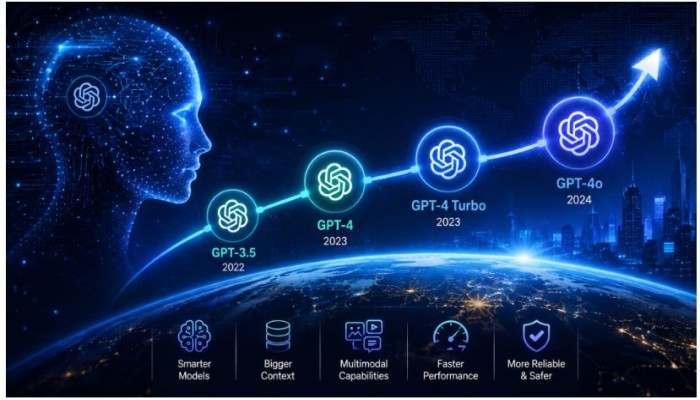
The journey from GPT-3.5 to GPT-4o represents one of the fastest technological evolutions in modern history. Each generation introduced significant improvements in reasoning, accuracy, usability, and real-world applications. Understanding this evolution provides valuable insight into why discussions around ChatGPT-6 have become so important.
The Beginning: How ChatGPT Changed the Technology Industry
When OpenAI launched ChatGPT in November 2022, few people expected it to become a global phenomenon.
Built on GPT-3.5, ChatGPT introduced a new way for humans to interact with technology. Instead of using commands or complicated software interfaces, users could simply ask questions in natural language and receive detailed responses within seconds. The impact was immediate.
Students used it to understand difficult concepts. Professionals used it to improve productivity. Developers used it to write and debug code. Businesses began exploring how AI could streamline workflows and enhance customer experiences.
Within months, ChatGPT became one of the fastest-growing consumer applications ever launched. More importantly, it introduced artificial intelligence to mainstream audiences and demonstrated the practical value of conversational AI.
GPT-3.5 marked a major milestone in the development of large language models.
For the first time, a widely accessible AI system could generate human-like responses, summarize information, answer questions, draft content, and assist with a variety of tasks.
Despite its groundbreaking capabilities, GPT-3.5 was far from perfect.
Its limitations highlighted many of the challenges that researchers needed to solve before AI could become a truly reliable digital assistant.
High Hallucination Rates
One of the biggest concerns was hallucination.
GPT-3.5 could sometimes generate inaccurate information while presenting it confidently. Users occasionally received incorrect facts, fabricated references, or misleading explanations.
This made verification essential, especially in research, journalism, education, and professional environments.
Robotic Responses and Generic Content
Although GPT-3.5 produced impressive results, many responses felt repetitive and formulaic.
Conversations often lacked the nuance, creativity, and contextual understanding that users expected from natural human communication.
Limited Context Window
Early versions struggled with long conversations.
As interactions became more complex, the model could lose track of earlier instructions, forget details, or provide inconsistent answers.
Lack of Multimodal Capabilities
GPT-3.5 was primarily text-based.
It could not effectively understand images, screenshots, diagrams, or voice interactions, limiting its usefulness in many practical scenarios.
Despite these shortcomings, GPT-3.5 laid the foundation for the next generation of AI innovation.
GPT-4: A Major Leap Forward
The release of GPT-4 marked one of the most significant advancements in modern artificial intelligence.
Compared with GPT-3.5, GPT-4 demonstrated substantial improvements in:
Accuracy
Reasoning
Problem-solving
Contextual understanding
Instruction following
The model became more reliable when handling complex questions and multi-step tasks.
For researchers, professionals, and developers, GPT-4 represented a major step toward more capable AI systems.
It showed that artificial intelligence could move beyond simple text generation and become a practical tool for analysis, learning, and decision-making support.
GPT-4 Turbo: Faster and More Efficient AI
As AI adoption accelerated, demand grew for models that were not only more capable but also faster and more efficient.
GPT-4 Turbo addressed many of these needs.
The model introduced improvements in speed, responsiveness, and context handling, allowing users to work with larger amounts of information during a single interaction.
This made AI more useful for:
Long-form writing
Research projects
Business documentation
Technical analysis
Complex workflows
The improvements demonstrated how quickly AI systems were evolving to meet real-world demands.
Unlike earlier models that focused primarily on text, GPT-4o expanded AI's ability to understand and interact with multiple types of information.
This included:
Text
Images
Audio
Voice conversations
Documents
The transition from text-only AI to multimodal AI significantly expanded what artificial intelligence could do.
Users could now upload images, analyze visual content, engage in natural voice conversations, and interact with AI in ways that felt more intuitive and human-like.
This shift marked the beginning of a new era in human-computer interaction.
How AI Became Part of Everyday Life
As AI capabilities improved, adoption expanded rapidly across industries.
Today, artificial intelligence supports millions of users in their daily activities.
Education
Students and educators use AI for:
Learning support
Research assistance
Language practice
Study material preparation
Software Development
Developers use AI to:
Generate code
Debug applications
Learn new programming languages
Improve productivity
Business Operations
Organizations use AI to:
Draft reports
Analyze data
Automate repetitive tasks
Improve customer service
Creative Industries
Writers, designers, marketers, and content creators increasingly use AI as a creative assistant for brainstorming, planning, and content development.
What was once considered an experimental technology has become an everyday productivity tool.
Why This Evolution Matters
The journey from GPT-3.5 to GPT-4o illustrates how rapidly artificial intelligence is advancing.
In just a few years, AI evolved from a text-based conversational assistant into a multimodal system capable of understanding images, voice, documents, and complex instructions.
Each generation addressed weaknesses found in earlier models while introducing new capabilities that expanded the practical value of AI.
This continuous improvement has laid the foundation for the next chapter in artificial intelligence.
And that chapter is increasingly centered around discussions of ChatGPT-6 and the future of AI.
Looking Ahead
The evolution of AI is far from over.
As researchers continue pushing the boundaries of reasoning, memory, autonomy, and multimodal intelligence, expectations surrounding future AI systems continue to grow. Since GPT-4o, newer models have continued this trend.
In Part 2 of this series, we will explore what ChatGPT-6 could mean for the future of artificial intelligence, including AI agents, advanced reasoning, persistent memory, human-AI collaboration, and the opportunities and challenges that may shape the next generation of intelligent systems.
FAQ
What is GPT-3.5?
GPT-3.5 is the language model that powered the initial public release of ChatGPT in 2022 and helped popularize conversational AI worldwide.
How is GPT-4 different from GPT-3.5?
GPT-4 introduced significant improvements in reasoning, accuracy, contextual understanding, and complex problem-solving capabilities.
What makes GPT-4o important?
GPT-4o expanded AI beyond text by introducing advanced multimodal capabilities, including image, voice, and document understanding.
Conclusion
The evolution from GPT-3.5 to GPT-4o represents one of the most significant technological transformations of the modern era. In a relatively short period, artificial intelligence has progressed from a promising innovation into a practical tool used by millions of people around the world.
Understanding this journey is essential for understanding where AI may go next. As technology continues to advance, the discussion is no longer just about what AI can do today—but what future systems such as ChatGPT-6 may be capable of achieving in the years ahead.