
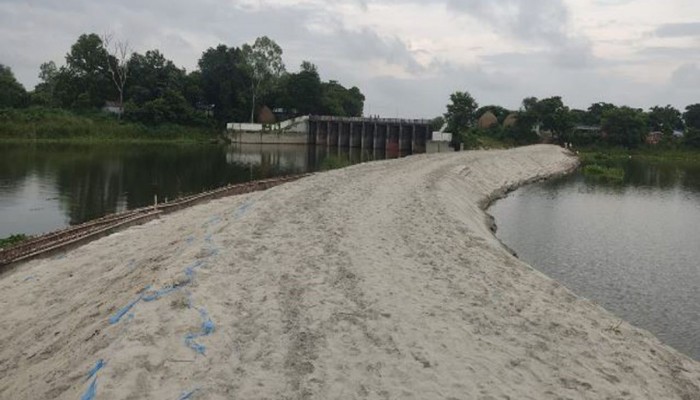
For over four decades, a 2.2-kilometer strip of sand at Rautara in Sirajganj’s Shahzadpur has served as an annual goldmine for a cozy nexus of Water Development Board (WDB) officials, corrupt contractors, political patrons, and compromised local influencers.
Under the guise of protecting Boro crops across 62,000 hectares in Chalan Beel, millions of taka in public money are poured directly into a temporary embankment every dry season — only to be intentionally breached and washed away months later.
What locals brand a "money-making trap" has siphoned off more than Tk 50 crore in public funds since the Liberation War, according to official records obtained through a Right to Information (RTI) application.
Insiders and local sources reveal that the project operates less as flood defense and more as a institutionalized kickback scheme. An estimated 50 percent of the allocated funds are routinely embezzled through exaggerated earthwork costs, phantom expenditures, and low-grade sand dumping. The loot, sources confirmed, is systematically divided among actors across the chain — from top-tier WDB engineers down to field staff, syndicate contractors, political fixers, and even a section of local journalists who are kept quiet with a slice of the pie.
A YEARLY CYCLE OF FRAUD
The financial scale of this seasonal plunder has steadily climbed in recent fiscal years:
• FY 2025–26: Tk 2.47 crore
• FY 2024–25: Tk 2.55 crore
• FY 2023–24: Tk 2.70 crore
• FY 2022–23: Tk 2.65 crore
• FY 2021–22: Tk 2.34 crore
The modus operandi is straightforward yet brazen. Each year before the Boro harvest, the WDB constructs the seasonal embankment using dredged sand. Once harvesting concludes around June, the structure is deliberately dismantled under the convenient pretext of restoring navigability and fishing access in the surrounding waterbodies.
To evade regulatory oversight and mask repeating players, a powerful contractor cartel in the town monopolizes the bidding process. The syndicate executes the work year after year by rotating front companies and borrowing different trade licenses, ensuring competition remains a complete sham.
"The embankment has been left intentionally vulnerable since the 1990s," said Abul Baker, a resident of Rautara village. "Once paddy harvesting finishes, the dam is demolished with tacit approval from WDB officials. Tens of millions of public taka literally dissolve in the water."
EXPERTS POINT TO VESTED INTERESTS
The public's long-standing demand for a permanent, engineered solution — complete with sluice gates, bridges, and pumping stations — has been repeatedly stonewalled.
Md. Mokhlesur Rahman, a former Executive Engineer (EE) of Sirajganj WDB, conceded that reliance on annual sand barriers is a glaring deliberate failure in water management planning.
"Jamuna swells every April–May, pushing floodwaters into tributaries like the Boral and Dholai, which inundate Chalan Beel," Rahman said.
Rahman said, during his tenure in Sirajganj, he came to know about a feasibility study conducted by a government team formed to examine the possibility of relocating Rabindra University to the Chalan Beel area.
If a permanent flood-control structure is built at Rautara area in accordance of the study and design, it may reduce the recurring need for temporary works and provide lasting benefits to local communities.
"WDB officials, contractors, and ruling-party figures have zero interest in a permanent structure because it permanently shuts down their invisible cash cow," he added.
AGRICULTURAL GROWTH HELD HOSTAGE
Elected representatives and agriculture officers stress that replacing the seasonal sand barrier with permanent infrastructure would unlock immense economic potential for eight upazilas across Sirajganj, Pabna, and Natore.
"If a permanent dam and pump house are constructed, two-crop lands will instantly turn into three-crop agricultural hubs," said Shahidul Islam, Acting Chairman of Potazia Union Parishad. "Instead, WDB officials and contractors line their pockets while public money goes down the drain."
Abdullah Al Mamun, an upazila agricultural officer, noted that a permanent structure would secure livestock grazing lands during monsoon, modernize regional irrigation, and prevent catastrophic losses for smallholders.
When confronted with allegations of systemic delay and money plundering, incumbent WDB Executive Engineer Md. Sazzad Hossain offered a boilerplate response: "A design based on the feasibility study was sent for revision. Steps will be taken once the revised report is approved."
For the farmers of Chalan Beel, however, the official delay is business as usual — ensuring that next year, another batch of public millions will be dumped into the river.