
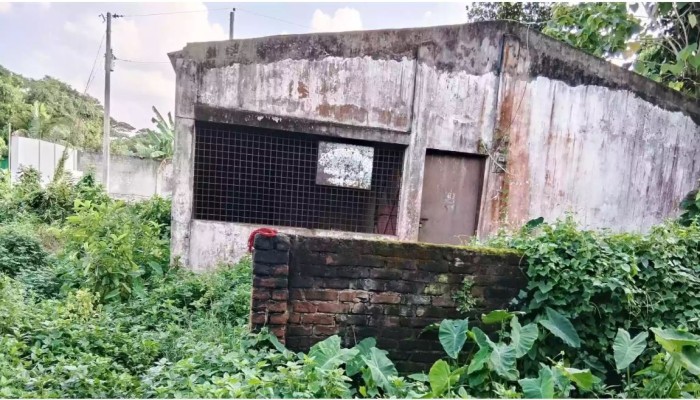
Nearly three decades after its establishment, the BSCIC Industrial Estate in Baburhat of Chandpur Sadar has yet to see significant development, with several factories remaining closed.
Established in 1998 following the launch of the initiative in 1987, the 10-acre industrial estate stands beside Chandpur-Cumilla regional highway.
It also houses the district office of the Bangladesh Small and Cottage Industries Corporation (BSCIC).
Local businesspeople and environmental activists said the estate has failed to achieve its potential because of a lack of effective initiatives and sustained development efforts.
They also pointed to the absence of BSCIC offices at the upazila level across Chandpur district, which they say has made it difficult for small entrepreneurs to access institutional support, loans and other services.
It has 33 industrial units, of which 27 are currently operational and six are closed, said Md Shahriar Khan, an industrial officer serving as the officer-in-charge of the district BSCIC office and performing the additional duties of assistant general manager.
Employees at operating factories told UNB that several businesses, including a juice factory, shut down one after another after suffering losses despite producing and marketing their goods.
The closures have left many workers unemployed, they said.
Security concerns, poor infrastructure
A visit to the industrial estate revealed a range of longstanding problems, including inadequate security, poor drainage, unreliable electricity and insufficient lighting.
There is no gate or security guard at the main entrance, nor are there regular security patrols.
The estate also lacks CCTV cameras, leaving the premises vulnerable, particularly at night.
A recent theft was reported to the local police, and a case was filed with Chandpur Sadar Model Police Station. Police are investigating the incident.
The estate’s drainage system is also inadequate, with rainwater accumulating on roads during wet weather.
The lack of security and maintenance was evident around several closed factories, where gates remained shut and dry leaves, bushes and overgrown vegetation had accumulated.
Instead of the steady movement of workers and the sound of machinery expected in an industrial zone, much of the estate appeared deserted.
Some industries continue to provide jobs
Despite the difficulties, several businesses remain operational, providing employment to hundreds of people.
At the Apollo and Monohorkhadi cold storage facilities, women labourers from marginalised backgrounds were seen sorting potatoes alongside male workers.
Asked about their daily earnings, several workers, including Rasheda, Sajeda, Nargis and Fatema, said their income varied from Tk 100 to Tk 500 a day, depending on the work available.
Around 60 to 70 women work as daily labourers at the two cold storage facilities, according to the workers.
A garment factory nearby is also operating smoothly, employing women workers and producing quality clothing for export, people familiar with its operations said.
The estate also has a flour mill, a rice mill and a recycling factory that processes plastic waste.
Young entrepreneur Kamrul Khan, one of the mill owners, said the flour and rice mills together employ around 300 to 400 people.
These operating businesses demonstrate the estate’s potential to generate employment and support local economic activity if the necessary infrastructure and institutional support are ensured.
Entrepreneurs face a long journey for support
The absence of BSCIC offices in the district’s eight upazilas has created additional difficulties for entrepreneurs seeking assistance, officials said.
People from Kachua, Shahrasti, Hajiganj, Matlab North, the southern and eastern parts of Faridganj, and the remote riverine areas of Haimchar have to travel to Chandpur town to obtain information or services related to industrial development.
For residents of some areas, the journey can involve travelling 45 to 48 kilometres.
Entrepreneurs from remote chars of Haimchar must also contend with the Meghna River, with travel becoming particularly difficult during storms and heavy rain.
The distance and lack of local offices can discourage prospective entrepreneurs from seeking assistance, particularly those with limited resources.
Shahriar Khan said he had provided loans to only three entrepreneurs under the cottage industry sector this year. All three were based outside the industrial estate.
Staff shortages hamper BSCIC operations
The district BSCIC office is itself struggling with a shortage of manpower.
According to Shahriar Khan, six key positions have remained vacant for a long time, including two promotion officers, three extension officers and one survey and information officer. One office staff position is also vacant.
The shortage has disrupted routine office work and limited the capacity to provide services to entrepreneurs across the district.
Businesspeople and concerned citizens say the situation calls for coordinated action to improve infrastructure, strengthen security, fill vacant positions and expand BSCIC services beyond the district headquarters.
They believe better access to loans, technical assistance and market information, alongside improved roads, drainage, electricity and security, could help revive closed units and encourage new investment.
--UNB