
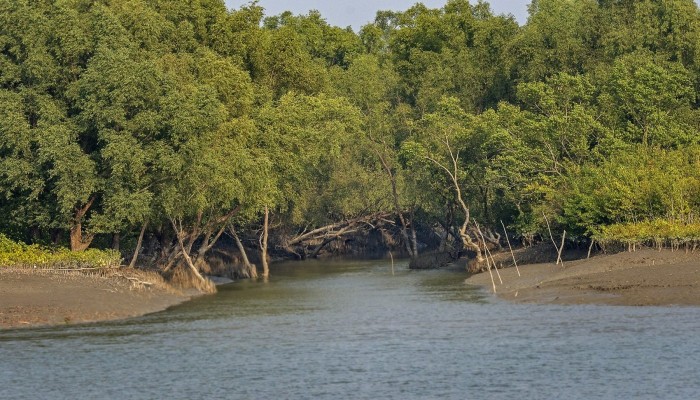
Experts have called for strict environmental safeguards, eco-friendly industries and the relocation of polluting factories near the Sundarbans to protect the world's largest mangrove forest, following a study that detected particulate matter exceeding safe limits in several areas.
They also stressed the need for advanced technology and effective dust-control measures during the unloading of cement raw materials and coal from vessels and industrial production near the forest.
The concerns emerged after a baseline study detected elevated levels of fine particulate matter (PM2.5) and particulate matter (PM10) in different areas of the Sundarbans.
Describing the findings as alarming, Rezaul Karim Chowdhury, divisional forest officer of the Eastern Sundarbans, said continued pollution could have serious consequences for the forest's wildlife and vegetation.
He said he would discuss the issue with the relevant department, local stakeholders and environmentalists to identify ways to address the problem.
Professor Dr Md Abdullah Yousuf Al Harun of the Environmental Science Discipline at Khulna University told BSS, a new policy was needed to regulate industrial activities near the Sundarbans.
Excessive PM2.5 and PM10 concentrations could damage flowers and fruits, hamper plant reproduction and reduce species diversity, he said, adding that air pollution could also cause respiratory problems in wildlife.
He suggested expanding air-quality monitoring at different distances, including 100, 200 and 500 metres from industrial areas.
Talking to BSS, Researcher and educationist Professor Anwarul Kadir called for strict safety measures and advanced technology during cement production and the unloading of clinker and other industrial raw materials near the forest. He said coal-fired power plants near the Sundarbans could also pose environmental risks.
He also proposed establishing a separate Sundarbans board or ministry to strengthen forest protection and management.
Advocate Md Babul Howlader, coordinator of the Khulna unit of the Bangladesh Environmental Movement (BAPA), referred to legal safeguards for the ecologically critical area (ECA) surrounding the forest. He called for relocating factories that threaten the Sundarbans.
He said emissions and dust from vessels transporting and unloading raw materials at nearby factories, as well as activities at the Rampal coal-fired power plant, were contributing to environmental pollution.
Although the study provides an initial baseline of air pollution in different parts of the forest, further research is needed to determine how pollution levels change over time. Continuous and precise monitoring is therefore essential, experts said.
Sheikh Ashrafuzzaman, president of the Greater Khulna Development Action Coordination Committee, also stressed the need for precautionary measures and advanced technology in industries near the Sundarbans and Mongla Port.
The findings came from a baseline study conducted in January and February of 2024 and 2025 across the Khulna, Satkhira, Sharankhola and Chandpai ranges of the Sundarbans.
Titled 'Ecological Monitoring of Sundarbans', the study examined wildlife, air, soil, water and vegetation. It was jointly conducted by the Centre for Environmental and Geographic Information Services (CEGIS), an associate organization of the Ministry of Water Resources, and the Arannyak Foundation.
The findings were unveiled at a workshop at the Forest Department headquarters in Dhaka on September 14, according to Forest Department officials.
The study recorded PM2.5 concentrations of 102 micrograms per cubic metre of air in the Sharankhola range and 89.3 micrograms in the Chandpai range. PM10 levels in the two areas stood at 114 and 98.1 micrograms per cubic metre, respectively.
Under the Air Pollution Control Rules 2022, PM2.5 concentrations exceeding 35 micrograms per cubic metre and PM10 levels exceeding 45 micrograms are considered unhealthy.
The World Health Organization's 2021 air quality guidelines set the recommended limit for PM2.5 at five micrograms per cubic metre. The study found that sulfur dioxide, nitrogen oxides and carbon monoxide remained within tolerable limits.
Researchers suggested that dust generated during the unloading of clinker at private cement factory jetties along the Passur River and coal brought for the Rampal power plant through the Passur channel was a likely source of the particulate pollution.
--BSS