
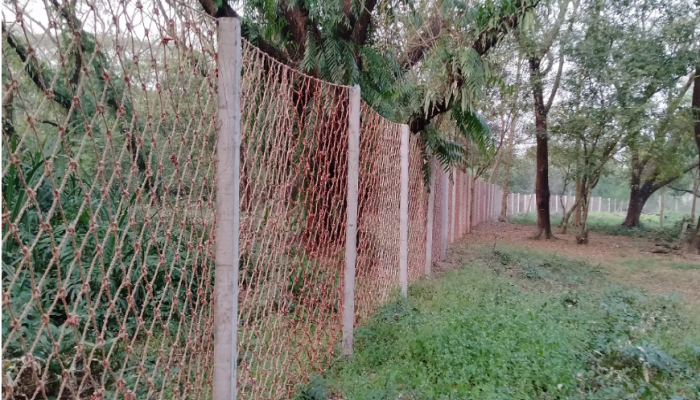
In Bangladesh's Sundarbans, where fishing boats, honey collectors and forest workers venture deep into the world's largest mangrove forest, a simple nylon fence is emerging as a potential tool to reduce encounters between people and Bengal tigers.
The lightweight fencing is being used around selected areas frequented by forest-dependent communities, creating a physical barrier between people and tigers without permanently altering the fragile mangrove ecosystem.
Divisional Forest Officer of Sundarban West Forest Division AZM Hasanur Rahman said the Forest Department has already set up 74-kilometre nylon fences around the Sundarbans under a three-year project.
Human-tiger conflict has long been a challenge in the Bangladesh portion of the Sundarbans. Thousands of people depend on the forest for fish, crabs, honey, wood and other resources, often entering areas that are also part of the tiger's natural habitat.
Unlike concrete walls or permanent metal structures, nylon fencing can be installed relatively quickly and removed or relocated when necessary. Its flexibility also makes it more suitable for an environment shaped by tides, muddy terrain and seasonal changes.
Claiming that there is no human-tiger conflict after installation of nylon fencing, Hasanur mentioned that one tiger entered locality in 2018 and since then, no such incident has been recorded.
Conservation experts say preventing encounters is often more effective than responding after a tiger has entered a settlement or attacked a person. By separating people from areas where tigers are likely to pass, fencing can provide an additional layer of protection while allowing wildlife to continue moving through its habitat.
The approach is particularly relevant around temporary camps and other locations where forest workers spend extended periods. Such sites can become vulnerable when people sleep, cook or store food close to the forest edge.
The Sundarbans is home to a significant population of Bengal tigers, which play an important ecological role as a top predator. But the forest is also a workplace for many communities, making complete separation between people and wildlife impossible.
Nylon fencing is, therefore, being viewed not as a standalone solution, but as part of a broader strategy that can include early-warning systems, improved awareness among forest users, safer work practices, patrols and rapid responses to tiger movements.
The material also has practical advantages in a landscape where conventional barriers can be difficult and expensive to construct. However, its effectiveness depends on proper installation, regular maintenance and the behaviour of people using the forest.
Talking to BSS, Conservator of Forests Imran Ahmed said for tigers, the nylon fencing works as a psychological barrier, and once tigers and other wildlife notice the fences, they step back to the forest.
He said the human-tiger conflicts have been dwindled significantly around the Sundarbans in the last four to five years.
Conservationists caution that fencing must be designed carefully so that it does not trap, injure or unnecessarily restrict wildlife. It should also be monitored to determine whether tigers simply move around the barrier or whether encounters are actually reduced.
For Bangladesh, the challenge is increasingly about finding ways for people and tigers to share a landscape under pressure from climate change, rising resource demands and environmental change.
As communities continue to depend on the Sundarbans for their livelihoods, relatively low-cost measures such as nylon fencing could offer a practical means of reducing dangerous encounters.
The wider lesson, conservationists say, is that protecting people and protecting tigers do not have to be competing objectives. In the Sundarbans, creating safer boundaries between the two may help make coexistence possible.
The Forest Department has successfully completed 74 kilometres of high-strength nylon net fencing along critical conflict hotspots, including Dhansagar, Kaikhali and Kailashganj.
The latest survey of Forest Department recorded 125 Bengal tigers in the Bangladesh portion of the Sundarbans.
In the Bangladesh part of the Sundarbans, about 300 human deaths and 38 tiger deaths occurred over a 20-year span (roughly since 2000), alongside roughly 172 to 328 total human casualty or conflict incidents documented.
--BSS