
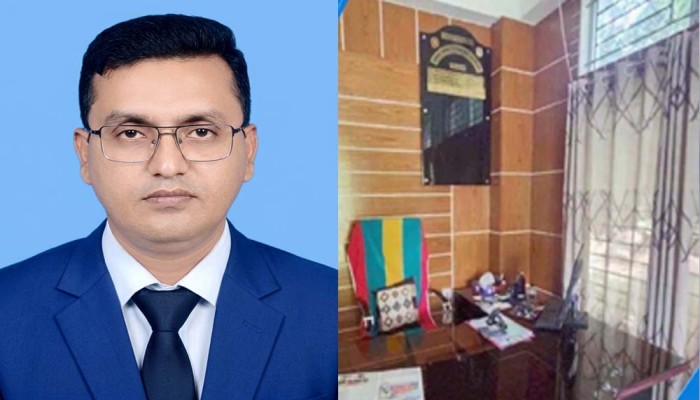
Sirajganj District Food Controller Harun-or-Rashidis being sought by law enforcement agencies over his alleged involvement in an inter-ministerial syndicate accused of leaking recruitment examination questions and supplying answers to candidates, including in the recruitment test of the Department of Youth Development.
Harun, also a 36th Bangladesh Civil Service (BCS) batch officer, has reportedly been switched off his mobile phone and WhatsApp and remained absent at his workplace since October 15. His prolonged absence during government holidays, including Durga Puja, has disrupted administrative activities at the district food controller’s office. Investigators believe that, he may be in hiding following the exposure of the alleged network, while concerns have also been raised that he could leave the country anytime.
Law enforcement officials are continuing surveillance and operations to locate him and other suspects. Investigators expect to arrest him soon.
The Special Response Battalion (SRB) and the Criminal Investigation Department (CID), which is investigating into the cancellation of the Youth Development Department’s recruitment examination, have uncovered evidence pointing to an organised network allegedly involved in leaking questions for at least 11 government recruitment examinations across several departments and agencies.
The institutions concerned include the Directorate of Primary Education, the Controller General Defence Finance (CGDF), the Ministry of Food, the Department of Environment, the Election Commission, the National Board of Revenue (NBR), and secondary and higher secondary education boards.
7 arrested, 11 recruitment exams under scrutiny:
The recruitment examination for the post of Assistant Upazila Youth Development Officer was scheduled for October 10 against 242 vacancies, with 318,976 candidates expected to participate. However, the authorities suspended the examination minutes before it was due to begin after receiving specific information about the leakage of question papers.
A case was filed with Motijheel Police Station in Dhaka on October 11 under Sections 4, 5 and 9(a) of the Public Examinations (Offences) Act, 1950.
During the investigation, the SRB arrested seven members of the alleged syndicate. Analysis of their mobile phones and WhatsApp communications provided investigators with information about the network’s operations and links to other government recruitment examinations.
Investigators said that, the syndicate allegedly operated through a multilayered structure involving government employees from different institutions.
According to the investigation, Bangladesh Bureau of Statistics (BBS) statistics officer Sujit Gop was at the centre of the alleged network. His associates allegedly included lower-ranking employees of the Ministry of Defence, the NBR and the Department of Environment.
The group reportedly maintained secretive facilities, described as ‘booths’, in the Motijheel area, where candidates were allegedly coached to memorise answers in exchange for deals worth crores of taka.
Harun, Sohag allegedly recruited candidates:
Harun-or-Rashid and Sohag Fakir, an assistant director at the Bangladesh Agricultural Research Council (BARC), were involved in another phase of this alleged operation.
The two former students of Dhaka University allegedly maintained close ties and developed a network for recruiting candidates and arranging access to leaked questions and answers.
According to information gathered during the investigation, candidates were allegedly charged Tk10 lakh each. To secure the arrangements, the network reportedly collected signed stamp papers, original academic certificates or blank bank cheques worth Tk2 lakh to Tk3 lakh as security.
Several sources said, Harun allegedly used trusted officials and employees of his own office to identify and recruit candidates in exchange for commissions.
Harun last attended his office on October 15, a Wednesday, after the alleged involvement of the network’s members came to light. He subsequently switched off his mobile phone and WhatsApp and disappeared from public view. Officials at his workplace have been unable to provide information about his whereabouts.
CID sources said, technological surveillance and operations are continuing to locate and arrest Harun and Sujit Gop. Both could be taken into custody at any time, the sources added.
Agriculture official Sohag arrested:
In a related development, the CID arrested Sohag Fakir, 38, from Durgabardi village in Badarpasha Union of Rajoir upazila in Madaripur at around 10:30pm on Tuesday.
Sohag Fakir serves as an Assistant Director at the Bangladesh Agricultural Research Council (BARC). He is the son of Abdul Halim Fakir and Beauty Begum. He is a resident of Ward No. 2 in Sutarkandi village, located in Bajitpur Union of Rajoir Upazila, Madaripur. Two smartphones were seized from his possession.
In a press release issued on Wednesday, the CID said investigators identified Sohag’s location using information gathered during the investigation and intelligence inputs before conducting the raid. The department said, arrangements were being made to produce him before a court and that the investigation remained underway.
It is to be mentioned that, the postponed recruitment examination was subsequently held again on Friday, with 5,386 candidates passing.
Allegations of Tk5.89 billion rice allocation amid irregularities by Harun:
Separate allegations have also surfaced against Harun over the allocation of government rice procurement contracts to allegedly fictitious rice mills in Sirajganj, with claims that the scheme enabled him to amass crores of taka and acquire substantial property in different parts of the country, including Dhaka and Gaibandha.
According to the allegations, Harun allocated contracts for the supply of 12,000 tonnes of parboiled rice to 137 out of the 142 registered rice mills in Raiganj upazila in exchange for large sums of money.
At the government procurement rate of Tk49,000 per tonne, the total value of the allocation comes to approximately Tk588.9 million, or Tk58.89 crore.
Local rice mill owners and residents, however, claimed that, at least 70 out of the 137 mills awarded allocations do not physically exist. They alleged that, contracts were issued in the names of these so-called ghost mills using fabricated or defective documents in exchange for substantial payments.
Harun has allegedly built and acquired multiple houses, flats and other assets in Dhaka, Gaibandha and elsewhere in the country.
Environmental clearance questioned:
Assistant Director of the Department of Environment in Sirajganj, Tuhin Alam, said, “Most of the rice mills do not have environmental clearance. Questions remain as to how they received allocations despite this.”
The issue has raised questions about the scrutiny applied before government procurement contracts were awarded and whether the mills met the required regulatory conditions.
Three-member probe committee formed:
Following public concern over the alleged irregularities, the Sirajganj deputy commissioner directed to form a three-member investigation committee headed by Raiganj Upazila Agriculture Officer Md Mominul Islam. The committee is working under the supervision of the Raiganj upazila nirbahi officer (UNO).
However, the investigation has yet to gain momentum. Several legitimate rice mill owners have alleged that influential officials in the district and upazila administrations are attempting to suppress the matter.
They said, the investigation had been delayed under the pretext that government officials are busy with addressing the current fertiliser crisis in the district. The legal mill owners also alleged that, efforts were being made to divert attention from the core issues.
Meanwhile, rice mill owners who benefited from the disputed allocations have allegedly been making efforts to conceal irregularities and alter or improve their mills’ records and documentation.
Local residents fear that, the inquiry could fail to produce meaningful findings, if the investigation continues to be delayed.
Concerned citizens believe that, the arrest and interrogation of Harun could help investigators uncover further details about the alleged recruitment examination question-leak syndicate and the separate rice allocation irregularities, potentially bringing to light the full extent of the alleged misconduct.