
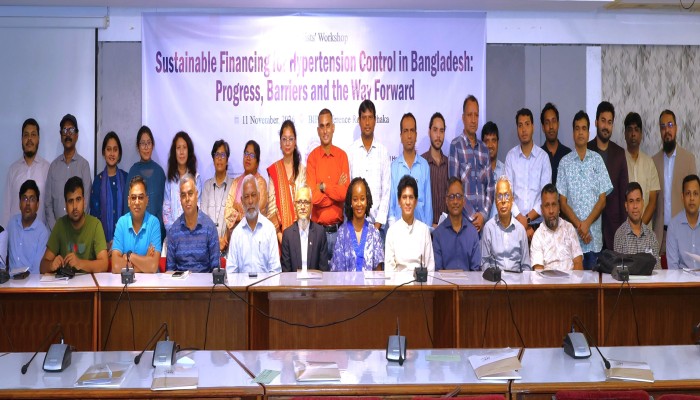
Speakers at a journalists’ workshop on Wednesday called for sustainable and increased government funding to strengthen hypertension prevention and treatment, warning that inadequate financing is contributing to a growing burden of cardiovascular diseases and premature deaths in Bangladesh.
They stressed the need to prioritise hypertension control in the national health budget, ensure an uninterrupted supply of free medicines at public healthcare facilities and strengthen awareness campaigns to reduce preventable deaths.
Around 283,800 people died from cardiovascular diseases in Bangladesh in 2024, with hypertension accounting for 52 per cent of those deaths, according to data presented at the workshop.
The speakers noted that despite an increase in the government's health budget, funding for hypertension prevention and control remains inadequate. They said allocating a substantial share of the increased budget to hypertension and other non-communicable diseases (NCDs) could help reduce the risk of premature deaths.
The observations came at a journalists’ workshop titled “Sustainable Financing for Hypertension Control in Bangladesh: Progress, Barriers and the Way Forward” held at the BIP Conference Room in the capital on Wednesday (November 11).
Research and advocacy organisation PROGGA (Knowledge for Progress), with support from the Global Health Advocacy Incubator (GHAI), organised the workshop, attended by 25 journalists from print, television and online media outlets.
Presentations at the workshop revealed that approximately 570,263 people die from various NCDs in Bangladesh every year, accounting for nearly 71 per cent of all deaths. Around 19 per cent of these deaths are premature.
According to the Bangladesh Bureau of Statistics (BBS) Health and Morbidity Status Survey 2025, hypertension ranks first among the country's 10 leading diseases. Despite this growing health burden, only 4.2 per cent of the national health budget is allocated to NCD control, according to World Bank data.
The speakers also highlighted the impact of inadequate financing on the availability of essential medicines. Funding constraints are disrupting the regular supply of free antihypertensive medicines at Community Clinics and NCD Corners in Upazila Health Complexes, limiting access to treatment for patients, particularly those who depend on public healthcare services.
Dr Md Enamul Haque, Director General of the Health Economics Unit, said the allocation for the health sector had increased from 5.3 per cent to 7.4 per cent in the current budget, describing the rise as encouraging.
“Now it is essential to allocate a portion of this increased budget to hypertension control,” he said.
Zahirul Alam, Executive Director of Channel 24, underscored the role of the media in building public awareness and advocating policy changes.
“Regular campaigns through mass media and social media must continue to highlight the importance of sustainable financing for hypertension control,” he said.
The workshop also highlighted the importance of stronger policy advocacy, adequate budgetary allocations and coordinated efforts among government agencies, healthcare professionals, development partners and the media to address the growing NCD burden.
Ezinne Ezekwem, Associate Director, Non-communicable Diseases, GHAI; Muhammad Ruhul Quddus, Bangladesh Country Lead, GHAI; Mortuza Haider Liton, Convener of the Anti-Tobacco Media Alliance (ATMA); and ABM Zubair, Executive Director of PROGGA, attended the workshop as discussants.
Thematic presentations were delivered by Hasan Shahriar, Head of Programmes at PROGGA, and Samiha Bintay Kamal, Programme Officer at the organisation.