
Dollar reaches Tk124.75 in interbank market; trade deficit stands at $7.82 billion as Bangladesh offers 90-day credit facility for 10 essential commodities ahead of Ramadan
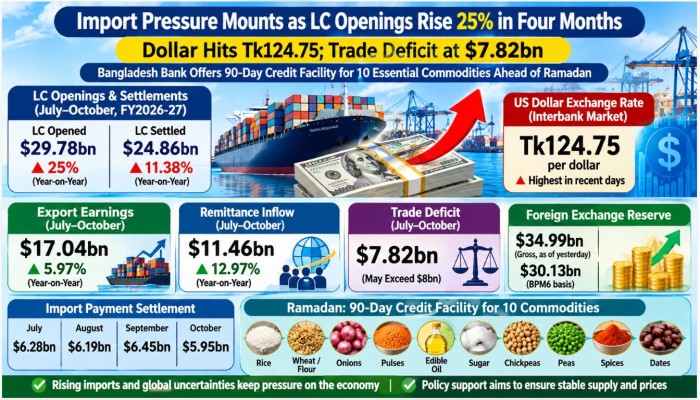
Bangladesh is facing growing pressure on its external trade as import demand rises amid higher global prices of fuel and other commodities. Banks opened letters of credit (LCs) worth $29.78 billion for imports during the first four months of the current fiscal year (July-October), marking a 25 per cent increase from the corresponding period of the previous fiscal year.
During the same period, LC settlements rose 11.38 per cent to $24.86 billion, reflecting an increase in import payment obligations.
The growing demand for foreign currency to meet import payments has also put pressure on the domestic foreign exchange market, pushing the US dollar's interbank exchange rate to as high as Tk124.75 yesterday.
According to Bangladesh Bank data, the country's export earnings stood at $17.04 billion in the first four months of FY2026-27, up $960 million or 5.97 per cent from the same period a year earlier.
However, calculating imports on the basis of settled LCs, the country's trade deficit reached $7.82 billion during the period. Actual imports are generally somewhat higher than LC settlements, suggesting that the final trade deficit could exceed $8 billion once the data are fully accounted for. The deficit stood at $7.47 billion in the first three months of the fiscal year.
Remittance inflows, meanwhile, continued to show healthy growth. Expatriate Bangladeshis sent home $11.46 billion during the July-October period, up 12.97 per cent year-on-year.
Despite growth in both export earnings and remittances, rising demand for dollars to meet import payment obligations has continued to put pressure on the foreign exchange market.
Bangladesh Bank data show that import payments settled through LCs amounted to $5.95 billion in October, down from $6.45 billion in September. The corresponding figures were $6.19 billion in August and $6.28 billion in July.
Banks opened LCs worth $7.32 billion in October, compared with $8.52 billion in the previous month.
Bankers said the dollar's price was rising because demand in the foreign exchange market continued to exceed supply.
The average interbank exchange rate stood at Tk124.65 per dollar yesterday, compared with Tk124.42 the previous day. The rate was Tk124.30 on November 1.
At the beginning of October, the interbank dollar rate was Tk123, rising to Tk123.99 on the last working day of the month.
For around one and a half years after the fall of the Awami League government in August 2024, the dollar rate remained within the Tk121-Tk122.30 range. It began rising gradually from March this year.
To maintain stability in the foreign exchange market, Bangladesh Bank recently sold $222 million to several banks after a prolonged interval. This was the central bank's largest dollar sale since the change of government in August 2024.
The country's foreign exchange reserves had previously fallen to $25.92 billion in August 2021 following substantial dollar sales to support the market. They subsequently recovered, crossing $37 billion on June 29 this year and reaching $37.85 billion in the first week of July.
However, reserves have declined since then. Gross reserves stood at $34.99 billion yesterday, while reserves calculated under the International Monetary Fund's BPM6 methodology amounted to $30.13 billion.
Bangladesh Bank has yet to finalise the import data for the first four months of the current fiscal year. However, figures for the first three months indicate a substantial increase in spending on fuel and consumer goods.
Petroleum product imports cost $4.22 billion during July-September, up 105 per cent from the same period of the previous fiscal year.
Import expenditure on consumer goods increased 26.50 per cent to $1.40 billion. In contrast, capital machinery imports declined 13.60 per cent to $2.46 billion during the period.
Apart from higher international energy prices, geopolitical tensions following US and Israeli attacks on Iran have added to uncertainty in the global energy market, raising concerns over further increases in fuel import costs and pressure on foreign currency reserves.
90-day credit facility for 10 commodities ahead of Ramadan
In a move to ensure adequate supplies of essential food items and keep prices affordable during Ramadan, Bangladesh Bank has allowed importers to bring in 10 commodities on deferred payment terms of up to 90 days.
Under the facility, importers will be able to pay for the goods within the stipulated period after receiving them.
Earlier, on Sunday, the central bank issued a directive instructing banks to keep LC margins for these commodities at the minimum possible level.
The commodities covered by the facility include rice, wheat or flour, onions, pulses, edible oil, sugar, chickpeas, peas, spices and dates.
Importers will be able to use suppliers' credit or buyers' credit facilities to bring in the products.
The measures are intended to facilitate imports ahead of Ramadan, maintain regular supplies of essential food items and ease potential pressure on market prices. Effective monitoring of imports, stocks and distribution will also be important to ensure that the benefits of the facilities reach consumers.