
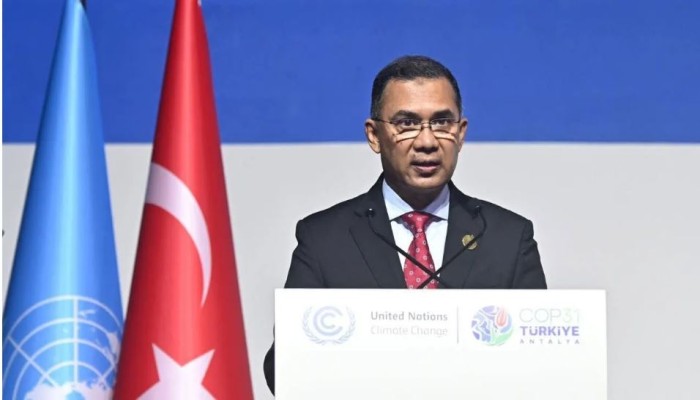
Prime Minister Tarique Rahman has called for allocating at least 50 per cent of international climate finance to adaptation efforts for climate-vulnerable countries, stressing that these nations need grants rather than more loans.
Addressing the high-level segment of the UN Climate Change Conference (COP31) in Antalya, Turkey, on Thursday (12 November), he outlined Bangladesh's climate stance, national development plans, and the urgent need to reform the global climate finance architecture. He also proposed adopting the 'Belem-Antalya Action Mechanism' at COP31 to ensure a just energy transition based on fair finance and trade.
At the outset of his speech, Tarique Rahman thanked the Turkish government for hosting COP31 and expressed gratitude to Australia for leading the negotiation process. He noted that Bangladesh stands on the front lines of climate change despite contributing less than 0.5 per cent to global greenhouse gas emissions.
Bangladesh's green transition and conservation plans
Despite these challenges, the Prime Minister affirmed that his government is committed to building a one-trillion-dollar climate-resilient and sustainable economy. Guided by the 'Bangladesh First' philosophy, the administration believes economic growth and environmental protection must complement each other while preserving ecological balance during industrialisation.
He stated that the government aims to meet 20 per cent of the country's electricity demand from renewable sources by 2030, aligning with the Paris Agreement to achieve net-zero emissions. Backed by special tax incentives, efforts are underway to generate 4,000 megawatts of solar power alongside promoting waste-to-energy initiatives.
Highlighting green industrialisation, Tarique Rahman noted that Bangladesh hosts around 300 LEED-certified ready-made garment factories. The government is also promoting eco-friendly transport, including electric vehicles, expanding the use of jute bags, and developing a national framework for carbon trading.
Regarding environmental conservation, he announced plans to plant 250 million trees over the next five years. Alongside the Padma and Teesta barrage master plans, the government is excavating 20,000 kilometres of rivers and canals to retain water in reservoirs, reduce flood risks, revive wetlands, and replenish groundwater levels. Mangrove restoration initiatives have also been launched on reclaimed coastal land to protect local communities.
Five-point call for global climate action
Pointing out the limitations of the current international climate finance system, the Prime Minister said it remains inadequate and fails to properly reflect the priorities of developing nations. Climate-induced losses are imposing a heavy burden on Bangladesh's economy, compounded by rising debt repayments and limited fiscal resources.
Reiterating that vulnerable countries need grants, reliable financial support, and modern technology, Tarique Rahman proposed five urgent actions based on the principle of common but differentiated responsibilities and respective capabilities.
First, at least 50 per cent of international climate finance must be allocated to adaptation according to each country's priorities, alongside support for mitigation efforts. Second, urgent debt-relief mechanisms—including climate-resilient debt clauses and debt-for-climate swaps—must be introduced for vulnerable nations.
Third, equitable access to green climate technologies and support for technology transfer to developing nations must be guaranteed. Fourth, the transition to renewable energy should be accelerated through affordable financing, capacity building, and a just energy transition. Fifth, COP31 must adopt the 'Belem-Antalya Action Mechanism' anchored in fair finance and trade.
He also emphasised the inclusion of women and youth in climate action, the creation of decent green jobs, and cutting global emissions to keep the 1.5-degree Celsius temperature limit within reach. Concluding his address, Tarique Rahman expressed hope for an ambitious and balanced outcome from COP31, urging world leaders to turn pledges into action and build a sustainable future together.