
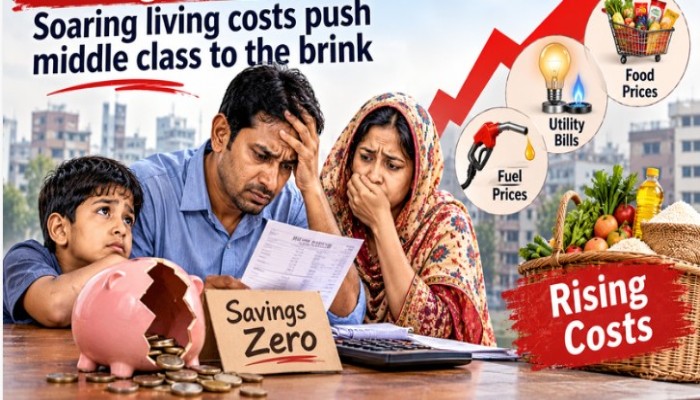
Millions of lower- and middle-income families in the capital are struggling to cope with soaring living costs, as dwindling savings, mounting debt and growing financial uncertainty take a heavy toll on their mental well-being.
For private-sector employee Selim Hossain, earning Tk 35,000 a month, simply keeping his household running has become an uphill battle. He spends Tk 18,000 on rent alone. Once electricity, gas and water bills are added, more than half his salary is gone at the beginning of the month.
The remaining income barely covers his children's education, regular medication and groceries. Often running out of money before the month ends, he has been forced to break his long-term deposit pension scheme (DPS) savings to meet household expenses. At times, he also borrows money from relatives.
His experience reflects the growing financial distress of countless middle-income families in Dhaka.
With the relentless rise in the cost of living, maintaining even a modest standard of living has become increasingly difficult for lower- and middle-income households. As savings disappear, financial insecurity and psychological stress are mounting.
Buying quality food, fish and meat has increasingly become a luxury. Many families are surviving on cheaper vegetables and other low-cost food items. Some are even cutting back on their own medical expenses to meet the basic needs of their families.
The pressure to maintain social status despite financial hardship, coupled with mounting debt, is creating severe emotional and psychological strain within middle-class households.
Private-sector employee Russel Islam said his family's monthly grocery expenses had almost doubled.
"Previously, we could manage our monthly shopping within Tk 14,000 to Tk 18,000. Now it has increased to around Tk 30,000 to Tk 32,000," he said.
He added that his family had been forced to make significant cuts to its food budget, as fish and meat had become increasingly unaffordable. Consequently, they were relying on cheaper foods simply to meet basic dietary needs, raising concerns about long-term nutritional deficiencies.
Another private-sector employee, Kazi Rafique, said his family's combined monthly income from his salary and his father's pension was Tk 45,000.
"Yet, rent and gas and electricity bills alone consume Tk 32,000 to Tk 35,000 every month," he said.
To cope with the financial pressure, many families are withdrawing their children from expensive schools and enrolling them in less costly institutions.
Entertainment, weekend outings and festive shopping have largely disappeared from their budgets. Healthcare has also taken a major hit, with an increasing number of families postponing routine medical check-ups and even avoiding necessary treatment.
Social analysts say lower-income people can sometimes openly seek assistance or turn to government and private relief programmes, including subsidised food distribution through the Trading Corporation of Bangladesh (TCB).
Middle- and lower-middle-income families, however, often remain silent because of concerns about social status and dignity. As a result, they continue to struggle privately, frequently exhausting their savings and investment certificates before falling into deeper financial and psychological distress.
According to the Bangladesh Bureau of Statistics (BBS), the pace of overall and food inflation has moderated somewhat in recent times. However, price pressures on non-food goods and services have continued to rise.
At the same time, wage growth has remained considerably slower than inflation, putting sustained pressure on people's real incomes and purchasing power.
Economist and Policy Exchange Bangladesh Chairman Masrur Riaz said several years of persistently high inflation had significantly increased living costs while weakening household consumption and demand.
He identified manipulation in supply chains, higher prices of imported raw materials due to the dollar shortage, and ineffective market management as major factors behind the inflationary pressure.
Dr Iftekharuzzaman, executive director of Transparency International Bangladesh (TIB), said that despite the political transition, the syndicates and influential groups controlling markets had largely undergone a change of hands rather than being dismantled.
He said the financial burden of these practices was ultimately being passed on to ordinary consumers.
Without strong political commitment and more effective market monitoring, overcoming the crisis would remain difficult, he added.
Economists say temporary rationing or short-term relief measures alone will not be enough to address the growing middle-class crisis.
They stress the need to dismantle market syndicates, stabilise money supply and supply chains, revise the tax-free income threshold in line with rising living costs, and introduce stronger social safety nets and affordable financial support for middle-income households.
Without comprehensive measures, they warn, the economic foundation of the country's middle class could face further erosion, threatening the financial stability of a crucial segment of society.