
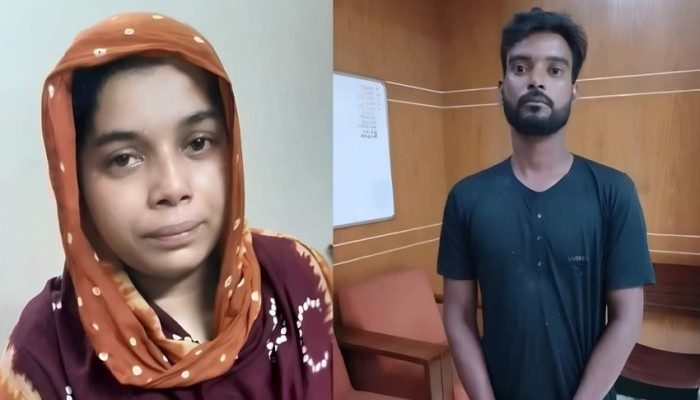
The High Court has upheld the death sentence of Sohel Rana for the rape and murder of seven-year-old Ramisa in Dhaka’s Pallabi area, while acquitting his wife, Swapna Akter, citing a lack of evidence establishing her involvement in the crimes.
A High Court bench comprising Justice Bhishmadev Chakraborty and Justice KM Rasheduzzaman Raja delivered the verdict on Tuesday (November 17).
The court began announcing its decision at 10:36am, with senior judge Justice Bhishmadev Chakraborty reading out the verdict. The decision came a day after the bench concluded hearings on the death references and appeals filed by the two convicts.
In its observations, the court said the post-mortem report confirmed that Ramisa had been raped and that Sohel’s confessional statement was genuine and made voluntarily.
Describing the murder as exceptionally brutal and unnatural, the court observed that the death penalty was an appropriate punishment for the crime.
However, the court found no sufficient evidence to establish Swapna’s involvement in the rape and murder. It noted that Sohel had not mentioned in his confessional statement that his wife had assisted him in committing either offence. Consequently, the court acquitted her.
Speaking to journalists after the verdict, Attorney General Ruhul Quddus Kajal said Sohel had confessed to the crime after his arrest and that the High Court had considered his statement in upholding the death sentence.
Explaining Swapna’s acquittal, he said there was no evidence linking her to the rape or murder. Her involvement was limited to helping her husband flee, he added.
How the brutal murder unfolded
According to case records, Sohel, a neighbour of Ramisa’s family in Pallabi, raped the child and subsequently slit her throat to conceal the crime. He then dismembered her body before escaping by cutting through a window grille.
Ramisa’s mother, Parvin Akter, who was staying in an adjacent flat, heard the child’s screams but could not initially identify them as her daughter’s cries. The child’s dismembered body was later recovered from the neighbouring flat.
The gruesome murder sparked widespread outrage and protests across the country.
The day after the incident, Ramisa’s father, Abdul Hannan Molla, filed a rape and murder case with Pallabi Police Station.
Police initially detained Swapna Akter and later arrested Sohel, the prime accused, from Fatullah in Narayanganj. On May 21, Sohel gave a confessional statement before a magistrate under Section 164 of the Code of Criminal Procedure.
Following the investigation, police submitted a charge sheet against both Sohel and Swapna.
Trial and subsequent appeals
The trial formally began on June 1, when charges were framed against the two accused. The court recorded the testimony of 16 witnesses in a single day on June 2.
On June 7, just 19 days after the murder, Judge Masrur Salequin of the Dhaka Metropolitan Children’s Court for the Prevention of Violence against Children sentenced both accused to death. The court also fined Sohel Tk 500,000 and Swapna Tk 200,000.
Under the law, the trial court's death sentences were subsequently referred to the High Court for mandatory confirmation. Both convicts also filed jail appeals challenging their sentences.
Given the gravity of the case, the High Court proceedings were taken up on a priority basis. After hearing the appeals and death references, the bench reserved Tuesday for delivering its verdict.
Before the announcement, Ramisa’s father appeared at the High Court premises and told journalists that he hoped the death sentences handed down by the trial court would be upheld. He also thanked the government and the Attorney General’s Office for expediting the judicial process.
Prime Minister Tarique Rahman had earlier visited Ramisa’s home to offer condolences to her bereaved parents. Home Minister Salahuddin Ahmed accompanied him during the visit. They assured the family that those responsible for the crime would face exemplary punishment.
The High Court's verdict has thus upheld the capital punishment of the principal accused while overturning the death sentence against his wife, distinguishing between the evidence establishing Sohel's direct involvement in the crimes and the lack of proof against Swapna.