
Think-tank says simple poverty-line average ignores workers' concentration in industrial hubs; proposes evidence-based wage assessment
The Centre for Policy Dialogue (CPD) has questioned the methodology of calculating minimum wages for readymade garment (RMG) workers by taking a simple average of urban and rural poverty lines, arguing that the approach fails to reflect the actual cost of living in the country's major garment-producing areas.
In a letter sent on November 22 to Bangladesh Garment Manufacturers and Exporters Association (BGMEA) President Mahmud Hasan Khan, CPD Executive Director Nazneen Ahmed said such an average was methodologically flawed without reliable data on the geographical distribution of garment workers.
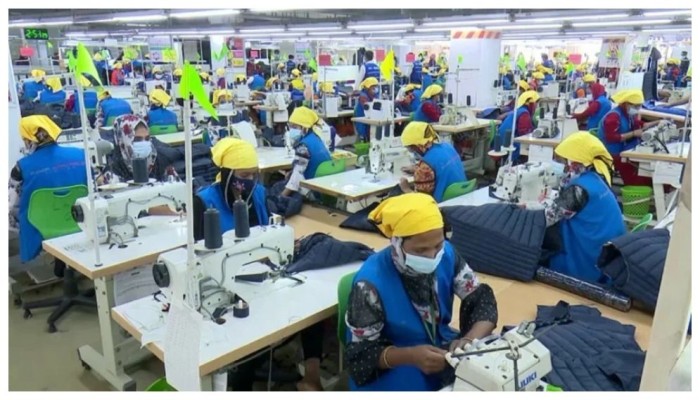
The think-tank argued that most garment workers live in urban and peri-urban industrial hubs, particularly in Gazipur and Narayanganj under Dhaka division, where housing rents and food costs are considerably higher than in rural areas.
According to CPD, the upper poverty line for urban areas in Dhaka division, based on the Bangladesh Bureau of Statistics' (BBS) Household Income and Expenditure Survey (HIES) 2022, stands at Tk4,922 per person, compared with Tk4,234 in rural areas. A simple average of the two produces Tk4,578, effectively assuming an equal distribution of workers between urban and rural areas.
CPD said this assumption does not reflect the actual concentration of garment workers in industrial zones. A weighted average could be calculated if factory-level data on workers' geographical distribution were available alongside relevant BBS statistics. Using export volumes as a proxy for worker distribution would also be inappropriate, as export figures do not directly reflect workers' living expenses.
Four-member household used as wage benchmark
Explaining its wage calculation methodology, CPD said it adopted a standard household size of four members, with 1.58 earning members, based on the median of six published studies. These included government household survey data and research by BILS, Anker et al., Syed et al., ACD, and the ILO-UN Women.
The organisation said using the median helped prevent unusually high or low estimates from distorting calculations based on studies conducted at different times and using different methodologies.
It also rejected concerns that the four-member household benchmark artificially inflated wage requirements. Using the BBS Socio-Economic and Demographic Survey (SEDS) 2023 figure of 3.96 members would reduce the estimated poverty-line minimum wage from Tk18,578 to Tk18,392 a month—a difference of only Tk186.
CPD further noted that the average urban household size in HIES 2022 was 4.18, supporting its use of a four-member benchmark.
The think-tank also dismissed allegations of double counting housing expenses, saying house rent had been deducted from non-food expenditure and tobacco expenses from food expenditure before calculating essential non-food costs.
Tk12,500 entry-level wage remains unchanged
CPD stressed that minimum wage assessments must prioritise entry-level workers while ensuring a rational wage hierarchy across grades based on skills, experience and productivity.
It pointed out that although the annual wage increment was raised from 5 per cent to 9 per cent effective December 1, 2024, the adjustment increased the basic pay and overall payroll costs of existing employees without changing the mandatory Grade 5 entry-level minimum wage of Tk12,500.
The organisation acknowledged the financial pressures facing factory owners, including higher production costs, elevated interest rates, export price pressures and US tariff burdens. It therefore advocated an indicative wage range rather than a single fixed figure, with workers' basic needs setting the lower limit and factories' financial capacity determining the upper limit.
However, CPD said a credible assessment of the industry's ability to pay remained difficult because of inadequate and outdated information on production costs, product prices and profit margins.
CPD calls for evidence-based wage settlement
CPD outlined three principles for determining the final minimum wage.
First, it called for scientific, sample-based surveys covering both workers and factories in line with Section 141 of the Labour Act, taking into account living costs, production expenses, productivity, inflation and business viability.
Second, it reaffirmed its support for wage adjustments while opposing industrial violence, vandalism and disruptive activities, saying such incidents harm workers, businesses and the national economy.
Third, it urged the Minimum Wage Board to strike a balance between workers' essential needs and the economic realities of the industry.
The think-tank also argued that structural problems, including energy shortages, high bank interest rates and administrative inefficiencies, should be addressed through separate policy reforms rather than shifting their costs onto workers through lower wages.
CPD said it remained committed to evidence-based discussions with factory owners, trade unions and other stakeholders to help establish a realistic and sustainable wage structure for the garment sector.