
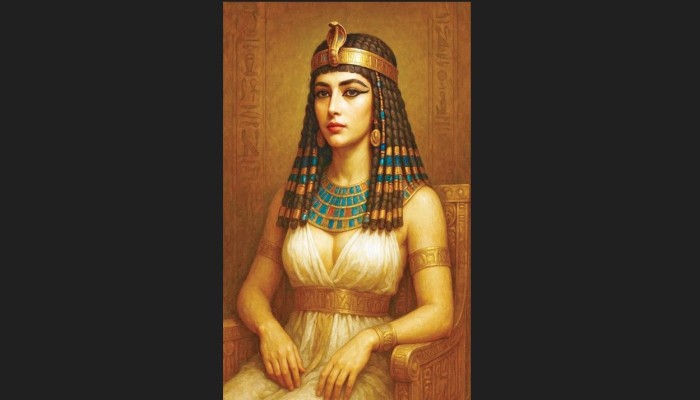
The circumstances surrounding the death of Cleopatra, the last ruler of Egypt’s Ptolemaic dynasty, remain one of history’s enduring mysteries. Historians and researchers have revisited the available evidence, but the exact cause of her death remains uncertain.
According to the traditional account, Cleopatra took her own life after being defeated, along with her Roman lover Mark Antony, by Octavian’s forces. She is believed to have died from the bite of a venomous asp, or Egyptian cobra. However, many modern historians question this version, suggesting that the story may have served Roman political interests by strengthening Octavian’s image and authority.
Prudence Jones, a professor of classics at Montclair State University in the United States, says there is no way to establish with certainty how Cleopatra died. Historians, however, broadly agree that the last ruler of the Ptolemaic dynasty chose to end her own life. She wanted a method that would leave her body looking peaceful and dignified.
Jane Draycott, a historian at the University of Glasgow, says suicide in the Greco-Roman world was not regarded as a sin or social disgrace in the way it came to be viewed in later Christian societies. Instead, it could be seen as a way to erase past shame and humiliation.
After their remaining forces were defeated in Alexandria, Mark Antony reportedly took his own life after receiving false news that Cleopatra had died. According to the ancient Greek biographer Plutarch, Cleopatra later visited Antony’s tomb, bathed and ate. She then sent a sealed letter to Octavian, requesting to be buried beside Antony. The letter conveyed her final wishes.
Realising what Cleopatra intended, Octavian quickly sent messengers to intervene. But they arrived too late. They found the queen dead in royal attire, with her two attendants, Iras and Charmion, also dead beside her.
After reviewing accounts written by ancient historians and physicians, Jones says nearly all the surviving early sources mention a snakebite as the cause of Cleopatra’s death. However, some accounts and interpretations raise other possibilities, including the use of a poisonous ointment, poison concealed inside a hairpin, or the possibility that she inflicted a wound on herself and introduced snake venom into it.
The exact circumstances remain difficult to establish. Strabo, a geographer who was alive around the time of Cleopatra’s death, and the people who were inside the room with the queen offer limited evidence. The latter reportedly died alongside her. Roman historian Cassius Dio wrote that two faint marks on Cleopatra’s arm were the only physical clues.
Jones says a cobra bite can leave two puncture marks, but not every cobra bite produces such visible marks. Likewise, two marks on the skin do not necessarily indicate a snakebite.
Jones also points to Octavian as a possible source of the snakebite narrative, noting that he was in Alexandria when Cleopatra died. The account may have helped shape the image of the queen’s death in a way that served his political interests. However, the available evidence is insufficient to establish this conclusively.
The mystery surrounding Cleopatra’s exact cause of death may never be solved. Historians, however, largely agree that she chose to end her own life.
Source: Live Science