
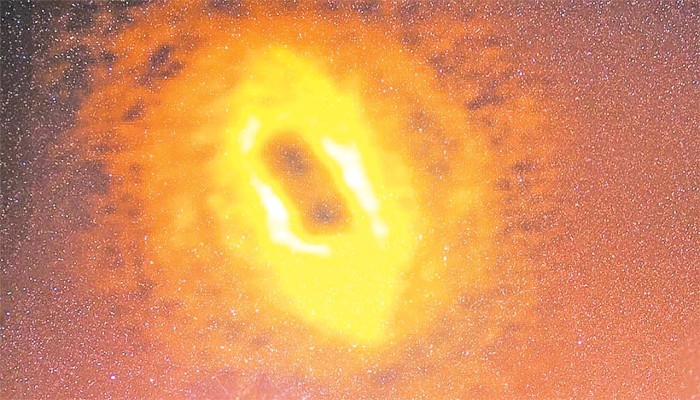
Like the Sun, stars eventually reach the end of their lives. Unlike massive stars, which can die in spectacular supernova explosions, Sun-like stars are expected to end their lives relatively quietly. But their final stages are not entirely peaceful. They can experience intense bursts of nuclear activity before their demise.
Scientists have now obtained what they describe as the first direct evidence of such a dying star’s final nuclear activity. The discovery was made through observations by ALMA (the Atacama Large Millimeter/submillimeter Array), located in northern Chile.
Science news outlet Space.com reported the findings. The research was led by Raghvendra Sahai, a researcher at NASA’s Jet Propulsion Laboratory (JPL). He said scientists had previously predicted such events through theoretical models. The latest observations, however, have provided a real image of the final nuclear ‘heartbeat’ of a star, preserved in the surrounding gas.
The death process of a Sun-like star begins when its core runs out of hydrogen fuel. Nuclear fusion, through which hydrogen is converted into helium, then ceases in the core.
Fusion is the star’s main source of energy. As energy production declines, the pressure needed to counter the inward pull of gravity weakens.
The star’s core then begins to contract, eventually forming a white dwarf. Meanwhile, its outer layers expand, causing the star to grow enormously. This stage is known as the red giant phase.
Over time, the star’s outer layers cool and disperse into space, leaving behind the white dwarf. The expelled gas and dust form what is known as a planetary nebula.
During the red giant phase, stars can experience occasional bursts of intense nuclear activity known as thermal pulses. During these episodes, stellar material is expelled into space in explosive outflows.
To better understand the final stages of stellar evolution, the researchers used ALMA to observe a star known as IRAS 06530-0213. Located in the constellation Monoceros, the star is about 12,000 light-years from Earth.
The observations revealed a vast ring of gas surrounding the star. Researchers believe it is the remnant of the star’s final thermal pulse. The ring surrounds a developing planetary nebula with an hourglass-like shape.
Sahai said stars are generally seen as fixed points of light in the sky. But the latest observations have captured a significant moment in a star’s death, showing how an expanding red giant is transforming into a bright planetary nebula.
According to the researchers, the shell of gas surrounding the star extends about half a light-year across. The gas was expelled into space around 6,500 years ago.
The researchers also found that the star gradually lost mass for about 2,000 years after the outburst. The rate of mass loss then increased significantly over the following 1,000 years.
The spiral shape of the gas filaments suggests that the star may have a companion. Scientists believe it could be influencing the flow of gas around the dying star.
Meanwhile, the hourglass-shaped nebula closest to the star began forming about 700 years ago. In cosmic terms, this means the star has only recently ended its red giant phase.
ALMA’s observations also revealed several unexpected features around the star. Researchers detected the presence of different heavy isotopes of carbon, oxygen and nitrogen.
The abundances of these elements do not fully match existing theoretical models. The findings challenge current explanations of how Sun-like stars produce different elements and release them into space.
However, the researchers did not find one feature they had expected to see: a dense disk of dust around the star.
Such disks and companion stars have previously been observed around other dying stars of this kind. Scientists believe a companion star can draw gas and other material from the dying primary star, creating a disk of dust in the process.
Researchers have used this mechanism to explain the formation of hourglass-shaped nebulae. High-speed jets generated through the interaction with a companion star can shape the gas surrounding the dying star.
The researchers suspect that a similar disk may once have existed around this star but survived only briefly. During that period, the disk may have produced short bursts of high-speed jets, shaping the nebula into an hourglass. The disk subsequently disappeared.