
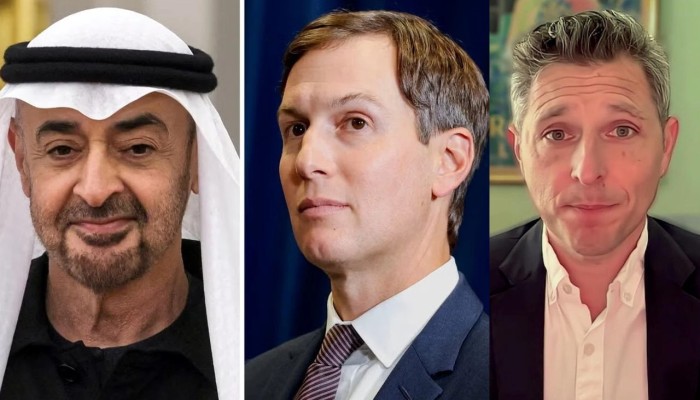
Secret access to nearly $2 billion in funds allegedly provided by Saudi Arabia and the United Arab Emirates, the use of a sex tape in a royal power struggle, the alleged incapacitation of a ruler through medical treatment and military cooperation involving Israeli technology—these are among five explosive allegations made in a new book by American investigative journalist Matthew Cole.
The book examines the relationship between US President Donald Trump's son-in-law and former senior adviser Jared Kushner and UAE President Sheikh Mohamed bin Zayed Al Nahyan, raising serious questions about Gulf financial influence, royal family rivalries and Washington's Middle East policy. Kushner has strongly denied the allegations, while much of the book's reporting relies on anonymous sources and has not been independently verified.
Cole's book, Princes and Thieves: Jared Kushner and Mohamed bin Zayed's Secret Plot to Remake the Middle East, was published in October 2026. It explores Kushner's close ties with Saudi Crown Prince Mohammed bin Salman (MBS) and UAE President Mohamed bin Zayed (MBZ) during Trump's first administration, as well as their alleged efforts to influence US foreign policy and reshape the Middle East.
One of the book's most significant claims is that Saudi and Emirati leaders made at least $2 billion available through bank accounts accessible to Kushner while he was serving as a senior White House adviser.
According to Cole, approximately $750 million was held in an account at First Abu Dhabi Bank under the name of the Watani Al Emarat Foundation, a UAE government-funded charity. Kushner allegedly had signatory authority over the account, allowing him access to the funds.
The author claims the money was intended to support foreign policy objectives and covert military and intelligence operations. However, the book does not establish that the funds were Kushner's personal property. Rather, it alleges that he had access to foreign money that could be used to advance Saudi and Emirati interests in Washington.
Kushner's lawyers have rejected the allegations as completely false and defamatory and threatened legal action. The author has stood by his reporting.
The Middle East Eye has said it could not independently verify all the claims. Much of the reporting on the alleged secret financial arrangements and internal royal family affairs relies on anonymous sources.
Alleged attempt to blackmail brother with sex tape
Cole claims that in the 1990s, Mohamed bin Zayed hired two Syrian men to secretly film his brother, Khalifa bin Zayed, who later became UAE president, during a sexual encounter at a hotel in southern Europe.
According to the book, the footage was delivered to their father, UAE founder Sheikh Zayed bin Sultan Al Nahyan, through Russian intermediaries.
The alleged objective was to embarrass Khalifa and use the recording as leverage against him. Their father reportedly understood the intended blackmail strategy but was impressed by his son's cunning, Cole writes.
The author also alleges that Mohamed bin Zayed attempted to undermine former Saudi Crown Prince Mohammed bin Nayef in Washington by using similar sexual scandal allegations against him.
Allegation that brother was incapacitated through medical treatment
Khalifa bin Zayed became UAE president in 2004, but much of the country's political power gradually shifted to his brother, Mohamed bin Zayed.
Khalifa was widely reported to have suffered a stroke in 2014, which left him unable to perform his duties fully. However, Cole's book presents a different account of his health and the circumstances surrounding his declining role.
The author alleges that after becoming Abu Dhabi's crown prince in 2003, Mohamed bin Zayed arranged medical treatment for his brother that left him increasingly incapable of functioning normally.
According to the book, the treatment kept Khalifa in an almost unconscious state and caused neurological damage. Cole also claims that an American nurse was enlisted to assist with the alleged medical arrangements.
These allegations have not been independently established.
Israeli technology and the UAE's F-16 fighter jets
The book also raises questions about the role of Israeli technology in strengthening the UAE's military capabilities.
Cole claims that in 1998, Mohamed bin Zayed persuaded his father to pursue the purchase of advanced F-16 fighter jets after learning about Israeli software and technology associated with the aircraft.
The UAE subsequently moved ahead with a deal to acquire 80 F-16 fighters from the United States.
The proposed acquisition reportedly raised concerns over Israel's regional military superiority. According to the book, secret discussions involving the United States, Israel and the UAE took place with mediation from the administration of then-US President Bill Clinton.
The UAE publicly announced its decision to purchase 80 F-16 aircraft in May 1998. Historical records confirm that Washington faced concerns over the advanced capabilities being offered to the UAE and their implications for Israel's security. However, the specific details of the alleged secret arrangements described in the book have not all been independently confirmed.
Emirati poet allegedly tortured and killed over criticism of Israel
Cole also alleges that Emirati poet and writer Habib Al Sayegh was detained, tortured and killed for opposing the normalisation of relations with Israel.
On August 11, 2019, Al Sayegh published an article titled "Israel Is Our Real Enemy and a Dangerous Project". Nine days later, on August 20, the UAE's state news agency announced his death without specifying the cause.
According to Cole, security officers raided Al Sayegh's home shortly after the article appeared and took him into custody. The book alleges that he was tortured for several days, including having several teeth pulled out, before dying in detention.
The allegations remain unverified. In October 2026, human rights organisation Democracy for the Arab World Now (DAWN) called on UN experts to launch an independent investigation into his death. The organisation also acknowledged that it had not independently verified the allegations in the book.
Kushner's rivalry with Tom Barrack
The book also describes an alleged rivalry between Kushner and another influential figure in Trump's administration, Tom Barrack.
Cole claims Barrack wanted to establish a Middle East development programme modelled on the Marshall Plan, financed by Abu Dhabi and Riyadh. However, Kushner allegedly restricted Barrack's responsibilities to Egypt-related affairs.
In 2017, when Saudi Arabia, the UAE and several allied countries imposed a blockade on Qatar, the two Gulf states reportedly tried to enlist Kushner's support for the move.
Barrack and then-US Secretary of State Rex Tillerson, however, advised Trump against supporting the blockade. According to the book, disagreements over influence within the Trump administration were among the factors behind the tensions between Kushner and Barrack.
Sources: Middle East Eye, The Guardian, Vanity Fair, DAWN and the US Congressional Research Service.