

Prof Yunus calls for urgent united efforts to curb food contamination
- Update Time : Sunday, December 7, 2025

UNB:
Voicing concern over widespread food contamination, Chief Adviser Prof Muhammad Yunus on Sunday called for collective and urgent action to address the crisis, stressing the need for coordinated efforts in everyone’s best interests.
“We are aware of the various types of contamination found in food. We must take measures to tackle this. Our children, parents and relatives are all victims of food contamination. We have to work together to address this crisis for our own wellbeing,” he said.
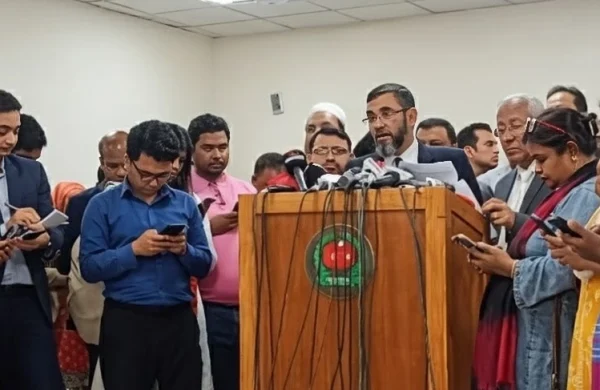
Prof Yunus made the call at a meeting held at the state guest house Jamuna, where participants discussed the presence of harmful chemicals in food, the context behind rising contamination and strategies to curb food adulteration.
After reviewing implementation aspects, he said they would prioritise which measures need to begin immediately. “We will take urgent initiatives in this regard without delay,” he added.
Agriculture and Home Affairs Adviser Md Jahangir Alam Chowdhury, Food Adviser Ali Imam Majumder, Health Adviser Nurjahan Begum, Fisheries and Livestock Adviser Farida Akhter, National Security Adviser Dr Khalilur Rahman, Special Assistant to the Chief Adviser Sayedur Rahman, Principal Secretary to the Chief Adviser Siraz Uddin Miah, secretaries of concerned ministries, BSTI Director General SM Ferdous Alam, and Directorate of National Consumers’ Rights Protection Director General Farooq Ahmed, among others, attended the meeting.
The discussion focused extensively on foodborne diseases, contamination-related risks and necessary actions to confront the crisis.
The Chief Adviser instructed all relevant authorities to submit written proposals within one week outlining the activities needed to combat food contamination.
The Bangladesh Food Safety Authority presented several data points at the meeting. Citing World Health Organization research, they noted that one in ten children falls ill at least once a year due to foodborne diseases, and one-third of infected children die.
Foodborne diseases affect 600 million children globally and 30 million children in Bangladesh each year.
According to the Food Safety Authority, food may contain four types of contaminants: heavy metals, pesticide and disinfectant residues, radioactive substances and biological contaminants.
In the last fiscal year, 1,713 samples were tested, while 814 samples have been tested so far this year.
Excessive levels of lead/lead chromate were detected—lead was found in 22 out of 180 samples.
A joint study by Sher-e-Bangla Agricultural University, Bangladesh Agricultural University, and Umeå University in Sweden identified 300 types of medicines, 200 types of pesticides, and 16 types of PFAS in water and fish samples collected from different regions of the country (87 water samples and 23 fish samples).
The Special Assistant to the Chief Adviser noted that all public universities in Bangladesh have laboratories and students equipped to conduct such tests.
He said quick action could be taken through a comprehensive study on the extent of lead contamination in food.










Editor & Publisher: Golam Mostafa Jibon
News & Commercial Office:
Railgate, Sirajganj & 2 R. K Mission Road, Dhaka.
Hotline: 01715-319996, 01558-314179
E-mail : [email protected]