

29 projects scrapped after spending Tk6,755cr
- Update Time : Wednesday, January 14, 2026

TDS Desk:
After spending nearly Tk6,755 crore, 29 projects were declared closed without completion in the last fiscal year. These projects, under 12 ministries and divisions, had a total approved cost of Tk12,433 crore.
The information comes from the Implementation Monitoring and Evaluation Division’s (IMED) Annual Development Programme (ADP) implementation progress review report for FY2024-25, published on Monday.
Notable projects on the cancellation list include the Bangabandhu Sheikh Mujibur Rahman Space Observation Center; Establishment of Bangabandhu Sheikh Mujibur Rahman Novotheatre, Khulna Project; procurement of 200 metre-gauge passenger carriages for Bangladesh Railway; widening and strengthening of the Jamalpur-Dhanua-Kamalpur-Roumari-Datvanga Zilla Highway (Z-4606) (Kurigram part); development of the Sarail-Alfadanga-Kashiani road along with development of the Faridpur (Maijakandi)-Boyalamari-Gopalganj (Bhatiapara) roads; Language Soldier Shaheed Salam Memorial Disability Service Center and Community Hospital Construction in Daganbhuiyan, Feni; construction of a monument for the martyrs of the Mitro Bahini during the Liberation War of Bangladesh (second revised); establishment of Sheikh Zahurul Haque Rural Development Academy, Jashore; and construction of six TV stations in divisional cities.
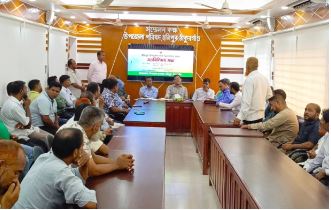
The report was placed at a meeting of the National Economic Council (NEC), held at the NEC conference room in Sher-e-Bangla Nagar on Monday and chaired by the chief adviser.
According to IMED and Planning Commission data, the Bangabandhu Sheikh Mujibur Rahman Space Observation Center project was taken up to create facilities for space observation at the intersection of the Tropic of Cancer and the 90-degree east longitude in Bhanga, Faridpur, and to promote scientific research. The Executive Committee of the National Economic Council (Ecnec) approved the project in 2021 at a cost of Tk213 crore, with completion scheduled for June 2024.
After spending about Tk6.64 crore, the implementing agency – the National Museum of Science and Technology – declared the project closed.
Officials of the science and technology ministry said the project proposal had been prepared and approved hastily, resulting in errors and shortcomings, and that the survey was also weak. Under the current design, the project would not deliver any benefit; achieving meaningful outcomes would require several times more funding. For these reasons, the decision was taken to declare the project closed.
Another cancelled project – “Modernisation of River Ports at Paturia and Daulatdia with Ancillary Facilities” – was approved by Ecnec in 2020 for implementation from 1 January 2020 to 31 December 2024.
The project cost was estimated at Tk1,351.70 crore. After spending about Tk79.87 crore, the project was cancelled.
Land acquisition complications emerged as a major obstacle. The funds earmarked for land acquisition in the DPP fell short of the final estimate by Tk15.89 crore, making it impossible to begin land acquisition without revising the DPP. As a result, the project’s main construction work effectively came to a standstill.
In addition, the cost of riverbank protection – one of the project’s key components – rose abnormally. Due to morphological changes in the river, frequent shifts of the bank line, and rising prices of construction materials, the cost of bank protection increased from Tk680 crore to Tk2,106 crore. As this cost did not align with the approved DPP, project implementation became even more complicated.
From a technical perspective, the project also faced major challenges. Experts from Buet stated that the Daulatdia end is a highly risky area, making it impossible to finalise a bank protection design based on previous data. Collecting new data and redesigning would require at least two years, which was incompatible with the project timeline. For all these reasons, the shipping ministry decided to cancel the project, according to sources.
Meanwhile, IMED sources said that in 2017 the previous government initiated a project to build six TV stations in six divisional cities outside Dhaka and Chattogram at a cost of Tk1,391 crore. The project proposed borrowing Tk988.55 crore from China. However, after coming to power, the current government cancelled the project, citing lack of priority.
Dr Fahmida Khatun, executive director of the Centre for Policy Dialogue (CPD), said such instances of project closure are not new. Similar cases have occurred before – projects taken up without proper planning, large amounts of public money spent on partial work, and then projects shut down on various pretexts. This is not merely the failure of individual projects, but a reflection of persistent weaknesses in state planning and management.
“The most important question is whether these problems could not have been identified earlier. River morphology changes, land acquisition costs, and high-risk locations are not new issues; they could have been identified through feasibility studies before project approval. Instead, these ‘risks’ appear after approval and are then used as justifications for cancellation,” she said.
She further questioned whether feasibility studies are being conducted only in name. Even when studies exist on paper, they often lack realism, robust data, and technical strength, leading to major problems during implementation. “The question arises – does the country lack qualified experts, or is there a lack of willingness to place the right people in the right roles?”
Dr Fahmida said this is where the core gap becomes clear – lack of transparency and accountability in planning.
Former planning secretary Md Mamun-Al-Rashid said the most alarming issue is that nearly Tk6,755 crore of public money had already been spent before these projects were cancelled. “Even though the projects were scrapped, the state has already lost a huge sum – an unmistakable policy and financial failure.”
“More importantly, the technical findings now used to justify cancellation bear little resemblance to the feasibility studies conducted at the time of project approval. This raises the key question: why are those who conducted the feasibility studies, proposed the projects, and approved them not being brought under accountability?” he said.
He added that the only way out is to set precedents: no project approval without proper and independent feasibility studies; holding those responsible accountable when implementation diverges from studies; and taking administrative action where necessary.




Editor & Publisher: Golam Mostafa Jibon
News & Commercial Office:
2 R. K Mission Road, Dhaka & Railgate, Sirajganj.
Hotline: 01715-319996, 01558-314179
E-mail : editor.thedailysky@gmail.com
news.thedailysky@gmail.com