

Crime index 2025: Violence against women and children tops list, murder cases increase
- Update Time : Thursday, January 8, 2026

TDS Desk:
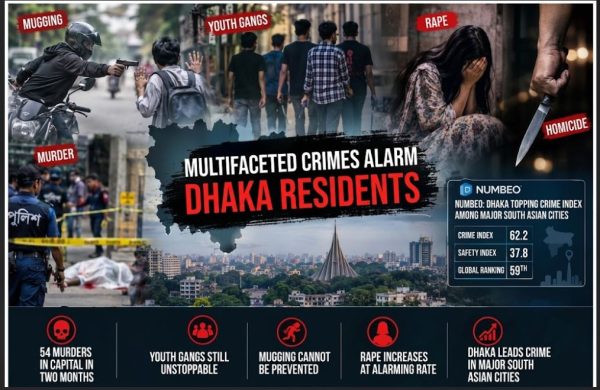
The crime index remained on an upward trajectory in 2025, the year following the political transition brought about by the mass uprising. Incidents of violence against women and children were the most prevalent, while serious crimes such as murder, robbery, and mob violence were also recorded at notable levels. Analysts attribute the surge largely to the fact that the law and order situation has yet to return fully to normal. Law enforcement agencies, meanwhile, say efforts are underway to restore police morale and rein in crime swiftly.
The Police Headquarters compiles crime statistics based on cases filed at police stations across the country. According to its data, a total of 181,737 cases — including recovery-related cases — were recorded in 2025, incorporating some cases carried over from 2024. The figures show that cases of violence against women and children topped the list, with 21,936 such cases filed over the year. Theft ranked second, with 12,740 cases, followed by murder, with 3,785 cases recorded nationwide. Dacoity also remained significant, with 1,935 cases filed during the year. In addition, police records show 702 cases of robbery, 988 cases under the Speedy Trial Act, 66 cases of rioting, and 1,101 cases of abduction. There were also 601 cases of attacks on police personnel, while other categories together accounted for 81,738 cases.
One of the most widely discussed incidents last year was the murder of four-and-a-half-year-old Roza Moni. A day after she went missing from the capital’s Tejgaon area, her body was recovered on May 13 from a garbage heap in Tejkunipara near the Bijoy Sarani overpass. The child bore severe signs of torture. Police initially suspected that she had been brutally abused by pouring hot water on her body before being strangled to death. Roza Moni was not an isolated case. At least 1,000 incidents of child abuse were reported in the capital alone last year, with Tejgaon and Mirpur emerging as the most affected areas. Beyond workplaces, children have also faced abuse in educational institutions. In Nawabganj, the family of a class-seven student alleged that she was abused by her teacher on September 23. After a case was filed, the accused teacher, Md Ali Aslam, was arrested and later gave a confessional statement before a court.
Associate Professor Dr. Tawohidul Haque of the Institute of Social Welfare and Research at the University of Dhaka, a criminologist, believes that crimes such as violence against women and children increased largely because law and order did not fully stabilise. Speaking to journalists, he said, “The crime statistics of 2025 reveal some deeply alarming trends. With the law and order situation not fully normalised, crime has increased significantly, and its impact has fallen disproportionately on women and children. Their legal and social protection mechanisms are still implemented in a very lax manner. Although many laws exist to protect them, enforcement remains weak. Violence against women and children, as well as the obstacles affecting their lives, would only be eliminated when the state ensures strict enforcement of the law. Women are still treated as second-class citizens in our society. In the case of children, we often see that even when they are abused, they do not receive adequate legal support.”
Dr. Tawohidul Haque further said, “In the aftermath of the political transition, the collapse of the law and order situation has had its most severe impact on women and children. At the same time, some of the grave crimes committed during this period include incidents such as targeted killings and mob violence. To overcome this situation, proper and strict enforcement of the law is essential.”
He noted that juvenile offenders were most heavily involved in incidents of violence against women and children, as well as in cases of mob violence. Bangladesh currently ranks 12th on a global index of juvenile crime, which is based on three indicators: the number of juvenile gang members relative to population, their involvement in violent crime, and the tendency to recruit children and adolescents. El Salvador tops the list with 15 points, followed by Honduras, Guatemala, Mexico, Colombia, Brazil, South Africa, the United States, Jamaica, the Philippines, and Nigeria. Bangladesh stands 12th with eight points. India ranks 13th and Pakistan 14th on the same index, both with similar scores. Juvenile gang activities are comparatively more prevalent in major cities such as Dhaka and Chattogram. Members of these gangs are typically aged between 13 and 19 and are often engaged in asserting neighbourhood-level dominance, drug trafficking, and expanding social influence. Although law enforcement agencies have conducted multiple operations to curb juvenile gangs, a tendency for these groups to reorganise has been observed.
Assistant Inspector General of Police (Media and Public Relations) at Police Headquarters, AHM Shahadat Hossain, told journalists, “Bangladesh Police have strengthened legal measures to curb such serious crimes. Steps have been taken, including activating women and children desks, ensuring swift registration of cases, forming special investigation teams, enhancing intelligence surveillance to identify offenders, and conducting regular operations. Future plans to control such crimes include expanding technology-driven policing, conducting targeted operations by identifying high-risk areas, strengthening community policing, and further broadening victim support services.










Editor & Publisher: Golam Mostafa Jibon
News & Commercial Office:
2 R. K Mission Road, Dhaka & Railgate, Sirajganj.
Hotline: 01715-319996, 01558-314179
E-mail : editor.thedailysky@gmail.com
news.thedailysky@gmail.com