

Silent extortion ahead of election
- Update Time : Monday, January 19, 2026
—Audite Karim—
Anis (a pseudonym) is a businessman. He did not go to his office last week. For an entire week, he kept his mobile phone switched off as well. Office staff meet him secretly only when there is an urgent need. No, it is not out of fear of creditors, nor does he face any legal cases. Then why has he gone into hiding? His colleagues at the office say he has been forced to take this path simply to protect himself from extortionists. Since the announcement of the election schedule, people identifying themselves as members of various political parties have been coming to his office to demand extortion money. The pressure keeps mounting every day—money is needed for the election. This helpless businessman wonders whom to pay, and how many people he must pay. Ultimately, he chose to disappear.
Anis is not alone. From large business owners to small entrepreneurs, everyone in Bangladesh is now in the same situation.
To escape the harassment of extortion, most private industrial entrepreneurs and businesspeople are living almost like fugitives—avoiding their offices and keeping their mobile phones switched off. Ordinary people are exhausted by this silent extortion. As it is, the economy has not been doing well for the past year and a half. Mob violence, deterioration of law and order, cases and attacks have left the private sector in turmoil. There is hardly any environment conducive to new investment. Industrial owners are struggling to keep their enterprises running amid these adverse conditions, and many have already shut down their businesses. In such a situation, election-related extortion is like a final blow to a dying patient.
This epidemic of silent extortion began after 5 August, 2024. Following the fall of the Awami League, a group of opportunists took to the field. Using various identities, they began extortion and looting across the country. This trend continues to this day. With the change of power, only the faces have changed—extortion has not stopped. After a brief “pause” at the beginning of the regime change, extortion resumed under new hands. Recently released top criminals have also joined in. Extortionists have descended in force. Across the country, extortion and illegal financial gains are being extracted from dish internet businesses, tender processes, transport, footpaths, markets, scrap businesses, commercial establishments, and construction projects. Their main targets are industrial zones, commercial areas, bus and river terminals, and marketplaces.
A defining characteristic of these extortionists is that they always operate under the shelter and patronage of the ruling party. During the Awami League’s uninterrupted 15-year rule, businesspeople and residents alike were tormented by these extortion syndicates. After the fall of that government through the student–mass movement, the victims hoped that change would finally come. But in most cases, it did not.
The vacuum left by extortionists from the previous regime was quickly filled. Occupation and extortion have resumed at all points. These new extortionists are now reportedly backed by some unscrupulous leaders from various political parties that currently enjoy favorable positions. For the time being, however, there are fewer complaints about police extortion. Instead, extortion in the names of candidates from different parties has begun, leaving businesspeople terrified.
In recent times, shootings, attacks, and killings over extortion have further heightened anxiety. Business owners say that criminals are becoming increasingly reckless due to the lack of progress in arrests and weapons recovery.
In Chattogram’s Chandanpura area, the residence of former Member of Parliament Mujibur Rahman was shaken late at night by gunfire from masked assailants. In the early hours of January 2, the attackers fired several rounds and fled in a white microbus. Allegations say that a demand for 100 million taka in extortion was made from a foreign number in the name of fugitive criminal “Boro Sajjad.” The attack was meant to intimidate after the extortion demand was refused.
Just days earlier, in Hamzarbagh, Chattogram, criminals opened fire and stabbed three workers at an under-construction building after failing to obtain extortion money. In the same police station area, nearly 350 bhori (about 4 kilograms) of gold were looted from two gold traders. Most recently, a criminal group has been accused of threatening to kill employees after entering the BADC office to manipulate tenders. Businesspeople say that both overt and covert, sector-based extortion has increased around the election.
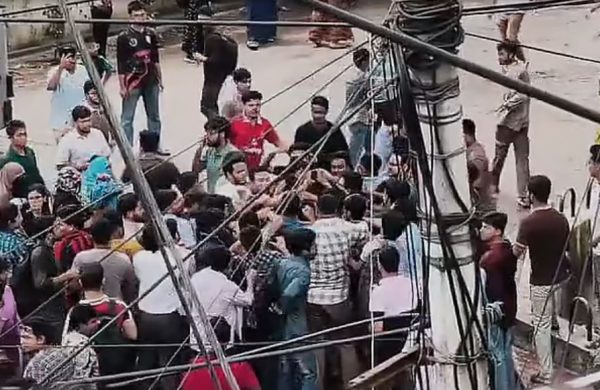
People are afraid to speak out against extortion. Recently, when traders at Karwan Bazar tried to protest extortion, they were attacked. On December 29 last year, a group of miscreants armed with sticks attacked a human chain formed by traders protesting extortion at Karwan Bazar. Extortion had resumed in the area for several months, prompting the traders to gather in protest. About half an hour after the human chain began, the attackers suddenly charged at them, leading to clashes. At the time, the role of law enforcement appeared largely that of spectators. This incident clearly shows how helpless and vulnerable people are in the face of extortionists.
Today, extortion is rampant everywhere in the country—from industrial establishments to marketplaces, shopping malls to grocery stores, ferry terminals to public toilets. There is no place untouched by extortion. Extortionists now seem more powerful than the government itself. Even law enforcement agencies are afraid to take action against them. Many officers cannot clearly determine who actually holds power, or against whom action can or cannot be taken. There is constant fear that taking action against certain individuals might jeopardize their own careers. As a result, extortionists roam with their chests puffed out. Some even claim to be “July fighters.” In reality, no one dares to verify who they truly are. Did the July uprising give an open license for extortion? Because of these extortionists, the July movement itself is now being questioned by many.
No one in the government dares to take action against these opportunists. No one adopts a firm stance. The government has failed to boldly declare that extortionists belong to no political party—that they are enemies of the country and enemies of the people—and to act accordingly. As a result, extortionists have become unstoppable over the past year and a half. Under political patronage and using political identities, they have carried out extortion fearlessly.
Without taking action against extortionists, illegal arms holders, and known criminals, the government is moving ahead with the national parliamentary election scheduled for February 12. So far, there are no visible steps to improve the law and order situation. Consequently, the election atmosphere has created lucrative opportunities for extortionists, making them even more reckless during this election season. Groups of people are going from business to business, demanding money for election funds in the name of candidates or parties. If refused, they first issue threats, then file false cases. Once a case is filed, mob violence follows. In other words, either you pay extortion, or you enter a dark tunnel of harassment and suffering.
Such a terrifying situation now prevails in the country. This anarchy must be stopped immediately. To curb the all-consuming activities of extortionists, the government must take a firm stand without delay. Political parties must take a public position against extortionists and clearly state that they will not shelter them. In this election, everyone must collectively boycott extortionists and say “no” to extortion. If we fail to unite against extortionists, the dream of a new Bangladesh will fade away. Whoever wins the election, they will not be able to ensure public welfare if they cannot control extortion.
Will we be able to build an extortion-free Bangladesh? Or will we remain hostages to these criminals?
———————————————————-
Audite Karim Writer and Playwright Email: auditekaim@gmail.com






Editor & Publisher: Golam Mostafa Jibon
News & Commercial Office:
2 R. K Mission Road, Dhaka & Railgate, Sirajganj.
Hotline: 01715-319996, 01558-314179
E-mail : editor.thedailysky@gmail.com
news.thedailysky@gmail.com