

A faction of the caretaker govt aided in manipulating the 2008 parliamentary polls
- Update Time : Saturday, January 24, 2026
TDS Desk:
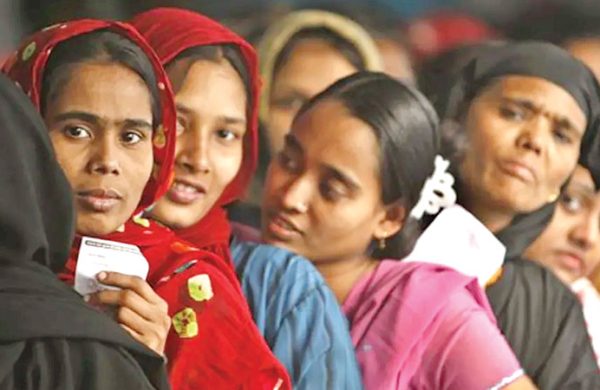
The ninth parliamentary election remains a heavily debated event in Bangladesh’s political history. The vote, which took place on December 29, 2008, was described at the time as a “return to democracy” and was conducted under a prolonged state of emergency and a military–backed caretaker government, with strict limits on political activity. The Election Commission reported voter turnout at an exceptional 87.16 percent. In 74 constituencies, the figure exceeded 90 percent — a level many observers found “unbelievable”. Although the “1/11” interim government hailed it as a major success, the high turnout soon sparked controversy. Political analysts noted that the BNP–led four–party alliance failed to win a single seat in Dhaka or Sylhet division, adding to the anomalies that reinforced a view that part of the caretaker government and state security apparatus influenced the election outcome.
The Awami League–led Grand Alliance secured 263 seats in that election; the BNP–led four–party alliance won just 33. According to commission data, Khulna division recorded the highest turnout at 90.43 percent, with Rajshahi a close second at 90.42 percent. Nationally, the EC claimed 85 to 90 percent turnout in 126 constituencies, with a further 67 and 28 seats seeing 80 to 85 and 75 to 80 percent respectively.
Bangladesh’s electoral history reveals the 2008 figures as a stark anomaly. The first post–independence election in 1973 saw approximately 55 percent participation, a level that fell to around 51 percent in 1979 and 1988. Even the 1991 and 2001 polls recorded turnout only between 55 and 75 percent. Consequently, the sudden surge beyond 87 percent in 2008 struck many as implausible. This was an election held under a tight state of emergency, with limited political activity, stringent security surveillance, and minimal campaigning. The central question of how such a massive turnout emerged from a barren political landscape lies at the heart of doubts and controversy surrounding the poll.
Another major controversy surrounding the 2008 election was the extensive redrawing of parliamentary constituency boundaries. The delimitation was conducted just before the poll under the 1/11 caretaker government and it fundamentally altered the country’s electoral geography. Led by the then–Chief Election Commissioner ATM Shamsul Huda, the commission published a draft of the new boundaries on April 29, 2008. Officials framed the exercise as a mandatory reform to ensure constitutional and demographic equality. Many observers, however, argue that its political impact was far from neutral. Long–established vote banks in many constituencies broke down, local power balances changed, and “safe seats” were overturned. Existing electoral structures set up by political leaders were dismantled. The BNP felt this impact directly, with several of its popular and multi–term elected figures suffering defeat.
In a report on the ninth parliamentary election, the Asian Network for Free Elections — an Asia–based international, independent and non–governmental observer group — noted that although the delimitation was legal, it produced politically non–neutral outcomes. The breakdown of long–established voter networks and the disruption of “safe seat” patterns quickly altered political competition.
The report further highlighted that this redistribution occurred during a state of emergency when organisational activity for political parties was severely restricted, leading to no robust political debate or resistance materialising on the ground despite the legal avenue for objection.
This boundary revision contributed to the defeat of several prominent figures, including Abdul Moyeen Khan who was a former MP for BNP in the Narsingdi–2 (Palash) constituency. He had won the seat three consecutive times before the ninth parliamentary election in 2008, when he lost for the first time. Reflecting on this, Abdul Moyeen Khan, now a member of the BNP’s standing committee, recently stated: “The 2008 election was not neutral at all. It was a stage–managed election, planned in advance. Who would be elected where — that blueprint was already determined before the polls.”
The 2008 election was also marked by a drastic overhaul of the voter roll, including the registration of the Bihari community. During the caretaker administration, a new biometric photo–ID voter list was compiled, covering over 80 million individuals who were newly registered or re–registered. Among these, approximately 30 million — roughly 37 percent of the total — were first–time voters. However, this large–scale registration took place under a state of emergency, when political activity and public gatherings were severely restricted. In its report, the Asian Network for Free Elections questioned whether implementing such a vast electoral expansion within such a restricted political environment could yield a genuinely neutral political outcome.
Allegations of a covert understanding between Sheikh Hasina and then–Army Chief General Moeen U Ahmed later surfaced. Chowdhury Fazlul Bari, a former army official who was the acting director general of the Directorate General of Forces Intelligence in the early days of the 1/11 administration, addressed this in an interview last year. “After appointing General Moeen, the Hasina government voiced strong criticism about his role,” he told journalists. “Yet, she was the same person who later forged an alliance with Moeen U Ahmed.” He stated that Brigadier Amin (Retired Major General ATM Amin) would visit Sheikh Hasina’s cell with Gowher Rizvi. “It was abundantly clear,” Bari said, “that the then–army chief was scheming to secretly collaborate with Sheikh Hasina.”
A current interim government commission reviewing the 2014, 2018 and 2024 elections also reported on the 2008 poll. Its report states that, prior to the ninth parliamentary election, the then–Election Commission deliberately redrew constituencies to favour the Awami League by splitting areas with concentrations of rival party voters. It cites Chattogram–7 and Chattogram–8 as examples. The report said that the commission added Sreepurkharandwip union from Boalkhali upazila to Rangunia upazila to favour one individual and block another, even though the two upazilas are separated by the Karnaphuli River. Furthermore, the commission increased parliamentary seats in Dhaka district from 13 to 20 while cutting seats in 12 other districts — a move the report notes was designed to give one party an undue advantage.
The report further states that, to grant the Awami League special advantage, the then–ATM Shamsul Huda commission enacted sweeping changes in 130 of the country’s 300 parliamentary constituencies. The manipulation secured 262 seats for the Awami League–led Grand Alliance in 2008, which contested 260 seats and won 230. According to the report, the gerrymandering and illicit activities of 2008 established a pattern continued by successive election commissions in 2014, 2018 and 2024.
Reflecting on this period, the Chief Adviser’s Press Secretary Shafiqul Alam recently commented that the process of destroying Bangladesh’s electoral system began under the 2007–08 military–backed government. On his verified Facebook account, he wrote: “The military–backed leadership of 2007–08, led by General Moeen and his DGFI cohorts Brigadier Amin and Brigadier Bari, rigged the 2008 general election in a manner that handed a landslide victory to the Sheikh Hasina–led Bangladesh Awami League.”
Notably, several individuals from the 2008 caretaker government now hold significant, high–level positions within the current interim administration.
Analysts view the 2008 result — 263 seats for the Awami League–led alliance against a mere 33 for the BNP–led four–party coalition — as a definitive moment that radically altered the nation’s political equilibrium. Institutional “checks and balances”, essential for a healthy political system, began to erode quickly. Executive control over administration, law enforcement and state institutions expanded, while opposition space outside the parliament steadily narrowed — a point many see as the start of authoritarian rule.
Commenting on this, Badiul Alam Majumdar, former head of the Electoral Reform Commission and secretary of SHUJAN (Citizens for Good Governance), told journalists: “Until now, the 2008 election has received little detailed analysis. However, the BNP had already alleged at the time that the boundary was redrawn to ensure their defeat in the election.”


Editor & Publisher: Golam Mostafa Jibon
News & Commercial Office:
2 R. K Mission Road, Dhaka & Railgate, Sirajganj.
Hotline: 01715-319996, 01558-314179
E-mail : editor.thedailysky@gmail.com
news.thedailysky@gmail.com