

Climate Responsibility Meets Bangladesh’s Democratic Test
- Update Time : Sunday, February 1, 2026

—Kaniz Kakon—
Bangladesh is heading towards 12 February 2026 at a moment when politics, law and climate pressure are converging with unusual force. This will be the country’s first general election since the 2024 political upheaval, held under an interim administration led by Muhammad Yunus, with both national and international attention fixed on whether democratic credibility can be restored. Reporting indicates that the vote will take place alongside a constitutional referendum, raising the stakes far beyond routine party competition. More than 127 million eligible voters are expected to participate, and for the first time, the Election Commission has opened postal voting for overseas Bangladeshis, signalling an attempt to widen participation and legitimacy. Yet beneath the noise of campaign speeches and procedural reforms lies a quieter reality. Bangladesh is voting as a country already living with the consequences of climate change. Rivers continue to erode land, floods disrupt livelihoods, and recovery costs strain public finances. This election is not happening in a climatic pause. It is unfolding after COP30, after years of intensifying climate impacts, and after a legal moment that did not occur in a conference hall but in a courtroom in The Hague.
On 23 July 2025, the International Court of Justice issued its advisory opinion on Obligations of States in respect of Climate Change, responding to a request from the UN General Assembly. The Court clarified that states have duties under international law to prevent significant harm to the climate system, to act with due diligence and to cooperate, and that failure to do so may trigger international legal responsibility. This was not a symbolic gesture. It was the strongest articulation yet that climate harm is not only a policy failure but a matter of legal obligation. In January 2026, policy analysts at the Overseas Development Institute argued that this opinion has reopened the global debate on loss and damage, because a finance system built on voluntary contributions sits uneasily with a legal framework that speaks in the language of duty and responsibility. The opinion does not create instant liability, but it reshapes expectations. It narrows the space for delay and widens the moral and legal pressure on high-emitting states to treat climate harm as something that must be remedied, not merely acknowledged.
That pressure has landed directly on the architecture emerging after COP30. The Fund for Responding to Loss and Damage is no longer a theoretical construct. It is now operational within the UN climate framework, with an Executive Director in place and formal governance structures established. At COP30 in Belém in November 2025, the Fund announced its first Call for Funding Requests, allocating USD 250 million in initial grant resources for a start-up phase. The call formally opened on 15 December 2025 and is scheduled to run for six months, allowing vulnerable countries to submit proposals for support related to irreversible climate harm. This figure is fully verified and widely reported. It is also widely regarded as modest when set against the scale of loss and damage faced by climate-vulnerable states. The tension is now unmistakable. A legal signal from the world’s highest court is pointing towards responsibility, while the financial response remains cautious and experimental. This mismatch has become the most recent and contested issue in global climate politics.
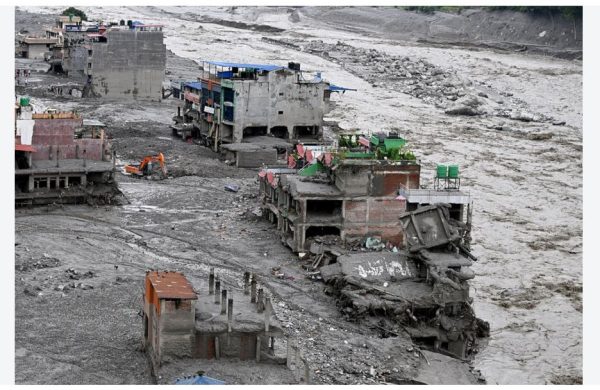
This global shift matters deeply for Bangladesh as it enters an election season. Climate change here is not an abstract campaign theme. It is a daily governance challenge that exposes institutional strength or weakness with brutal speed. When river erosion displaces families, compensation systems are tested. When floods damage roads and schools, procurement and recovery mechanisms are revealed. Voters may not speak in legal terms, but they understand whether the state can protect them from foreseeable harm. The ICJ opinion introduces a new benchmark into this domestic landscape. It quietly raises expectations about what responsible governance looks like in a climate-stressed country. Political parties can no longer rely solely on ambition or rhetoric. They are being judged on whether they can build institutions capable of accessing international climate finance, deploying it efficiently and doing so transparently. In a world where climate responsibility is increasingly framed as a legal duty, weak delivery systems are no longer just administrative failures. They become political liabilities.
Bangladesh’s own climate commitments sharpen this electoral test. In September 2025, the country submitted its Third Nationally Determined Contribution, committing to an unconditional emissions reduction of 26.74 MtCO2e, or 6.39 per cent below business as usual by 2035, and a further conditional reduction of 58.23 MtCO2e, or 13.92 per cent, dependent on international support. Together, these amount to a projected 20.31 per cent reduction below business as usual by 2035. These figures are not abstract targets. They draw a clear line between domestic responsibility and international obligation. As Bangladesh moves towards the February vote, the real question is not which party speaks most convincingly about climate justice, but which is prepared to govern in a world where climate harm is foreseeable, finance windows are opening, and legal language is sharpening. Ballots will be cast in February, but the judgment that matters will arrive with the next flood or cyclone. By then, voters will know whether their leaders understood the message coming from The Hague, or whether they treated it as distant thunder instead of an approaching storm.
———————————————————————————–
The writer is an Assistant Professor in the Department of Philosophy at IUBAT and is currently on study leave, residing in Oslo, Norway









Editor & Publisher: Golam Mostafa Jibon
News & Commercial Office:
2 R. K Mission Road, Dhaka & Railgate, Sirajganj.
Hotline: 01715-319996, 01558-314179
E-mail : editor.thedailysky@gmail.com
news.thedailysky@gmail.com