

How does the current oil crisis compare with 1973 embargo?
- Update Time : Wednesday, March 25, 2026
TDS Desk:
The ongoing United States-Israel war on Iran has triggered what the International Energy Agency (IEA) describes as the largest oil disruption in history. The IEA itself was established in 1974 in direct response to the 1973 oil embargo, when Arab producers led by Saudi Arabia cut output to retaliate against Washington’s support for Israel during its war with Egypt and Syria.
In 1973, the embargo created a shortfall of about 4.5 million barrels per day – roughly 7% of global oil supply at the time. Today’s disruption is far more severe in scale, reports Al Jazeera.
Iran has effectively choked off transit through the Strait of Hormuz, restricting passage to only a limited number of vessels and blocking the movement of over 20 million barrels of oil per day – around one-fifth of global consumption.
The market impact has been immediate. Since the conflict began, Brent crude prices have surged from $66 per barrel to above $100.
In response, the IEA’s 32 member countries have agreed to release 400 million barrels from their strategic reserves in an effort to stabilise supply. The agency has also urged consumers and businesses to cut back on travel, work remotely, and switch from gas to electricity for cooking, as geopolitical tensions drive up not only crude prices but also the costs of diesel, heating oil, and jet fuel.
However, analysts warn that these measures are unlikely to significantly ease the pressure if the disruption continues.
More than five decades after the 1973 oil embargo, the comparison highlights both familiar vulnerabilities and a far greater scale of risk in today’s global energy system.
What happened in 1973?
On 6 October 1973, Egypt and Syria launched a coordinated attack on Israel in a bid to reclaim territories lost during the 1967 Six-Day War. That earlier conflict had left Israel in control of the Golan Heights, Sinai Peninsula, Gaza Strip, and the West Bank, including East Jerusalem.
To maximise surprise, the offensive began on Yom Kippur – the holiest day in the Jewish calendar – when much of Israel shuts down, with no broadcasts, closed businesses, and minimal transport.
Ahead of the conflict, Saudi Arabia’s King Faisal warned US President Richard Nixon that backing Israel could put oil supplies at risk. Nevertheless, Washington proceeded with a major military airlift in support of Israel.
In response, on 17 October 1973, Arab oil exporters under the Organization of Arab Petroleum Exporting Countries (OAPEC) took retaliatory action. They raised oil prices by 70%, cut production by 5% per month, and imposed an embargo on shipments to the US. The Netherlands, Portugal, and South Africa were also targeted for supporting Israel.
At the time, the Middle East accounted for 36% of global oil production, and the embargo created a supply shortfall of about 4.5 million barrels per day.
How did the oil embargo affect petrol prices in 1973?
The impact was swift and severe, particularly in the US, where oil imports fell by 15%. Crude oil prices surged from under $3 per barrel to more than $12 within months – equivalent to roughly $22 to $75-$80 today.
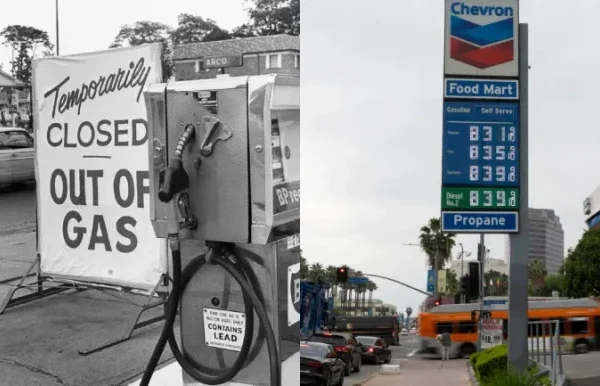
For consumers, petrol prices rose sharply. American drivers, who were paying about 38 cents per gallon at the start of 1973, faced prices of around 55 cents by 1974 – an increase of nearly 45%. Fuel shortages also led to empty pumps across the country.
In November 1973, President Nixon addressed the nation, urging conservation. His administration imposed lower speed limits, introduced fuel rationing, and adopted year-round daylight saving time to curb energy use.
The crisis rippled across other major economies. Western Europe and Japan, both heavily dependent on imported oil, were hit hard. Japan relied on foreign crude for three-quarters of its energy needs, with 77% coming from Gulf countries. The United Kingdom introduced a three-day workweek, while several European nations banned Sunday driving.
How have petrol prices been affected now?
The current crisis has triggered even sharper and faster price movements. Before the US and Israel launched strikes on Iran on 28 February, Brent crude stood at $66 per barrel. Within a week, it had surged past $100 – a rise of about 60%.
Prices have also been highly volatile. Brent futures initially jumped nearly 7% at the onset of the conflict, before falling more than 10% to around $100 following US President Donald Trump’s announcement of a temporary delay in strikes on Iranian energy facilities to allow for negotiations.
At the retail level, fuel prices have spiked dramatically. In the US, the national average climbed from under $3 per gallon to more than $5 in some states, reaching as high as $8 in places like California.
Globally, the increases have been widespread. Petrol prices have risen by more than 50% in several countries, including Cambodia (up nearly 68%), Vietnam (around 50%), Nigeria (35%), Laos (33%), and Canada (28%).
The scale of disruption reflects the strategic importance of the Strait of Hormuz, a narrow waterway between Iran and Oman through which a significant share of the world’s oil supply passes. Five of the world’s top 10 oil producers – Saudi Arabia, Iraq, the United Arab Emirates, Iran, and Kuwait – depend on this route to export energy to global markets.
According to Gavekal Research, Gulf producers could reroute at most 3.5 million barrels per day via pipelines that bypass the strait. However, if shipping through Hormuz remains largely suspended, the global market could still face a supply shortfall of around 15 million barrels per day.
How did governments respond to the 1973 oil crisis?
Governments moved quickly to curb consumption and stabilise supplies. In the US, the Nixon administration rolled out sweeping energy conservation measures – cutting heating oil use by about 15%, lowering indoor temperatures, and restricting fuel for aviation. It also created the Federal Energy Office to coordinate the national response.
Diplomacy played a central role. Secretary of State Henry Kissinger engaged Arab leaders while pushing Israel towards territorial concessions. These efforts led to the First Egyptian-Israeli Disengagement Agreement in January 1974, followed by the formal lifting of the embargo in March – though elevated oil prices persisted.
The crisis reshaped global energy strategy for decades. Nixon launched “Project Independence,” aiming for US energy self-sufficiency by 1980. Across Europe, governments accelerated nuclear power development, while investment surged into alternative energy sources such as wind, solar, and geothermal. Fuel efficiency standards for vehicles were also tightened.
Over time, these shifts paid off. The US is now energy self-sufficient and has been a net energy exporter since 2019. Japan, meanwhile, fundamentally restructured its economy – reducing reliance on imported oil, expanding liquefied natural gas use, and pivoting away from heavy, oil-intensive industries towards sectors like electronics.
How are governments responding to the oil crisis now?
The current response has centred on emergency reserves and short-term supply management. Within days of the conflict, the International Energy Agency’s 32 member countries coordinated the largest release of strategic oil reserves in its history – 400 million barrels, more than double the volume deployed after the 2022 Russia-Ukraine war. The US alone is set to contribute 172 million barrels this year.
This emergency system, created in the wake of the 1973 crisis, has been activated only six times – in 1991, 2005, 2011, twice in 2022, and now in 2026. Altogether, IEA members hold more than 1.2 billion barrels in government reserves, with an additional 600 million held by industry under state mandate.
Even so, the scale of the current disruption poses limits. The planned 400 million-barrel release would offset roughly 20 days of oil flows through the Strait of Hormuz and will take months to fully implement. It is not sufficient to counter a prolonged shutdown of the route.
Separately, the Trump administration has lent more than 45 million barrels from the US Strategic Petroleum Reserve to oil companies in an effort to ease price pressures. Other major economies are also leaning on their reserves. China, for instance, is estimated to have enough stockpiles to cover around 200 days of normal consumption, though many developing countries have far smaller buffers.
Why is this crisis different?
While comparisons with 1973 are useful, today’s crisis reflects a very different global energy landscape.
The 1973 shock was driven by a coordinated embargo from a bloc of oil-producing nations targeting specific Western countries. In contrast, the current disruption stems from a single actor constricting a single chokepoint – the Strait of Hormuz – without a broader, coordinated production cut.
Another key difference lies in long-term structural change. One of the enduring impacts of 1973 was the diversification of global energy sources, including the rise of North Sea oil, US shale, liquefied natural gas, and nuclear power. As a result, oil’s share of global energy consumption has fallen from 46.2% in 1973 to about 30.2% today.
However, this diversification has been uneven. Advanced economies – across Europe, North America, Japan, South Korea, and Australia – have significantly reduced their dependence on oil. In contrast, many fast-growing Asian economies remain highly exposed.
In 1973, Western economies bore the brunt of the shock. Today, the most vulnerable are developing Asian countries, many of which rely heavily on oil shipments passing through the Strait of Hormuz. Around 80% of their imports transit this route, yet their reserves are limited – often covering only a few weeks of consumption. Countries like Vietnam, Pakistan, and Indonesia, for example, hold roughly 20 days or less in reserves, leaving them particularly exposed to prolonged disruption.









Editor & Publisher: Golam Mostafa Jibon
News & Commercial Office:
2 R. K Mission Road, Dhaka & Railgate, Sirajganj.
Hotline: 01715-319996, 01558-314179
E-mail : editor.thedailysky@gmail.com
news.thedailysky@gmail.com