

World Cup 2026: Where have all the frenzies gone?
- Update Time : Saturday, June 13, 2026
Online Desk
The 2026 FIFA World Cup is kicked off across North America in an unprecedented 48 teams, with bleeding edge technologies, three hosts spanning the US, Canada, and Mexico.
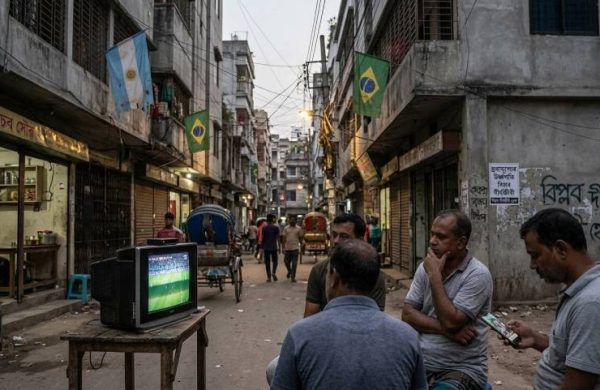
But a peculiar calmness is prevailing over the streets of Dhaka. Some are surprised about where the favorite team flags on the rooftops are gone, some are talking about their 90s nostalgia of Talibabad Satellite Ground Station, and some are looking for tea stalls turning into makeshift stadiums for midnight crowds.
It might be a trivial matter at the first look, but a closer look suggests something more thought provoking, a country wrestling with economic strain, political fatigue after a historic uprising, disillusionment with the politics surrounding the tournament’s hosts, and a generational shift in how football and media itself is consumed.
A nation looking inward
The most obvious answer to this calm and coldness can immediately be explained form economic angle.
The newly formed Bangladesh Nationalist Party-led government unveiled a record Tk 9.38 trillion budget for FY2026-27 that the opposition party has termed as ‘debt-dependent and prone to misuse’.
Think tank Centre for Policy Dialogue (CPD) also cautioned that the government’s budget spending plans in FY2026-27 could add to inflationary pressures if the expenditure fails to generate productivity gains.
For the middle and lower income people, this translates into something simple- less scope for celebration. Buying large team flags, renting projectors for community screenings in alleys, or painting murals on shutters and walls has quietly slipped from tradition into luxury.
When the choice is between a new gas cylinder and a giant Brazil or Argentina flag, a favorite team flag obviously loses.
The situation gets more complex when we take political scenario in concern. Nearly two years after the July 2024 uprising that reshaped the country’s politics, the energy of Gen Z, the central power of the uprising seems a bit confused.
Bangladesh has seen an inclusive national election and a change in government. But many among the politically-aware youth, the very group that historically powers football culture in the country, think the socio-economic structural changes they hoped is found slow to materialise. That collective emotional bandwidth, once connected to football mania, now seems is heavily being spent on career uncertainty along with economic, and domestic concerns.
The Iran war hits home
If economics explains the scarcity of money for celebration, geopolitical influence also explores some of the lack of mood for it.
The ongoing war between the US, Israel, and Iran, and its worldwide effects, has a straight consequences for Bangladesh, a country that imports roughly 95 per cent of its energy needs.
Earlier in the year, fuel rationing was imposed at filling stations, universities and private schools were temporarily shut to conserve electricity, and several state-run fertiliser plants suspended operations to redirect gas to power generation.
Finance Minister Amir Khosru Mahmud Chowdhury earlier said the conflict alone could add roughly Tk 42,600 crore to the country’s energy and fuel subsidy bill, widening the budget deficit and adding pressure on foreign exchange reserves through billions of dollars in extra import costs.
So, staying up late at night to enjoy a midnight match carries a cost, in load-shedding, in fuel queues, in energy consumption, in electricity unit prices, and in a household budget already stretched thin.
Host nation hard to cheer for
One of the host nations, the United States, is engaged in a war with Iran and barred Somali referee Omar Abdulkadir Artan to enter into the country.
In June 2026, when Somali referee Omar Abdulkadir Artan, set to become the first official from his country ever to take charge of a World Cup match, and Africa’s reigning referee of the year, was denied entry into the United States. He arrived in Miami holding a diplomatic passport and a valid visa, but US Customs and Border Protection ruled him “inadmissible” on vetting grounds, with a White House official later citing alleged links to “suspected members of terror organizations.”
For many information-aware persons in Bangladesh, these episodes are more than news. It read as a reminder alarm that the tournament’s branding of global unity walks disturbingly alongside the immigration policies and power politics in the Middle East of its largest host nation whose effects are being felt as far away as Dhaka’s fuel pumps.
When idol goes to the White House
Needless to say, Argentine heartthrob Lionel Messi carries more emotional weight among Bangladeshi football fans.
So when Messi, alongside Inter Miami co-owner Jorge Mas and head coach Javier Mascherano, visited the White House on March 5, 2026, to celebrate the club’s first MLS Cup title, the images travelled fast.
During the ceremony, Messi presented US President Donald Trump with a signature pink Inter Miami soccer ball, while Mas and Mascherano gifted him a custom jersey bearing the number 47 and a luxury Tudor watch.
For Bangladeshi fans who have long mythologised Messi as football’s last “pure” superstar, the White House visit was a hard hitting crack in that myth. It is not that anyone expected Messi to refuse an invitation extended to his entire championship-winning team. But, the image of football’s biggest icon handing gifts to a president who is being criticized for his role in immigration rules and war-loving image hits really hard to his fans.
The popularity of short videos
Underneath all of this there sits a quieter, longer-running shift, how people actually watch football, to be precise consume media, now.
The communal watching culture of neighbours crowding around a single television or projector screen is being gradually eroded by short-form video or watching on mobile devices.
Viewers and fans are gradually being interested in consuming in fragments, as the trend goes on- a goal clip on Facebook Reels here, a controversial-decision compilation on YouTube Shorts there, a highlight reel on TikTok in the next morning.
The drama of a match unfolding in real time, shared with a room full of friends and opponent team fans, is slowly replaced by an algorithmically curated, solitary scroll, often after the result is already known.
This is not unique in Bangladesh too. Due to economic anxiety, political exhaustion, and geopolitical unease a World Cup is gradually becoming a solitary enjoyment instead of gathering together, watching, and feeling something together.
However, none of this means Bangladesh stopped loving football. Still the country is celebrating the global event but without the past enthusiasm and spontaneity.
But, the all-consuming carnival of socio-political complexities squeezed the emotion marred by an economy in survival mode, a political mood still searching for expected outcome, a tournament whose host keeps generating headlines for war and immigration policies, and a consumer base that has simply learned to watch the world’s biggest events in short videos.






Editor & Publisher: Golam Mostafa Jibon
News & Commercial Office:
2 R. K Mission Road, Dhaka & Railgate, Sirajganj.
Hotline: 01715-319996, 01558-314179
E-mail : editor.thedailysky@gmail.com
news.thedailysky@gmail.com