

Inu gets 10 years’ rigorous imprisonment in crimes against humanity case
- Update Time : Tuesday, June 30, 2026
Court Reporter:
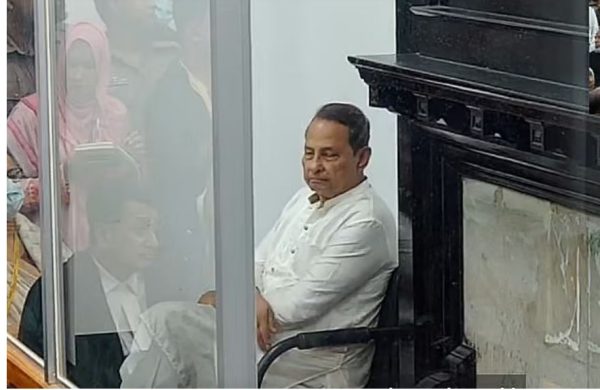
Hasanul Haq Inu, president of the Jatiya Samajtantrik Dal (JSD), has been sentenced to 10 years’ rigorous imprisonment in a case filed over crimes against humanity committed during the July mass uprising.
The verdict was delivered on Tuesday by International Crimes Tribunal-2, headed by Justice Nazrul Islam Chowdhury. The tribunal’s other two members are Judge Md Manzurul Bashid and Judge Nur Mohammad Shahriar Kabir.
Inu, the sole accused in the case, faced a total of eight charges. Among the principal allegations was that he ordered the killing of six people in Kushtia during the July mass uprising and incited attacks on protesters.
The verdict was broadcast live on Bangladesh Television (BTV). It marks the sixth judgment delivered in a case involving crimes against humanity committed during the July mass uprising.
The prosecution said on Monday that the investigation into the case against Inu began on 25 March 2025. The investigation report was submitted on 11 September of the same year, and formal charges were filed before the tribunal on 25 September.
Following hearings by both sides, the tribunal framed charges on 2 November last year.
The formal trial commenced on 30 November last year with the prosecution’s opening statement. Testimony from the first witness was recorded on 1 December.
The prosecution produced 10 witnesses in support of its case, while the defence presented two witnesses.
Following the conclusion of witness testimony, closing arguments began on 13 April this year and concluded a month later, on 13 May. The case had since been awaiting judgment. On 22 June, the tribunal fixed Tuesday for delivering the verdict.
Eight charges
The first charge alleges that, in an interview with an Indian media outlet on 18 July 2024, Inu described the July protesters as members of Jamaat, terrorists and communal elements. He is also accused of inciting, encouraging and assisting the use of force against the protesters, including allegedly ordering killings.
The second charge states that Inu attended a meeting of the 14-party alliance chaired by then-prime minister Sheikh Hasina at Ganabhaban on 19 July 2024, where a “shoot-at-sight” policy was allegedly adopted to suppress the Anti-Discrimination Student Movement. He is accused of directing, instigating, provoking and facilitating the adoption and implementation of that decision.
The third charge alleges that he instructed the superintendent of police in Kushtia by telephone to identify protesters from photographs and arrange for their arrest and torture.
The fourth charge accuses him of supporting the use of lethal weapons against protesters and planning aerial bombings using helicopters and a student force to suppress the movement.
The fifth charge alleges that he made inflammatory public statements and implicitly endorsed the killings and other acts of repression carried out by the government.
The sixth charge accuses him of participating in the 14-party alliance meeting that decided to ban Jamaat-e-Islami.
The seventh charge alleges that he conspired through telephone conversations with Sheikh Hasina.
The eighth charge alleges that on 5 August, 2024, he ordered the killing of six protesters in Kushtia town — Yusuf Sheikh, Osama, Suruj Ali, Ashraful Islam, Bablu Foraji and Abdullah Al Mustakin. He is also accused of ordering the killing of 1,400 people and the injuring of more than 25,000 protesters across the country.




Editor & Publisher: Golam Mostafa Jibon
News & Commercial Office:
2 R. K Mission Road, Dhaka & Railgate, Sirajganj.
Hotline: 01715-319996, 01558-314179
E-mail : editor.thedailysky@gmail.com
news.thedailysky@gmail.com