

Tk3,000cr refinance scheme to power North Bengal growth
- Update Time : Tuesday, July 7, 2026
Staff Reporter:
In a major push to overhaul the agricultural supply chain in Bangladesh’s northern region, the central bank has launched a Tk3,000 crore refinance scheme designed to transform the area into a specialised agro-economic hub.
Outlined in a policy directive issued on Monday, the three-year fund will be drawn from the surplus liquidity of scheduled banks. It aims to tackle long-standing bottlenecks in the Rajshahi and Rangpur divisions – two of the country’s most crucial agricultural heartlands.
Despite producing a substantial share of Bangladesh’s crops, the northern region has long struggled to capitalise on its yields.
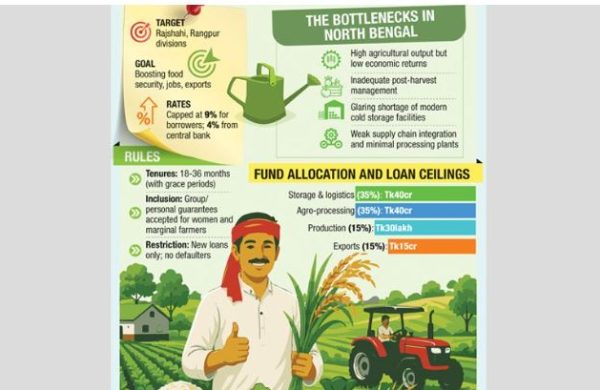
The central bank noted that inadequate post-harvest management, a glaring lack of modern cold storage, and weak supply chain integration have continually stifled economic growth.
By financing everything from seed storage to cold-chain logistics, the scheme is expected to bolster food security, drive job creation, and alleviate regional poverty.
Targeted allocations
The Tk3,000 crore fund will be disbursed across four strictly ring-fenced sectors, though the central bank may permit lenders to adjust these ratios for environmentally friendly or non-traditional projects.
Both the agricultural storage and logistics sector, which covers modern cold storage, grain silos, and cold-chain infrastructure, and the agro-processing sector, dedicated to establishing or modernising food processing plants, have been allocated 35% of the fund each, with individual loans capped at Tk40 crore.
Meanwhile, agricultural production – covering crops, fisheries, livestock, and machinery – will receive 15% of the resource pool, allowing borrowers to access up to Tk30 lakh.
The final 15% has been earmarked for export development to fund export-oriented preparation and manufacturing up to a ceiling of Tk15 crore per loan. Participating lenders have the leeway to adjust these individual borrowing limits by up to 20%, depending on a client’s specific financial requirements.
Favourable terms and strict caveats
Under the scheme’s framework, Bangladesh Bank will charge participating scheduled banks a 4% annual refinance rate.
In turn, commercial lenders and Islamic banks – operating under Shariah-based profit margins – are strictly prohibited from charging borrowers more than 9%, calculated on a declining balance basis.
Production loans will carry a maximum tenure of 18 months, inclusive of a three-month grace period. Projects falling under the other three categories will benefit from a 36-month repayment window, with grace periods extending up to six months.
Crucially, the funds are exclusively ring-fenced for new projects. The central bank has barred the use of this scheme to regularise, restructure, or pay off existing working capital facilities.
Furthermore, anyone flagged as a defaulter by the Credit Information Bureau (CIB) is instantly disqualified.
In a bid to bring marginalised demographics into the economic fold, the policy actively encourages banks to accept alternative collateral – such as personal, social, or group guarantees – from women and marginal farmers, bypassing the traditional requisite for immovable property.
Banks are also barred from levying any hidden fees outside the central bank’s standard schedule of charges.
Accountability and compliance
All scheduled banks operating in the country can tap into the scheme upon signing a participation agreement with the central bank’s Agricultural Credit Department-2.
However, Bangladesh Bank is taking a hardline approach to compliance. Participating banks bear the sole risk of loan recovery. Should a bank fail to repay its refinance instalments on time, the central bank retains the authority to automatically debit the institution’s current account.
Furthermore, if lenders are caught misusing the funds or charging above the 9% ceiling, they will face a punitive 2% surcharge on top of the standard refinance rate for the misused amount.
To ensure transparency, lenders must maintain separate accounts for scheme-financed loans and submit detailed reports within seven working days of each month’s end. Routine refinance claims must be filed by the 15th of the following month, though a two-month grace period is available for delayed submissions provided there is a valid justification.
The central bank has also confirmed it will conduct unannounced field inspections to verify that the funds are reaching their intended targets.











Editor & Publisher: Golam Mostafa Jibon
News & Commercial Office:
2 R. K Mission Road, Dhaka & Railgate, Sirajganj.
Hotline: 01715-319996, 01558-314179
E-mail : editor.thedailysky@gmail.com
news.thedailysky@gmail.com