

Policy panic or artificial crisis: Farmers fear production drop
- Update Time : Tuesday, August 25, 2026
—Golam Mostafa Jibon—
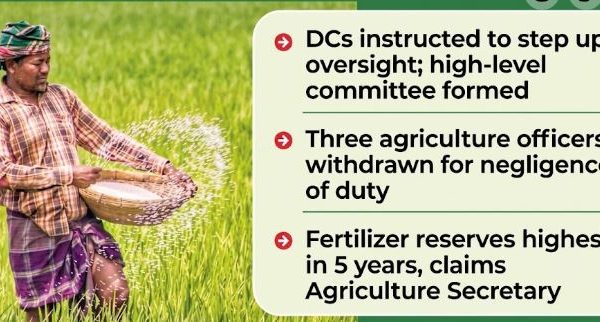
As the ongoing Aman paddy cultivation and seedbed maintenance reach their peak season, farmers across Bangladesh find themselves trapped in a severe fertilizer crisis. Despite the government’s firm stance that national stockpiles are more than adequate, the ground reality paints a drastically different picture. Farmers in Kurigram, Lalmonirhat, Meherpur, Bogura, Jashore, Netrokona, and several other districts are struggling to secure essential nutrients. Forced to buy chemical fertilizers at inflated prices from the open market, frustrated farmers in some areas have even resorted to breaking into dealer warehouses to claim supplies.
This stark disconnects between official inventory records and field-level distress raises a critical question: Is the current shortage driven by actual supply failures, or is it an artificial crisis born out of market manipulation and widespread anxiety over new regulatory policies?
FIELD REALITIES AND FARMER DISTRESS:
While the supply of Urea remains relatively steady, there is a sharp spike in demand for non-urea fertilizers—specifically Triple Superphosphate (TSP) and Di-ammonium Phosphate (DAP)—which farmers use alongside Urea to boost soil fertility during the Aman season. In sub-districts like Aditmari in Kurigram and Bhatpara in Meherpur, authorized dealers routinely claim “zero stock.” However, farmers report that paying an extra Tk 500 to Tk 700 above the government-fixed prices (Tk 1,350 for TSP and Tk 1,050 for DAP per 50 kg bag) miraculously makes the required fertilizer available at nearby retail shops.
Agricultural extension officials also attribute part of the pressure to improper fertilizer application and panic buying. Dr. Saikhul Arifin, Deputy Director of the Department of Agricultural Extension (DAE) in Lalmonirhat, noted that many farmers bypass scientific recommendations by using DAP instead of Urea for top dressing in char areas. This misapplication, coupled with hoarding and illegal middleman hoarding, has further exacerbated the local supply crunch.
POLICY PANIC OR DEALER SYNDICATES?
A major catalyst behind the market instability is the Integrated Fertilizer Dealer Appointment Policy 2025, which dissolved the traditional system of sub-dealers and nearly 45,000 retail sellers. The issuance of executive orders enforcing this revised policy on August 9 sent shockwaves through the distribution network, triggering deep uncertainty among existing dealer syndicates.
Agriculture Ministry officials allege that a section of dishonest dealers—fearful of losing their licenses under the new framework—is deliberately creating an artificial shortage by holding back distribution to embarrass the administration. In 15 northern districts (excluding Panchagarh), numerous dealers failed to draw their allocated quota despite submitting Demand Orders (DOs). In response, the ministry directed District Commissioners to initiate strict legal actions against delinquent dealers and immediately withdrew DAE Deputy Directors in Meherpur, Rajshahi, and Joypurhat for negligence of duty.
Conversely, leaders of the Bangladesh Fertilizer Association (BFA) point to structural constraints. They emphasize that while overall cultivable land and crop cycles have expanded over the years, regional fertilizer allocations have not kept pace. Furthermore, an ongoing natural gas shortage has forced three out of six domestic fertilizer factories to shut down operations, severely denting local production capacity.
GOVERNMENT STANCE AND INVENTORY DATA
The Ministry of Agriculture maintains that national reserves are at a five-year high. According to Agriculture Secretary Selim Khan, total starting stockpiles of the four primary fertilizers stood at 1.76 million metric tons as of mid-August—including 482,000 tons of Urea, 369,000 tons of TSP, and 458,800 tons of DAP—representing a significant increase over the same period last year.
To regain control over the supply chain, the government has implemented a series of emergency measures:
High-Level Task Force: A five-member central monitoring committee comprising two Joint Secretaries and three Deputy Secretaries has been formed to conduct daily field inspections.
Advance Allocations: Dealers were granted early permission on August 25 to lift their September quota ahead of schedule.
Strict BFA Directives: The BFA issued mandatory guidelines directing all dealers to sell strictly at government prices, maintain updated sales registers, and report deliveries to local Agriculture Officers.
THREATS TO FOOD SECURITY
Agricultural experts warn that if the distribution bottleneck is not resolved immediately, national crop yields will suffer a damaging blow. Agricultural Economist Dr. Jahangir Alam Khan emphasized that paper stockpiles offer no relief to farmers if products do not reach the fields on time.
“If supplies are truly adequate, why are farmers protesting and breaking into warehouses?” Dr. Khan questioned. “This points to a severe breakdown in administrative and logistics management. Following previous losses in Aus and Boro harvests, any major drop in Aman production will directly threaten the nation’s food security and disrupt upcoming winter vegetable cultivation.”
As the critical planting window narrows, agricultural observers stress that the government must move beyond bureaucratic assurances, dismantle dealer cartels, and ensure that fertilizers reach farmers at regulated prices before irreversible damage is done to the country’s agricultural output.







Editor & Publisher: Golam Mostafa Jibon
News & Commercial Office:
2 R. K Mission Road, Dhaka & Railgate, Sirajganj.
Hotline: 01715-319996, 01558-314179
E-mail : editor.thedailysky@gmail.com
news.thedailysky@gmail.com