

Bangladesh sees record road fatalities in 2025
- Update Time : Wednesday, January 21, 2026
TDS Desk:
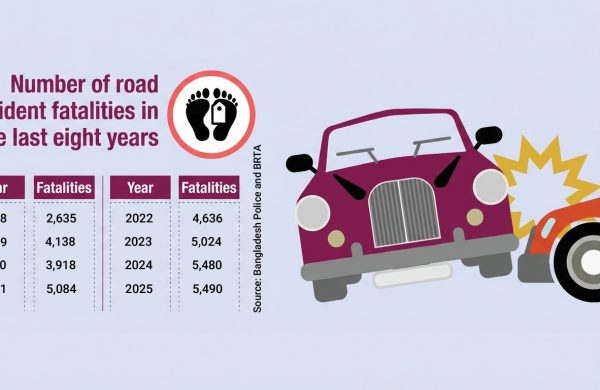
Road accidents claimed 5,490 lives across Bangladesh in 2025. The figure, released by the country’s top transport regulator Bangladesh Road Transport Authority (BRTA), is the highest annual death toll from road accidents on record. The grim milestone was reached under the interim government that took office after the 2024 July Uprising — an upheaval analysts trace to the 2018 Road Safety Movement. They argue the current administration inherited a rare chance to reform the chaotic transport sector but failed to act; disorder on the roads has instead worsened.
BRTA data show 2,635 people died on the roads in 2018, the year of the movement for road safety. Eight years on, the toll has more than doubled. After the 2018 protests, the then–Awami League government, later removed from office, enacted a safe road law and set up a task force. The law was never effectively enforced. The same government later amended the legislation, cutting fines and penalties and making two previously non–bailable sections bailable. Most task force recommendations were never implemented. With no meaningful reform of the transport sector, deaths continued to rise: 4,138 in 2019, 3,918 in 2020, 5,084 in 2021, 4,636 in 2022, 5,024 in 2023, and 5,480 in 2024.
The 2018 Road Safety Movement was led mainly by school and college students. By 2024, many were studying for undergraduate or postgraduate degrees. Their leadership played a key role in building the anti–discrimination student movement in July 2024 that brought down the Sheikh Hasina–led Awami League government and later led to an interim administration visibly shaped by students’ influence. Many July movement leaders and activists first entered politics during the movement for safe roads in 2018. Even so, experts say the interim government has delivered no visible improvement in terms of road safety.
National Citizen Party (NCP) Senior Joint Convener Samantha Sharmin was a student at the University of Dhaka during the 2018 quota reform movement. She also played an active role in the Road Safety Movement launched by school and college students soon after. Eight years later, she sees the more than doubling of road deaths as a failure of the political system.
Asked about the issue, Samantha Sharmin told journalists, “Many of the 2018 Road Safety Movement’s demands focused on improving road infrastructure. At the time, students didn’t fully grasp the deeper systemic failures behind road safety, though what they achieved was significant. Subsequent authorities failed to meet even those demands. This stands as a historic failure for Bangladesh. It’s a failure of our political system.”
She added, “We want roads that serve people, not kill them. Transport owners are the main obstacle; the government and the ministry simply follow their lead. They keep alive a system defined by mismanagement and disorder, which ultimately leads to deaths on the roads. Nearly five and a half thousand deaths in a single year is a number we must confront. If politics remains dysfunctional, this problem will never be resolved.”
Former director of Bangladesh University of Engineering and Technology’s (BUET) Accident Research Institute, Professor Dr Hadiuzzaman, said reform of the transport sector was critically urgent. A major overhaul was needed. Instead, he said, the period has seen an increase in unscientific vehicles such as battery–powered rickshaws.
“All the ingredients of accidents and disorder in the transport sector remain unchanged, including unskilled drivers and unfit vehicles. Responsibility lies not only with the interim government, but also with public and private stakeholders and political actors in the transport sector, who have failed to extend the necessary cooperation. This disorder in the transport sector will pose a major challenge for the next government,” Dr Hadiuzzaman added.
Saying the administration had failed to put in place even the minimum policies and groundwork for reforming the transport sector, he added, “The culture of weak accountability and transparency seen under previous governments remains unchanged. Those responsible must be held to account. That didn’t happen before, and it’s not happening now. Then how will change ever come?”
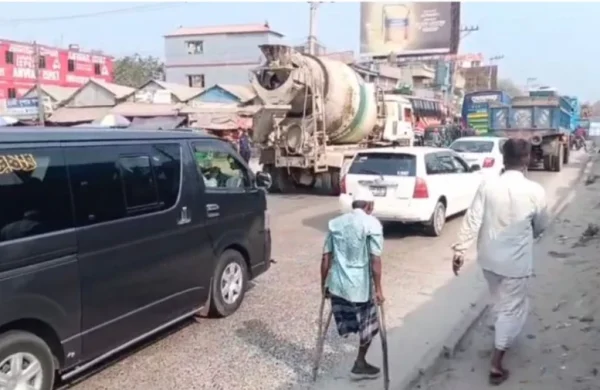
More than 75,000 buses and trucks operating on the country’s roads have exceeded their economic lifespan. These ageing vehicles are a major cause of accidents and disorder, and their dilapidated condition also contributes significantly to environmental pollution. After taking office, the interim government’s adviser to the road transport and bridges ministry, Muhammad Fouzul Kabir Khan, moved to remove these end–of–life vehicles from the roads. He announced a six-month grace period for owners to withdraw them — a deadline that has since passed and those vehicles continue to operate unchecked.
The volunteer group Road Safety Foundation has recently identified 13 main causes of road accidents in the country. These include defective vehicles, reckless speeding, overloading, driver incompetence and illness, undefined pay and working hours for drivers, poor road infrastructure, slow–moving vehicles on highways, reckless motorcycle riding by youths, public ignorance of and disregard for traffic laws, weak traffic management, limited BRTA capacity and accountability, feeble law enforcement, and extortion in the public transport sector.
Analysts say the interim government has so far taken no visible action to address these systemic road safety problems. Asked what steps had been taken to reduce accidents, adviser Muhammad Fouzul Kabir Khan declined to comment. When journalists contacted him yesterday, he suggested speaking to the BRTA.
Despite the rising death toll, the government is working to curb accidents and restore order on the roads, according to Sheik Moinuddin, the chief adviser’s special assistant for the road transport ministry. He told journalists, “The government has taken a number of steps to reduce accidents and bring order to the country’s road transport sector. The benefits of these measures are expected to become visible over the coming months.”
Outlining the measures, he said, “A major World Bank–funded road safety project is underway. Separately, a mandatory 60–hour driver training programme has begun through the BRTA. We have tested the eyesight of 1,000 drivers and provided glasses. This initiative is ongoing. The driving licence issuance process and specific tests have been reformed with new regulations imposed. Public awareness campaigns on accident prevention have also been stepped up.”
He added, “We planned to set up one or two specialised units within the roads and highways department to examine whether accidents were caused by infrastructure failures. Due to time constraints, we may not be able to complete this work. We hope the next government will implement it. Separately, we are planning to install GPS trackers in vehicles. These trackers will make it possible to control vehicle movement to a significant extent.”






Editor & Publisher: Golam Mostafa Jibon
News & Commercial Office:
Railgate, Sirajganj & 2 R. K Mission Road, Dhaka.
Hotline: 01715-319996, 01558-314179
E-mail : [email protected]