

Bangladesh still lags in global mobile internet speed rankings
- Update Time : Tuesday, December 30, 2025
TDS Desk:
Bangladesh, with over 110 million mobile internet users, ranked near the bottom globally in speed and quality. Despite relatively better connectivity in Dhaka and other major cities, slow speeds cripple networks across upazilas, unions, and hilly terrains, widening a stark urban-rural digital divide. Telecom operators cite inadequate spectrum allocation, infrastructure constraints, chronic subscriber overload, and underinvestment as core culprits behind sluggish mobile services.
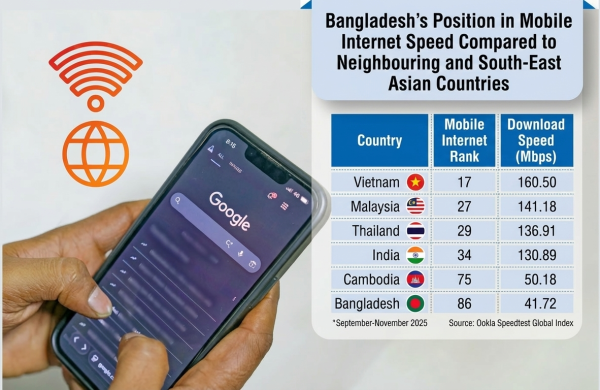
Ookla’s Speedtest Global Index put the country at 86th globally for mobile internet speeds during September–November this year, though average download speed remained modest at just 41.72 Mbps. A year earlier, the country was in 88th position. Download speeds during that 2024 window averaged 28.26 Mbps — an increase of 13.46 Mbps over the past twelve months. Upload speeds, by contrast, inched up merely 3 Mbps: rising from 10.98 Mbps in 2024 to 14.39 Mbps this year.
Latency — the time taken for user-sent data to reach a destination server and return — worsened to 25 ms this September–November, up from 23 ms a year earlier. Higher latency inherently delays data exchanges.
In broadband connectivity, Bangladesh held steady at 99th place globally for the same period, matching its 2024 ranking. Download speeds jumped from 48.91 Mbps to 63.48 Mbps year-on-year; upload speeds rose from 47.84 Mbps to 58.06 Mbps. Latency remained unchanged at 5 milliseconds across both years.
The United Arab Emirates dominated global mobile speeds for September–November, recording download rates of 672.68 Mbps and uploads of 41.50 Mbps. Singapore led broadband performance with downloads of 407 Mbps and uploads of 322.41 Mbps.
India and other Southeast Asian neighbours outpace Bangladesh on mobile networks. India ranked 34th during the same period. This marks a sharp drop from its 25th-place ranking last year. Its mobile network speed was recorded at 130.89 Mbps for download and 11.18 Mbps for uploads. Broadband internet speeds tell a different story: India trails Bangladesh, ranking 101st against Bangladesh’s 99th position.
Vietnam, Thailand, Malaysia, and Taiwan all recorded superior mobile speeds to Bangladesh. Vietnam, ranked 17th globally, notched downloads of 160.50 Mbps and uploads of 32.55 Mbps. Thailand achieved 136.91 Mbps downloads and 25.13 Mbps uploads; Malaysia managed 141.18 Mbps and 22.53 Mbps, respectively. Sri Lanka and Pakistan lagged behind Bangladesh, with download speeds of 38.55 Mbps and 24.79 Mbps.
Vietnam ranked 11th globally for broadband, with download speeds of 273.64 Mbps and upload speeds of 245.66 Mbps. Thailand recorded 275.26 Mbps downloads and 231.98 Mbps uploads. Malaysia followed with downloads of 162.39 Mbps and uploads of 65.41 Mbps.
Telecom sector insiders attribute Bangladesh’s sluggish mobile internet speeds to acute spectrum shortages, constrained network infrastructure, overwhelming subscriber density, and chronic underinvestment. Amid stagnant investment, many operators are awaiting policy clarity from the incoming government before committing fresh capital.
Technology experts note that 4G and 5G services still fail to reach most areas comprehensively. As 3G remains widely active, many users are forced onto this legacy network. But high-speed connectivity has become non-negotiable for video conferencing, software-based work, and particularly freelancing — areas where experts urge the government to spearhead action.
Although mobile internet speeds in other South Asian nations surpass Bangladesh’s, their user bases remain significantly smaller. Dhaka’s connectivity fares relatively better than in upazila towns, union parishads, and the hill tracts where speeds are significantly lower. Operators have installed towers across the country through public and private initiatives. Despite their efforts, 4G and 5G coverage lags severely.
Paradoxically, operators continue raising prices despite poor performance. BTRC sources confirm Grameenphone, Robi, Banglalink, and Teletalk have hiked tariffs by 10 to 50 percent across various packages over the past 18 months.
Mohammad Aminul Hakim, chairman of the Bangladesh Internet Governance Forum and CEO of Amber IT Limited, has decades of broadband experience. Speaking to journalists, he said, “Given citizens’ reliance on both mobile and broadband internet, two distinct policy frameworks are essential. The government still mandates operators to maintain 5–10 Mbps broadband packages. These must accelerate to 20 Mbps as stipulated in the national broadband policy. Operators will comply once authorities set clear capacity benchmarks. For mobile networks, the government could mandate nationwide minimum 4G coverage and guarantee 5G in divisional and district hubs.”
Banglalink and Grameenphone did not respond when contacted. Meanwhile, Robi Axiata declined to comment.
Lt Col (retd) Mohammad Zulfikar, secretary general of the Association of Mobile Telecom Operators of Bangladesh, acknowledges steady progress in mobile speeds. He told journalists, “Despite bearing high spectrum costs, restrictive tower regulations, and crippling taxation eroding profits, operators consistently deliver average speeds near 42 Mbps. This definitely needs recognition. Our upward trajectory continues. We’ve climbed Ookla’s global index and remain confident this progress will endure. Yet should the government roll back excessive levies to reasonable levels, operators would be inspired to enhance service quality through deeper investment.”
On state interventions to boost speeds, Brig Gen Shafiqul Azam Parvez, BTRC’s director general of engineering and operations, told journalists, “We’re finalising new network policies with operators to reduce internet bandwidth costs. Existing 3G, 4G, and 5G networks show positive momentum. We rigorously investigate user complaints. Furthermore, we’re introducing 700 MHz band spectrum to enable operators to provide high-speed, high-quality connectivity.”











Editor & Publisher: Golam Mostafa Jibon
News & Commercial Office:
Railgate, Sirajganj & 2 R. K Mission Road, Dhaka.
Hotline: 01715-319996, 01558-314179
E-mail : [email protected]