

Bangladeshis lured to Nepal, tortured and extorted on Europe trafficking route
- Update Time : Sunday, January 11, 2026

TDS Desk:
Nepal has emerged as a new transit route for illegal human trafficking to several European countries. Over the past year, incidents have been reported in which Bangladeshis were taken to Nepal on the promise of being sent to Europe, only to be subjected to torture and extortion for ransom.
On 1 December, the National Security Intelligence (NSI) sent a special report on human trafficking in Nepal to the senior secretary of the home ministry. The report details how the Nepal route is being used for trafficking.
The report stated that an active human trafficking network involving local and foreign brokers has recently developed using the Nepal route. The network primarily targets young Bangladeshi citizens aged between 18 and 35, trafficking them illegally to various countries in Europe and North America.
Nepal is one of the countries where Bangladeshis can obtain visas on arrival, and traffickers are exploiting this facility by using Nepal as a transit point.
Initially, the brokers lure Bangladeshi citizens with promises of a better life in Europe or North America and instruct them to travel to Nepal on visit visas. From there, the network deceives victims with fake visas of the destination countries, detains them, and extorts large sums of money from their families.
On 4 November, based on NSI intelligence, immigration police detained five Bangladeshi nationals carrying fake Belgian visas obtained from Nepal. Earlier, on 30 October, three Bangladeshis from Sylhet were taken to Nepal by a broker network after being promised a better life in Canada. They were detained there, and their families were demanded to pay large sums as ransom. The report notes that such trafficking incidents using Nepal as a transit route are having an adverse impact on Bangladesh’s labour market.
THREE TRAFFICKING ROUTES
Using both air and land routes, active broker networks are using three routes for trafficking people to Europe via Nepal, according to the report.
By air, the routes used by brokers include: Bangladesh (Dhaka)–Nepal (Kathmandu)–China (Hong Kong)–North America (Canada); Bangladesh (Dhaka)–Nepal (Kathmandu)–Italy (Rome)–Europe (Belgium); and Bangladesh (Dhaka)–India–Nepal (Kathmandu).
By land, brokers also take victims to Nepal using road routes, including: Dhaka/Khulna–Benapole/Bhomra–India and (Petrapole/Kolkata/Siliguri)–Kakarbhitta–Kathmandu.
WHY NEPAL HAS BECOME A NEW TRAFFICKING ROUTE
The report cites several reasons for Nepal being chosen as a new trafficking route. These include easy access through visa-on-arrival facilities for Bangladeshi citizens, the absence of complex visa verification and strict security screening, Nepal’s geopolitical location with easy land and air connectivity via India, and a lack of adequate information-sharing and monitoring between the immigration authorities of Bangladesh and Nepal.
VICTIMS AND BROKERS
The report identifies several Bangladeshi victims who were trafficked using the Nepal route, including Shahriar Rahman of Golapganj, Sylhet; Md Hafiz Uddin of Moglabazar, Sylhet; MA Manna of South Surma; Mahbub Hossain of Jajira, Shariatpur; Monir Hossain of Lalmai, Cumilla; Shah Paran Al Shamim of Lalmai; Sojon Mahmud of Sharsha, Jashore; Ohidur Rahman of Lalmai, Cumilla; and Jahirul Islam of Shariatpur.
It also names several brokers, including Sajharul Haque Mukul of Asha International Travel; Md Al Amin of Matlab North, Chandpur; Suman Ahmed of Hajiganj, Chandpur; Md Alamgir Hossain of Nangalkot, Cumilla; Malaysia expatriate ABM Nazrul of Noakhali; Md Aynal of Jajira, Shariatpur; Md Gias Uddin of Dhaka; British citizen Mizanur Amin of Sylhet; Md Shamim of Sylhet; Md Shoaib of Mirabazar, Sylhet; and Md Milon of Naria, Shariatpur.
The report details the case of three young men from Sylhet who were taken to Nepal after being promised safe passage to Canada. Upon arrival, their passports and mobile phones were seized, and they were detained and tortured at Hotel Delta Inn in Kalanki-14, Kathmandu.
The traffickers initially demanded Tk5 lakh from their families, later increasing the demand by another Tk12 lakh. After one broker was arrested in Bangladesh, the Nepali traffickers abandoned the victims at an unknown airport in Nepal. With coordinated efforts by BRAC and the Nepali authorities, the victims were eventually brought back to Bangladesh.
FAKE BELGIAN VISAS
Five Bangladeshi nationals were detained at Hazrat Shahjalal International Airport on 4 November while carrying fake Belgian visas. During interrogation, it emerged that they had paid between Tk17–18 lakh each after being promised jobs in Belgium via Italy. They had travelled to Nepal on 10 September and stayed near the Belgian consulate in Kathmandu, where a Nepali broker provided them with forged visas reportedly produced at computer shops in Thamel. Despite being victims themselves, one of them was found to have links to further visa and passport transactions involving other aspirant migrants.
Another case involved a man from Shariatpur who was promised work in Serbia via Nepal. After reaching Nepal, his family was falsely informed that he had reached Serbia and was asked to pay Tk35 lakh. The victim later escaped with the help of Nepal’s tourist police and returned to Bangladesh.
RECOMMENDATIONS MADE IN THE REPORT
The report recommends transferring Nepal-centric trafficking cases to the CID’s serious crime investigation division, informing relevant foreign missions through the foreign ministry, and investigating financial transactions of the accused through the BFIU.
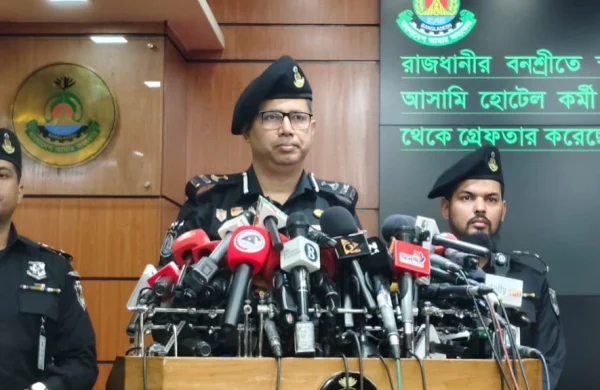
CID additional superintendent of police Mostafizur Rahman told journalists that three people, including a broker, have been arrested in Bangladesh in connection with a case involving torture in Nepal for ransom. He said the investigation is ongoing and that the involvement of foreign brokers is also being examined.
BRAC Migration Programme associate director Shariful Islam Hasan said attempts to traffic people to Europe via Nepal have been ongoing for nearly a year. He warned that Nepal is not a legitimate transit country for Europe and urged people not to fall for such offers, noting that easy visas and low airfare are key reasons traffickers exploit the Nepal route.







Editor & Publisher: Golam Mostafa Jibon
News & Commercial Office:
Railgate, Sirajganj & 2 R. K Mission Road, Dhaka.
Hotline: 01715-319996, 01558-314179
E-mail : [email protected]