

BNP vows to walk Khaleda’s path
- Update Time : Wednesday, December 31, 2025

TDS Desk:
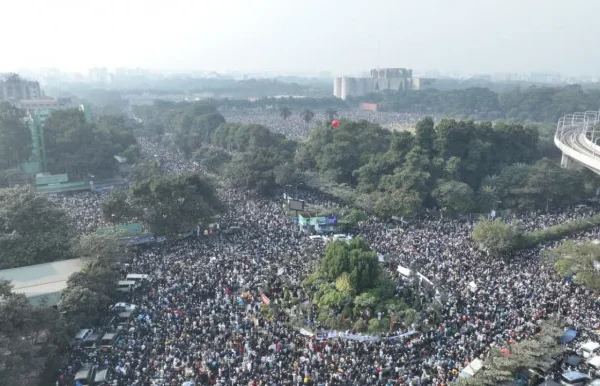
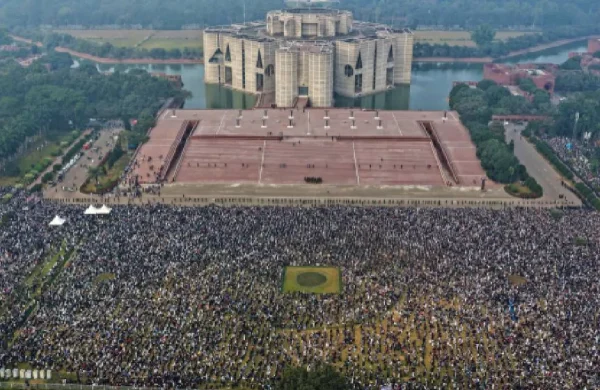
Millions stood shoulder to shoulder beneath an open winter sky as Bangladesh bid farewell to Khaleda Zia — a leader whose political life was defined by defiance, endurance and unyielding belief in democracy.
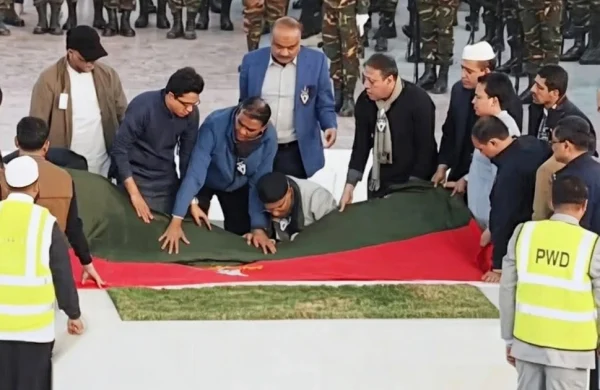
Moments before her funeral prayers, the Bangladesh Nationalist Party (BNP) pledged to walk the path she had carved through decades of confrontation with authoritarian power.
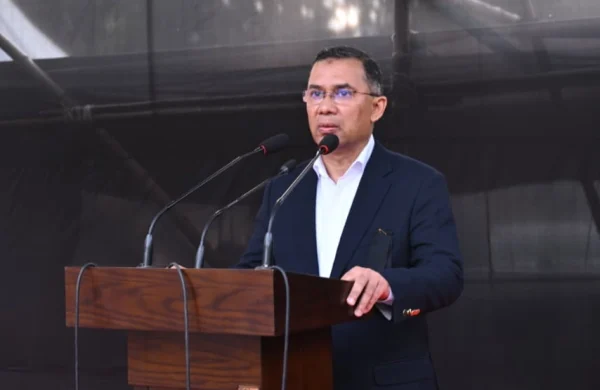
Just before the Janaza at the South Plaza of parliament, BNP Standing Committee member Nazrul Islam Khan read out a detailed account of Khaleda’s political life, her battles for democracy, and the persecution she faced under successive authoritarian regimes, from military ruler Hussain Muhammad Ershad to the governments led by Sheikh Hasina.
Recalling her imprisonment in 2018 and her release more than two years later in a frail condition, Khan said Khaleda became “severely ill” after being confined in what he described as a dark prison without proper medical care.
Recalling her imprisonment in 2018 and her release more than two years later in a frail condition, Khan said Khaleda became “severely ill” after being confined in what he described as a dark prison without proper medical care.
“The whole nation witnessed that she walked into prison on her own feet, but came out of solitary confinement gravely ill,” he said. He blamed what he called Hasina’s “personal vendetta” for denying Khaleda adequate treatment at home and abroad during her four years of confinement, arguing that doctors later concluded this refusal had worsened her condition and ultimately led to her death.
“Therefore, ‘fascist’ Hasina will never be absolved of responsibility for this death,” he said.
Bidding farewell to the party leader, Khan said Khaleda was departing with the love, respect and prayers of people across political divides.
“She leaves behind the legacy of a great woman, a relentless politician and a patriotic stateswoman — an exemplary life that will remain a guiding light for future generations of political activists,” he said.
He recalled Khaleda’s oft-quoted words: “I have no address outside this country. Bangladesh is my only address; this land and its people are everything to me.” She breathed her last on the soil she loved, he said, and would now rest beside her martyred husband.
Khan concluded by saying the BNP would move forward under the leadership of Tarique Rahman, keeping the same goals before them — democracy, peace, development and prosperity for the people.
Referring to Khaleda Zia as the “Mother of Democracy” and an “uncompromising national leader”, he said she passed away at 6am on Dec 30, 2025. Prayers were offered for the salvation of her soul.
He described the wave of grief that followed the news of her death, saying Bangladeshis at home and abroad were overwhelmed with sorrow as messages of condolence and prayers flooded mainstream and social media, while heartfelt tributes poured in from the global political community.
FROM FLOWER-LOVING HOMEMAKER TO POLITICS
Khan traced Khaleda’s early life, saying she was known from childhood for her neatness and her deep love for flowers.
“That fondness stayed with her throughout her personal and political life,” he said. “Perhaps that is why even in the hardest times her political speeches were marked by grace.”
He recalled her marriage on August 5, 1960, to then-Army officer Captain Ziaur Rahman. Of their two sons, the elder, Tarique Rahman, is now the BNP’s acting chairman. The younger, Arafat Rahman Koko, died in Malaysia on Jan 24, 2015 at the age of 45, which Khan described as the result of political persecution and lack of treatment. When Koko’s body was brought back to Dhaka, Khaleda herself was confined at her Gulshan office, he said.
Khan said Khaleda Zia’s entry into politics was sudden but unavoidable in the national interest. After Ziaur Rahman was assassinated on May 30, 1981 by a group of renegade Army officers, conspirators became active within the party and government, weakening both.
To keep up morale among party leaders and workers, Khaleda formally joined the BNP on Jan 3, 1982, he said.
“That marked the beginning of her tireless political journey,” he said, noting that over the next 43 years she led the party for 41 years, serving successively as vice-chairperson, acting chairperson and elected chairperson, strengthening the BNP organisationally.
NEVER DEFEATED
After nine years of relentless struggle against HM Ershad’s autocratic rule, Khaleda led the BNP back to power through what he described as a free, fair and neutral election in 1991.
“She never bowed before any foreign or domestic force, nor did any lure, conspiracy, or threat force her into compromise,” he said.
Khan highlighted initiatives taken during her governments, quoting her famous line: “We have friends abroad, not masters.” He said her development programmes earned Bangladesh recognition as an emerging tiger economy.
He noted that Khaleda was elected prime minister three times, winning every constituency she contested — five seats in several elections and three seats in 2008 — calling such popularity rare not only in Bangladesh but globally. She was Bangladesh’s first woman prime minister and the second in the Muslim world.
‘PERSONAL ENMITY’
Khan said Khaleda’s popularity, organisational strength and refusal to compromise led her rivals to treat her as a “personal enemy”, resulting in repeated imprisonment under Ershad, Hasina and even during the so-called 1/11 regime.
He accused Hasina of evicting Khaleda from her martyred husband’s home and sentencing her to 17 years in prison on false charges out of sheer vengeance.
“Yet she never compromised with authoritarian politics, freedom of expression or the right to vote,” he said, describing her as an enduring inspiration against “fascist rule”.
Contrasting their fates, he said Khaleda had been cleared of all charges and was now being honoured by millions, while those who jailed and persecuted her had fled or faced severe consequences.
Khan also recalled that during the 1971 Liberation War, Khaleda and her two young sons were held captive by Pakistani forces from Jul 2 until victory, while her husband declared independence and served as a sector and forces commander.
“The contribution of this family to the Liberation War stands as a unique example,” he said.




Editor & Publisher: Golam Mostafa Jibon
News & Commercial Office:
Railgate, Sirajganj & 2 R. K Mission Road, Dhaka.
Hotline: 01715-319996, 01558-314179
E-mail : [email protected]