

Didn’t make any statement on probe into police killings during July uprising: Salahuddin
- Update Time : Sunday, March 1, 2026
TDS Desk:
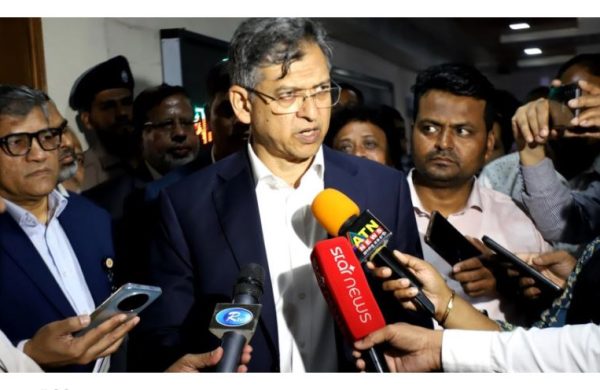
Home Minister Salahuddin Ahmed today said he has so far made no remarks about the investigation into the killing of police officers during the July mass uprising.
He was responding to a journalist’s question about comments attributed to BNP Secretary General and Local Government Minister Mirza Fakhrul Islam Alamgir, who reportedly said action would be taken in line with the home minister’s position on the deaths.
“Did the home minister say anything on this? I do not know why the secretary general gave such an explanation,” Salahuddin said. “I have not made any statement on this issue.”
He also referred to a “protection ordinance” [July Mass Uprising (Protection and Liability Determination) Ordinance, 2026] issued toward the end of the interim government, saying it stemmed from a clause in the July National Charter pledge agreed to by all political parties.
According to the home minister, the pledge included a commitment to provide legal and constitutional protection to those who led and participated in the July uprising.
Speaking during the briefing, Salahuddin said the government will crack down on extortion networks and “top criminals” following a brazen, heavy-weapon attack on a businessman’s home in Chattogram.
He said suspects have been identified and intelligence agencies were working on the case, but declined to disclose operational details.
“I cannot disclose the plan at this stage, but we will spare no effort to bring them to justice,” he said.
The remarks came after armed assailants opened fire on a businessman’s residence yesterday morning, allegedly after failing to extort Tk 5 crore from him.
The minister said the same group had demanded money from this businessman about two months earlier. Police had provided security at the time, including guards at the residence, he added, suggesting the attackers may have returned after failing in their initial attempt.
Responding to allegations that extortion was being carried out in the name of the Bangladesh Nationalist Party (BNP), he said those responsible must be identified and dealt with under the law.
‘Law and order improved’
The minister defended the government’s efforts on security, saying the situation has improved compared to the period before the election.
He argued that the establishment of a political government had brought “stability, reassurance, and a sense of security” among the public. While acknowledging that serious crimes are still occurring, he said authorities have been instructed to arrest offenders within 24 to 48 hours of major incidents.
Law enforcement agencies, he said, would conduct swift investigations, file charge sheets within the legal timeframe, and seek exemplary punishment through the courts to deter future crimes.
Armed forces deployment
Salahuddin said the armed forces remain deployed in the field with magistracy powers, even though the original instruction — to assist civil authorities until 15 days after the election — has expired.
He said the decision on withdrawal would be taken “at the highest level” and acknowledged that the military itself did not wish to remain deployed indefinitely because of disruptions to training and other duties.
“They would need to be withdrawn from field duties at some point,” he said.
Ordinances and Rab future
On governance issues, the home minister noted that 133 ordinances issued during the previous interim administration would be placed before the parliament at the start of its next session. Lawmakers would decide whether to adopt, amend, or allow them to lapse.
He also addressed the future of the Rapid Action Battalion (Rab), whose name and uniform were decided to be changed during the interim regime. Salahuddin said public opinion and recommendations in the July National Charter called for decisions on whether to abolish or rename the force.
He said any move would require political consensus and consideration of whether Bangladesh still needs a specialised law enforcement unit, as well as how to ensure accountability and transparency.
Firearms review and fire service gaps
Salahuddin said licensed firearms that were not surrendered as ordered have now become illegal, and the licences of their owners are liable to be cancelled.
He said district administrations have been asked to compile lists of firearm licences issued between 2009 and August 2024, investigate cases of non-compliance, and identify licences granted on political grounds or outside policy. A district-level committee — including senior civil, police, intelligence, and legal officials — will examine the cases and report to the ministry.
Salahuddin further said the government was assessing gaps in emergency services. Twenty-seven upazilas still lack fire service units, and plans are being considered to expand coverage.



Editor & Publisher: Golam Mostafa Jibon
News & Commercial Office:
Railgate, Sirajganj & 2 R. K Mission Road, Dhaka.
Hotline: 01715-319996, 01558-314179
E-mail : [email protected]