

Election-related violence: 144 incidents since schedule announcement, four political killings
- Update Time : Thursday, January 29, 2026
TDS Desk:
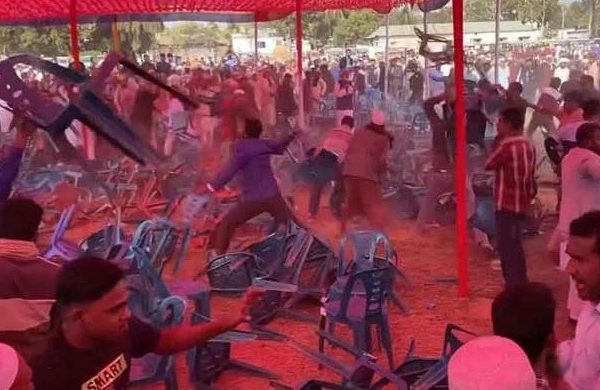
A Jamaat-e-Islami leader, Rezaul Karim, secretary of Sreebordi upazila unit, has been killed in a clash with BNP activists in Sherpur, triggered by a dispute over seating during a programme to read out election manifestos of candidates. The incident occurred on Tuesday afternoon at the Jhenaigati Upazila Mini Stadium, where the administration had organised a manifesto-reading event for candidates contesting the 13th parliamentary election in Sherpur-3 constituency. During the programme, activists of the BNP and Jamaat-e-Islami became embroiled in a clash. Rezaul Karim sustained a head injury and was rushed to Mymensingh Medical College Hospital, where he died around 10 pm.
Beyond the Sherpur incident, at least three other political killings have taken place since Chief Election Commissioner (CEC) AMM Nasir Uddin announced the election schedule in a televised address to the nation on December 11. Including these, in total, 144 incidents of election-related violence have been reported across 25 districts and various thanas in three metropolitan areas. Cumilla and Lakshmipur recorded the highest number of clashes, with four incidents each involving supporters of rival candidates. Crime analysts warn that failure to quickly identify and address violence-prone districts could push the law and order situation beyond control during the election period.
According to police headquarters data, between December 12 and January 26 — a span of 45 days — there were 144 incidents of election-related violence nationwide. Of these, 55 involved clashes between rival supporters. There were also 11 incidents of intimidation and aggressive behaviour, six attacks on candidates, and two cases involving the use of illegal firearms. In addition, police recorded six cases of threats and intimidation, 17 incidents of obstruction to campaign activities, eight attacks involving vandalism or arson at election-related offices or institutions, 10 incidents of blockades or protests, one attack on minorities, and 24 other incidents.
Apart from the Sherpur killing, police headquarters confirmed three other political killings during the period. These include the murder of Inquilab Moncho convener Sharif Osman Hadi, who was shot by assailants on Box Culvert Road under Paltan thana in the capital on December 12 and later died while undergoing treatment in Singapore on December 18.
In addition, police reported the killing of JASAS leader Farid Sarkar in Sreepur, Gazipur, on December 24, and the murder of Md Nazrul Islam, a supporter of independent candidate Salman Omar Rubel, in Dhobaura upazila of Mymensingh on January 16.
Crime analyst and Associate Professor at the Institute of Social Welfare and Research, University of Dhaka, Dr Tawohidul Haque, believes that ensuring a free and fair electoral environment requires law enforcement agencies to identify violence-prone districts and take prompt action swiftly. Speaking to journalists, he said, “One of the main reasons behind election-related clashes and violence in our country is the lack of democratic distance between rival candidates. One candidate doesn’t view the other from a democratic perspective; instead, they believe that unless the rival is harassed or suppressed, victory cannot be ensured. Basically, conflict stems from such a mindset.”
A review of police data shows that clashes between rival supporters have been the highest in the Cumilla district. On January 19, vandalism and arson were reported at a local Jamaat-e-Islami office and at the homes of its supporters in the Shameshpur and Telipukur areas under the Chauddagram thana. Following the incident, BNP and Jamaat supporters engaged in chases and counter-chases at Shubhapur and Munshirhat bazaars. The situation escalated further on January 20 in Wazirpur, also under Chauddagram thana, where Jamaat-e-Islami leaders and activists made provocative remarks against the BNP during a courtyard meeting. This led to clashes between BNP and Jamaat supporters, during which several chairs and the front windscreen of a vehicle were vandalised, and a motorcycle was set on fire. Three to four people were injured in the incident. Two days later, on January 22, another clash broke out between two factions of the BNP under the old bus stand overbridge area in Homna upazila of Cumilla. At least 10 people from both sides were injured as supporters attacked the convoy of independent candidate Engineer MA Matin, as well as the counter-chases from the MA Matin side. The army later intervened to bring the situation under control, arresting three people from the scene. Most recently, on January 25, further clashes were reported in Cumilla Sadar over election campaigning.
After Cumilla, Lakshmipur recorded the second-highest number of clashes between rival supporters. On January 15, BNP activists obstructed several Jamaat-e-Islami women activists in the Syedpur Bottola area of Charshahi union under Chandraganj thana, after receiving reports that they were distributing chocolates door to door and collecting photos of women’s national identity cards along with bKash or Nagad numbers. When local Jamaat supporters arrived at the scene, an altercation ensued, escalating into clashes that left four to five BNP activists and one Jamaat supporter injured. The following day, Jamaat and BNP activists clashed again in the same union. Later, on January 22, Jamaat-e-Islami and Islami Chhatra Shibir activists were attacked by BNP workers while distributing leaflets in the Refugee Market area under Lakshmipur Sadar thana, leaving one activist from each side injured. The latest incident occurred on January 25 in Chandraganj, Lakshmipur, when BNP supporters allegedly obstructed Jamaat-e-Islami supporters during election campaigning, leading to a physical altercation. Jamaat supporter Tarek Islam was injured in the clash and received treatment at Lakshmipur Sadar Hospital.
Clashes between rival supporters have been reported in 25 districts and three metropolitan areas, including Cumilla, Lakshmipur, and Sherpur. Among them, incidents occurred in Santhia and Chatmohar upazilas of Pabna; Nondigram, Dhunot, and Shibganj thanas in Bogura; Tangail Sadar, Basail, and Gopalpur in Tangail; Pakundia, Austagram, and Sadar in Kishoreganj; Kotowali and Bhanga in Faridpur; Patgram and Hatibandha in Lalmonirhat; and Mirpur Model and Khilkhet thanas under the Dhaka Metropolitan area. Clashes were also reported in Tongibari and Padma Bridge (North) thanas in Munshiganj; Ullapara in Sirajganj; Bauphal and Galachipa in Patuakhali; Gafargaon and Bhaluka in Mymensingh; and Patenga and Bandar thanas under the Chattogram Metropolitan area. Outside these, rival supporters were involved in clashes in Niamatpur and Raninagar in Naogaon; Alamdanga and Sadar in Chuadanga; Shibganj and Sadar in Chapainawabganj; Kendua in Netrokona; Companiganj in Noakhali; Shah Makhdum thana in Rajshahi Metropolitan area; Hajiganj in Chandpur; Companiganj in Sylhet; Muladi in Barishal; Saghata in Gaibandha; Meherpur Sadar; Chhagalnaiya in Feni; Palong in Shariatpur; and Sarail in Brahmanbaria.
Noting that very little time remains before the election, crime analyst Dr Tawohidul Haque said law enforcement agencies must identify districts where clashes are occurring most frequently and take decisive measures. “The steps taken by political parties to restrain their activists are usually limited to issuing show-cause notices, which is a weak measure. In this situation, law enforcement agencies must play a stronger role. Statements or show-cause notices alone cannot control such violence. The only solution is the strict enforcement of the law, which must be applied equally to all. If the Election Commission takes firm action in one or two constituencies where such clashes are frequent, many will refrain from engaging in these activities,” he said.
Meanwhile, Assistant Inspector General (Media and Public Relations) of Police Headquarters, AHM Shahadat Hossain, said law enforcement agencies are working on the ground to ensure equal campaigning rights for all candidates. Speaking to journalists, he said, “Ahead of the 13th national parliamentary election, some isolated incidents of conflict and clashes are taking place. Those involved are being identified and brought under legal action. At the same time, law enforcement agencies are working in the field to ensure equal opportunities for all candidates in election campaigning. Anyone attempting to exert undue influence is being identified and dealt with accordingly. Overall, the police are carrying out their duties with full professionalism to ensure a free and fair election.”







Editor & Publisher: Golam Mostafa Jibon
News & Commercial Office:
Railgate, Sirajganj & 2 R. K Mission Road, Dhaka.
Hotline: 01715-319996, 01558-314179
E-mail : [email protected]