

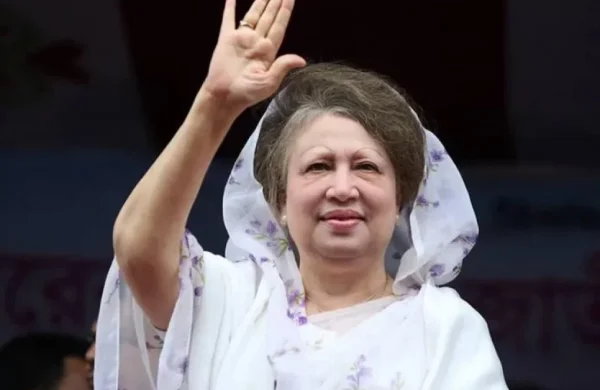
From housewife to first female PM of Bangladesh: BNP commemorates Khaleda Zia’s life
- Update Time : Tuesday, December 30, 2025
TDS Desk:
Khaleda Zia’s political career, which took her from years of private family life into the centre of Bangladesh’s power struggles, is being recalled by her party as a defining chapter in the country’s modern political history, following her death on Tuesday (30 December).
BNP has issued a statement commemorating the life and political career of its chairperson, Khaleda Zia, tracing her journey from a life outside politics to becoming Bangladesh’s first female prime minister, serving a total of 10 years in office over two terms between 1991-1996 and 2001-2006.
Dubbing her the first female freedom fighter, the party notes that she was also the second woman to become prime minister in the Muslim world.
The party highlights key milestones of her personal life, political rise and time in office, referring to her role in the BNP’s development, mass movements against the military rule of HM Ershad, and her two terms as head of government.
According to the BNP, Khaleda Zia was born as Khaleda Khanam on 15 August 1946, in Jalpaiguri, to Iskandar Majumdar and Taiyaba Majumdar. Her nickname was Putul. She was the third among three sisters and two brothers.
Her early education began at Mission School in Dinajpur, followed by Dinajpur Girls’ School and later Surendranath College.
She was married in August 1960 to Ziaur Rahman, who later became chief of army staff and president of Bangladesh.
Ziaur Rahman played a key role during the Liberation War, when he served as a sector commander and led the Z Force, after proclaiming independence on 27 March 1971.
Khaleda Zia lived in West Pakistan with her husband from 1965 until March 1969, before returning to Dhaka.
During the Liberation War in 1971, she went into hiding and later stayed in Dhaka with relatives. On 2 July that year, she was detained by the Pakistani army along with her two sons and held at Dhaka Cantonment until 15 December 1971.
She was released on 16 December, the day Bangladesh achieved independence.
Khaleda Zia remained outside politics and lived as a housewife even when Ziaur Rahman was president.
After Ziaur Rahman was assassinated during an attempted coup on 30 May 1981, BNP leaders and activists urged her to join politics. She formally joined the BNP on 3 January 1982.
She opposed the military takeover by then army chief Lt Gen HM Ershad in March 1982. She became senior vice-chairperson of the BNP in March 1983 and was later elected unopposed as party chairperson on 10 May 1984.
According to the party, she led movements against Ershad’s rule through alliances with other opposition parties during the 1980s.
The BNP says after years of political agitation, parliamentary elections were held on 27 February 1991, in which the BNP won a majority. Khaleda Zia contested five seats in that election and won all of them, the statement says.
She was appointed prime minister on 19 March 1991. The BNP says her government restored the parliamentary system through constitutional amendments passed unanimously in parliament later that year.
The statement also refers to the 15 February 1996 parliamentary election, which was boycotted by opposition parties and resulted in a short-lived parliament.
Khaleda Zia resigned after the caretaker government system was introduced following protests, the BNP says.
In the 1996 election held later that year, the BNP became the main opposition party, and Khaleda Zia served as leader of the opposition.
The BNP-led four-party alliance returned to power after the 1 October 2001 election, with Khaleda Zia again becoming prime minister until 28 October 2006.
The alliance was defeated in the December 2008 election, and the party later boycotted the 5 January 2014 election.
Khaleda Zia was imprisoned on 8 February 2018, in what the BNP describes as politically motivated cases. She was released by an executive order on 6 August 2024.
The party says there are 20 cases against her, including five filed by the Anti-Corruption Commission, alongside other cases related to violence, sabotage, sedition and defamation.
In its concluding remarks, the BNP describes Khaleda Zia as an uncompromising leader in the struggle for democratic rights and said her political legacy would be carried forward by her son, BNP Acting Chairman Tarique Rahman.






Editor & Publisher: Golam Mostafa Jibon
News & Commercial Office:
Railgate, Sirajganj & 2 R. K Mission Road, Dhaka.
Hotline: 01715-319996, 01558-314179
E-mail : [email protected]