

FY2024–25: Imports from India see highest growth among top sources despite calls to cut reliance
- Update Time : Wednesday, January 14, 2026
TDS Desk:
Ousted by a student–led mass uprising, former Prime Minister Sheikh Hasina fled to India on August 5, 2024. An interim government was formed three days later. Its chief adviser, Dr. Muhammad Yunus, told the Press Trust of India that September “no one is comfortable with her (Hasina’s) stance there in India”. Subsequently, numerous officials of the new administration spoke of reducing dependency on India across various sectors. In December, the food adviser announced plans to import rice from Myanmar, Thailand, and Pakistan through government–to–government deals, alongside existing Indian supplies. That same month, the Bangladesh Trade and Tariff Commission revealed it was seeking alternative sources for potato and onion imports to cut reliance on India. The import of yarn from India through land ports was halted the following April. Furthermore, the National Board of Revenue (NBR) banned importing numerous other Indian goods including newsprint, powdered milk, bicycle and motor parts, ceramics, sanitaryware and tiles. Social media also saw calls to boycott Indian products in Bangladesh over various issues.
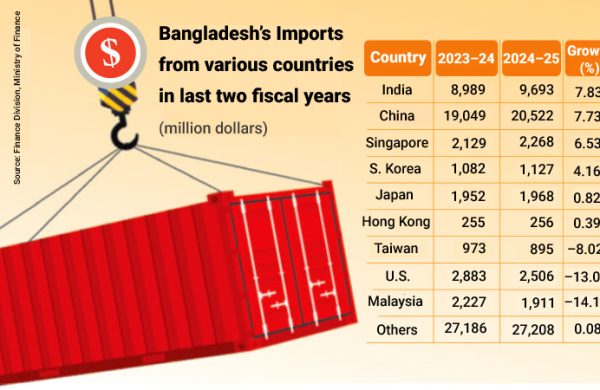
Despite these measures, imports from India during the 2024–25 fiscal year showed no sign of decline. Data from the Bangladesh Economic Review 2025, published by the Finance Division last December, reveals that import expenditure growth from India was actually the highest among Bangladesh’s top sourcing countries — recorded at 7.83 percent. Analysts say government procurement from India largely contributed to this increase.
India revoked transhipment facilities for Bangladesh to use Indian ports for third–country trade on April 9, 2025. Just days later, on April 15, Bangladesh’s NBR announced it would not allow importing swing yarn and some raw materials from India through land ports. The decision further strained commercial relations between the two neighbours. Most recently, there are discussions among policymakers and industry stakeholders to impose a safeguard duty on yarn imports from India to protect local manufacturing capacity.
Bangladesh imports vast quantities of goods annually to support its industrialisation, export–oriented production, and meet consumer demand. In value terms, China remains its largest import source with India the second–largest. The two countries together account for over 44 percent of total imports in Bangladesh.
The political shift in August 2024 and Hasina’s subsequent refuge in India led to a crisis of confidence in Dhaka–Delhi relations. A series of events including border tensions, hardened diplomatic rhetoric, restrictions on visa and consular services, and security issues such as push–ins followed.
In 2025, the bilateral strain spilled beyond diplomacy and politics into trade and economics — triggered by India’s withdrawal of transhipment facilities, restrictions on trade through land ports, and curbs on the export and import of raw jute and yarn.
The Bangladesh Economic Review 2025 reveals a 2.44 percent growth in the country’s total import expenditure for FY 2024–25 fiscal year. Imports solely from India, however, saw a far sharper rise of 7.83 percent.
According to the review’s country–specific data, China was the top import source by value that year, accounting for 30.02 percent of all imports in FY 2024–25. India and the United States held the second and third positions, with shares of 14.18 and 3.67 percent respectively.
Every major sector in Bangladesh — from ready–made garments, textiles, and power generation to construction and consumer markets — remains dependent on imported goods. Economists argue that building local industrial capacity and diversifying import sources now stand as critical challenges for reducing this reliance.
A detailed analysis of the Economic Review 2025 shows goods worth $8.98 billion were imported from India in FY 2023–24. This figure grew by 7.83 percent to $9.69 billion in FY 2024–25.
Bangladesh–India trade has expanded steadily over five decades. Imports from India, however, constitute about 85 percent of the total bilateral exchange. This fundamental dynamic has largely been unaffected by Bangladesh’s political shift following the 2024 uprising or the subsequent diplomatic friction. International trade analysts contend that the growth in trade, specifically import expenditure from India, has followed the inherent logic of the market economy.
“The economy moves on its own momentum,” Professor Mustafizur Rahman, distinguished fellow at the Centre for Policy Dialogue (CPD), told journalists. “Importers source from where consumers get lower prices. Exporters procure raw materials from where they can maintain competitive advantage. From this perspective, neighbouring countries often offer lower costs and shorter lead times. India is one such neighbouring country, and China certainly another. They are producing a wide range of goods with comparable quality and competitiveness with other countries. So products are being imported from those countries. This is the tendency of a market economy.”
Acknowledging that existing tensions periodically have an effect, Professor Rahman added, “Obstacles are created, non–tariff barriers are imposed. It can’t be said these measures have no effect. But it depends on whether the obstacles they create are greater than the differences in cost and time of importing from other countries. For example, yarn imports through the land port have now been halted. Yet imports by ship from India are still continuing. If tariffs were set at a much higher level, imports might become impossible. But as long as imports remain possible at a low cost despite these barriers, they continue, and that’s what we are seeing.”
Tensions began to rise along the border in September–October 2024. Bangladesh accused the Indian Border Security Force of constructing barbed–wire fences along the border and, in some areas, working beyond the demarcation line. The Border Guard Bangladesh lodged formal protests several times. Media reports emerged during the period alleging forcibly “pushing–in” people into Bangladesh from India.
By December 2024, diplomatic strains between the two countries became visibly pronounced. Dhaka expressed unease over Indian diplomatic activities in the capital, citing security concerns. A notable hardening of rhetoric was visible in official communication from both sides. Talks began later in the month regarding visa and consular services restrictions, sparking concern among ordinary citizens and business communities.
In a move in September 2024, the Bangladeshi government strictly enforced a ban on raw jute exports. Bangladesh argued it was necessary to ensure steady supply and price stability for its own mills and jute–based industries. This action created a supply shortfall for jute processing plants in India’s West Bengal and Tripura states. Indian trade bodies and industrial owners contended the decision taken against a backdrop of political friction was negatively impacting cross–border trade and exacerbating existing commercial tensions.
The issue was raised informally during bilateral trade talks in late 2024 and early 2025. Indian media reports stated that the continued export halt from Bangladesh had rendered the Indian jute industry dependent on imports, forcing it to source raw materials at higher costs from alternative markets. While Dhaka explained the policy as a measure to protect its domestic industry, Delhi viewed it as another sign of deteriorating bilateral trade climate.
In what many see as a direct economic response to the political tension, India revoked Bangladesh’s transhipment facility for sending goods to third countries in the first week of April 2025. The tension escalated further on April 15 when Bangladesh’s NBR announced an immediate halt to imports of swing yarn and certain raw materials from India via land ports. This decision instantly created supply chain pressure for the garment and textile sectors, and sharply intensified trade friction between the two neighbours.
India imposed countermeasures in late April and May 2025, restricting imports of several Bangladeshi goods including RMG, processed foods, plastic products, and furniture through land ports and directing they be routed through seaports instead. The move hit Bangladesh’s small and medium exporters and created a tangible crisis in bilateral trade.
May–June period in 2025 saw a significant drop in the volume of goods transported by rail and waterways between Bangladesh and India. Connectivity projects, long touted as hallmarks of successful relations, effectively came to a standstill. The stagnation was seen as a silent yet critical indicator of eroding commercial confidence.
Throughout the second half of 2025, India tightened customs clearance, quality checks, and non–tariff barriers for Bangladeshi goods. While tariffs were not increased directly, Dhaka viewed these procedural hurdles as a form of commercial pressure. Bangladesh then restricted visa and consular services for India in December last year, citing security concerns. By the start of January 2026, these visa and consular limitations had further complicated the bilateral relationship. Strains of this bilateral tension have now even extended to the sporting arena.
Since August 5, 2024, Bangladesh–India relations have progressively evolved from a crisis of political trust to border tensions, diplomatic rigidity, and finally to trade and economic friction. The issues have not remained confined to any single dispute but have evolved into a multi–layered contention, placing the relationship between the two countries in prolonged uncertainty.
Business leaders, however, note that the current strains are directly impacting traders of both countries. Abdul Wahed, joint general secretary of the India–Bangladesh Chamber of Commerce & Industry (IBCCCI), told journalists, “Exports have been affected, but import operations from India are currently running smoothly, albeit at reduced volumes. Additionally, for any imports, transportation costs are comparatively lower for us, which is why the impact hasn’t been too severe. Furthermore, although imports were halted last year, the government has now approved the import of rice and many other goods. We expect the situation to return to normal once the election takes place.”
While China remains the largest source of imports in terms of monetary value, the Economic Review 2025 shows import growth from the country last fiscal year was slightly lower than from India. Imports from China totalled $19.04 billion in FY 2023–24, rising 7.73 percent to $20.52 billion in 2024–25.
Following China and India, the United States was Bangladesh’s third–largest import source in the last fiscal year, though purchases from the U.S. fell 13.07 percent year–on–year to $2.5 billion in FY 2024–25, down from $2.88 billion the year prior. Imports from other major markets also declined: Malaysia by nearly 14.19 percent and Taiwan by 8.01 percent.
Diplomatic circles describe the Bangladesh–India relationship as complex and multi–layered. Former Ambassador M Humayun Kabir told journalists, “Our interdependence exists across many layers; the relationship is multidimensional.” He elaborated, “There is a political framework, a diplomatic framework, and an economic framework. There are also people–to–people ties. There is ongoing tension in the diplomatic and political framework; we are aware of that. The state of the political climate we are witnessing is reflected differently in the economic sphere. Despite tensions in the political and diplomatic environment, there is still engagement in the economy and among the people. This is why we are seeing growth in imports.”
When asked about the potential long–term consequences of sustained bilateral strain, the former ambassador stated, “If a political decision were taken to scale down relations with India, the opportunity for trade and commerce would vanish. We assume this exchange has not yet faced obstruction, despite some hurdles from the Indian side. However, if political relations remain poor, sooner or later it will inevitably cast a negative shadow over the economic relationship.”




Editor & Publisher: Golam Mostafa Jibon
News & Commercial Office:
Railgate, Sirajganj & 2 R. K Mission Road, Dhaka.
Hotline: 01715-319996, 01558-314179
E-mail : [email protected]