

Masud Rana turns 60, still going strong!
- Update Time : Tuesday, May 19, 2026
Towheed Feroze
Back in 1966, a year just after the brief and inconclusive Indo-Pak war, the literary scene of the then East Pakistan was rocked by a new kind of fictional protagonist — someone who was not the epitome of virtue and ideal but a person who often lived at the edge of morality.
Thus the first morally ambiguous Bangladeshi fictional hero was born.
He was styled after James Bond.
The guy loves whisky, does not shy away from taking a woman to bed, even if it’s only for a night, drives the car fast, enjoys life’s pleasures and is the envy of the staid lot.
While orthodox society with its pseudo puritanical norms was outraged at first; fathers reprimanded teenagers for showing interest in the character, although secretly harboured an admiration for the fellow.
Debonair, bon viveur and Bengali — Rana triggered a social storm!
Sixty years later, in the hearts of, if not millions but thousands, he still remains the Bangladeshi hero who can match any international superspy.
Masud Rana is his name and, this year, he turns sixty!
Sheba Prokashoni, the publishing house which brought out the Rana books written by Qazi Anwar Hussain, has reportedly suspended its operation in order to carry out an internal audit over allegations of financial aberrations but that has hardly impacted Rana’s cult status.
Hypothetically speaking, in a worse case scenario, even if Masud Rana books do not come out, the cachet of the fictional hero will remain and amplify.
Rana fans will never turn away from their hero who, in a time of socio-economic bleakness in post independent Bangladesh, provided the ultimate escapism.
From a World of Drudgery to a Realm Of Fantasy
The 1970s was a period in Bangladesh’s history marked by political upheavals, killings, natural disasters, food shortage and hardship.
In the first few years after liberation, there were seeds of misgivings among the people about the future and the general status of things, recalls Shahnoor Karim, a social observer who was a university student in the 70s.
Add to that the tug of war between socialist minded young and the capitalist supporting segment which only exacerbated a post war feeling of malaise, observed Shahnoor.
In such a volatile situation, people looked for an escape and Masud Rana was exactly that.
Rationed food was a reality, limited income a fact while luxury an alien term.
Amidst such a scenario, Rana was crossing continents, eating at the best restaurants, drinking premium alcohol and making nights spicy with beautiful women.
We lived a fantasy life through the pages of Rana, says Andrew Rozario, an avid Rana fan from the mid 70s.
Lazy afternoon moments were filled with excitement as we were whisked away in some far away land and, with Rana, became gleefully entangled in some grand adventure, reflected Andrew wistfully.
The appeal of Rana in post-independence Bangladesh, facing a plethora of challenges, is similar to the allure of James Bond in an austerity driven Britain of the post WW2 period.
Britain at that time faced similar social problems, ranging from food shortage to economic stagnation and a general feeling of disquiet.
Bond came as the saviour, allowing a disenchanted generation to quickly find solace in larger-than life adventures with outrageous but magnetic titles like: Octopussy, Goldfinger, You Only Live Twice, Moonraker, For our Eyes Only, On Her Majesty’s Secret Service etc.
The interesting thing is at the back of our minds, we knew Rana was not for real and the plots were mostly based on thrillers by Ian Fleming, Nick Carter, Alistair Mclean, Wilbur Smith, James Hadley Chase, Clive Cussler and so on but that realisation was set aside because in a time of socio-political unease, readers desperately needed to escape.
While many Rana books are adapted from Western thrillers, there are quite a few which are original stories.
One such book is “Pishach Dwip”, a horror thriller in which one Rana’s close aides plus romantic interest, a female agent called Sohana, is abducted by a vampire worshipper and locked in an island.
This book was adapted to a small screen telefilm in the early 90s, starring model Nobel and Bipasha Hayat.
With the usage of modern-day technology, this book should again be remade into a full-length film, set in an exotic island, feels Hassan Tareq, a collector of Rana’s original books.
To make a Masud Rana film, the film maker plus the producer need to read at least 10 books and get into the Rana philosophy, observes Hassan.
“And the most important part is the acting because just another model with a toned body cannot be Rana because the character needs to be portrayed properly.”
Hassan feels with three months training on martial arts, language and expressions, Shakib Khan can become the best Masud Rana.
Unfortunately, those who are making Rana films are choosing new actors who are diluting the cinematic appeal of the character, he lamented.
To create a bang on the big screen, a Masud Rana film must have a superstar and Shakib is that star, maintains Nilufer Rahman, a Rana reader from the early 80s.
The Resurrection at Sixty
If you have been an MR9 (Rana’s code name) fan and a regular user of social media then you will certainly know that in the past five years, there has been a resurrection of Masud Rana books, especially the ones published between 1966 and 1986.
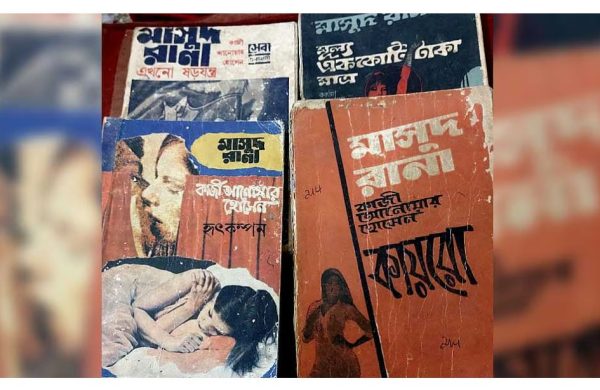
The books which were once thrown away by parents due to racy content are now gems, comments Mashud Hossain, a bookseller at Nilkhet second hand-book market.
A first edition of any book from the late sixties can be sold for as much as Tk 15000, he observes, adding: “Books from the early 70s are sold between Tk 5,000 and Tk 10,000.”
I just sold Cairo, Ekhono Shorojontro, Roker Rong and Mullo Ek Koti Taka Matro for Tk 16,000, enthused Mashud.
The online auction of Masud Rana thrillers involves millions, says Ashraf, another Masud Rana thriller collector.
“The first edition of the first book Dhongsho Pahar, if available, can go up to Tk 100,000.”
The Urdu version of the first book, titled “Maut ka Tila” is a coveted publication which can trigger a frenzied auction, asserts Ashraf.
The hard cover bigger sized copies, printed in very limited numbers, are also pricey, he says.
Scouring the Nilkhet market, it became evident that book sellers knew all about the Rana collection craze and an old copy of a book, irrespective of condition, had a steep price tag on it.
In pristine condition, I bought Rotnodweep, paying Tk 6,000 for it, said Ashraf.
One book seller made a very thought-provoking comment: back in the 70s and 80s, almost everyone read Rana books and if they didn’t throw away the books then they now have priceless gems.
Unfortunately, most people I ask who had small libraries at home tell me that at one point in time, they just sold Rana books to old item buyers.
But if you still have an old stack of books then better take a peek.
At sixty, Rana is more appealing now than he was thirty years ago.
Why do we love the spy so much?
Maybe the answer lies in a quote from Oscar Wilde: “You will always be fond of me. I represent to you all the sins you never had the courage to commit.”







Editor & Publisher: Golam Mostafa Jibon
News & Commercial Office:
2 R. K Mission Road, Dhaka & Railgate, Sirajganj.
Hotline: 01715-319996, 01558-314179
E-mail : editor.thedailysky@gmail.com
news.thedailysky@gmail.com