

No bribe, no service: Life trapped everywhere in a cycle of bribes
- Update Time : Friday, May 22, 2026
Online Desk:
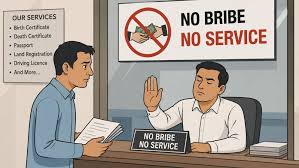
From birth certificates to death records, bribery has become deeply embedded in the daily lives of ordinary citizens in Bangladesh. Across multiple sectors, people are being forced to pay extra money beyond official fees to access basic government services, turning routine administrative procedures into prolonged and costly ordeals.
Citizens seeking birth registration certificates, death certificates or inheritance documents often face delays unless unofficial payments are made. Although government fees remain nominal, brokers and some dishonest officials allegedly work together to demand several times the official cost. Many complain that files simply do not move without bribes.
Iftekharuzzaman, executive director of Transparency International Bangladesh, said those involved in bribery and extortion must be held accountable.
“The government has declared a strong stance against corruption, yet bribery and extortion continue openly,” he told that. “Those benefiting from corruption often have links to power — whether political, bureaucratic or otherwise influential. Without exemplary punishment and strict enforcement, irregularities will continue unchecked.”
One of the sectors where citizens reportedly suffer most is passport and national identity card services. Applicants frequently face repeated rejection of forms over minor errors unless they seek help from brokers.
At the Department of Immigration and Passports office in Jatrabari, several applicants alleged that officials subjected them to unnecessary questioning and repeatedly returned applications when submitted without brokers.
A broker identified as Saiful Haque allegedly demanded between Tk 2,000 and Tk 5,000 in addition to official fees for resolving common issues. For major corrections, such as changing dates of birth or updating passports with new national identity information, charges reportedly ranged from Tk 50,000 to Tk 100,000.
One applicant, Arafat from Kadamtali, said his application was initially rejected. After paying Tk 2,000 to a broker outside the office gate, he was able to submit it successfully.
Similar allegations have emerged in government hospitals, where patients reportedly pay extra for beds, diagnostic tests, surgeries and ambulance services. Families claim ward attendants often demand money before arranging hospital admission, while ICU beds remain inaccessible without influence or payments.
Corruption allegations are also widespread in land registry and sub-registry offices. Citizens seeking land registration, mutation or record correction say they are regularly forced to pay additional money beyond government fees.
Mohammad Ali, a resident of Khilgaon’s Goran area, said he was asked to pay a large unofficial amount while seeking services at the Tejgaon Land Registry Office. He later resolved the matter through a third party after additional negotiations and payments.
Birth registration services at local government offices have also drawn criticism. Many applicants allege that registration applications remain pending unless extra money is paid through brokers or intermediaries.
Shahadat Hossain, a resident of Mirbagh, applied for his son’s birth registration at a regional office of Dhaka North City Corporation on May 14. Although the process typically takes two to three days, he said the application remained stalled until he paid Tk 1,200 through a local computer shop operator.
Another service seeker, Suraiya Begum, expressed frustration after spending months trying to correct a minor mistake in official documents.
“I would not have understood the suffering from birth to death if I had not come to this office,” she said. “After three months of running around, the work was finally completed only after paying extra money to a broker.”
Governance expert Badiul Alam Majumdar, editor of Shushasaner Jonno Nagorik (SHUJAN), said the government must take immediate and strict action to dismantle bribery networks within public service sectors.
“Citizens must also become more aware and vocal against corruption,” he said. “If we continue returning to the old system, then the sacrifices made for change will lose meaning.”
Bribery allegations also persist in services provided by the Bangladesh Road Transport Authority, where obtaining driving licenses or vehicle registration reportedly often requires unofficial payments.
Citizens additionally reported corruption in obtaining certificates for widowhood, unmarried status, disability allowances, elderly benefits, freedom fighter allowances, VGD and VGF cards, land records, e-mutation services and small business loans.
For many ordinary Bangladeshis, bribery has become more than an inconvenience — it has evolved into a parallel system governing access to essential public services. (Source: Bangladesh Pratidin)






Editor & Publisher: Golam Mostafa Jibon
News & Commercial Office:
2 R. K Mission Road, Dhaka & Railgate, Sirajganj.
Hotline: 01715-319996, 01558-314179
E-mail : editor.thedailysky@gmail.com
news.thedailysky@gmail.com