

Rangamati General Hospital: New building yet to open amid staff shortage; patients left in corridors
- Update Time : Thursday, February 19, 2026

Rangamati Correspondent:
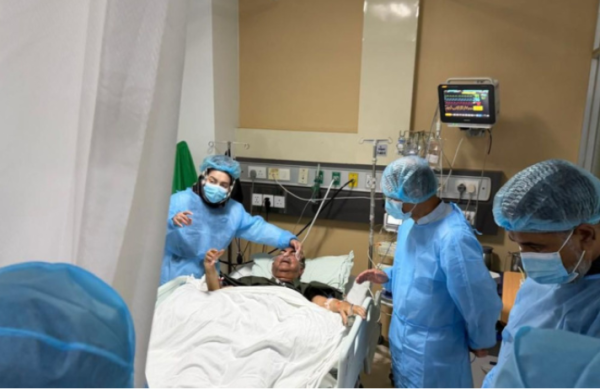
The government has constructed a state-of-the-art building at Rangamati General Hospital to expand healthcare services in the Chattogram Hill Tracts. The 11-storey structure is equipped with modern operating theatres, ICU, isolation units, and elevators. Of the total floors, six have already been completed and formally handed over to the Health Department by the Public Works Department (PWD). However, due to a shortage of manpower, hospital authorities have yet to relocate services or commence operations in the new facility.
Hospital insiders said that more than 100 patients are currently admitted to the 100-bed facility at any given time. With no additional bed allocation, many patients are forced to stay on the floors and in corridors, posing significant health risks. Officials believe that shifting several departments, designated wards, and cabins to the new building would help ease the overcrowding crisis.
According to the PWD Rangamati office, the modern hospital building was constructed under the Fourth Health, Nutrition, and Population Sector Programme (HNPSP), financed by the Ministry of Health and Family Welfare. Although designed as a 250-bed facility, it has not yet received formal approval for the upgrade. While the building has an 11-story foundation, construction has so far been completed up to the sixth floor. The project cost BDT 485 million, including BDT 340 million for civil works and BDT 145 million for electrical installations. The building features four elevators — two with a 1,600 kg capacity and two with a 1,000 kg capacity — as well as a central oxygen supply pipeline. The five-year project began in July 2019 and concluded in June 2024. Despite completion within the stipulated timeframe, the Rangamati health authorities took possession of the facility in November 2025 — more than a year after the project’s scheduled completion.
Sharmi Chakma, executive engineer of PWD Rangamati, told journalists, “The building has already been handed over to the Health Department. Although the Health Department has taken charge, I’ve heard that services have yet to begin. If a newly constructed building remains unused, electrical equipment, including elevators, may deteriorate.”
Hospital sources said the ground floor of the six-storey building will house the emergency department, pharmacy, store, ticket counter, and related services. The second floor includes a 20-bed ICU and isolation unit. The third floor is designated for diagnostic services, including a pathological laboratory, X-ray, MRI, and a kidney dialysis unit. The fourth floor will accommodate the Operation Theatre (OT), the fifth floor a post-operative unit, and the sixth floor wards and cabins for patients.
Physicians noted that Rangamati, a hilly district, remains comparatively behind other districts in terms of healthcare services. However, the establishment of a medical college, the construction of modern upazila-level health complexes, and the modernisation of the district’s only general hospital have brought some positive changes. Given the remoteness of many upazilas, Rangamati General Hospital serves as the last resort for marginalised communities seeking treatment.
Dr Nuyan Khisa, civil surgeon of Rangamati and superintendent of the General Hospital, told journalists, “PWD handed over the building late last year. Although the new facility is equipped with advanced arrangements for patient care, we’re unable to start operations due to manpower shortages. The 100-bed hospital must receive approval to be upgraded to 250 beds. If we had administrative approval for a 250-bed hospital, we could formally request additional staffing from the ministry. In administrative arrangements, a single individual may sometimes hold responsibilities in two upazilas. But it’s not possible to operate two separate facilities with the same manpower. As a result, despite struggling to manage services, we continue operations in the old building.”
Acknowledging concerns over the deterioration of electrical equipment, Dr Khisa said, “Nothing remains good if it is unused. Despite limited manpower, we’ll try to partially open the new building within the next few days. We’re considering whether eye surgeries can be shifted to the new facility by next month.”








Editor & Publisher: Golam Mostafa Jibon
News & Commercial Office:
Railgate, Sirajganj & 2 R. K Mission Road, Dhaka.
Hotline: 01715-319996, 01558-314179
E-mail : [email protected]