

Saving govt sugar mills – is it possible?
- Update Time : Sunday, December 21, 2025
TDS Desk:
Bangladesh’s state-owned sugar mills have an average extraction rate of about 6%, meaning six kilograms of sugar are produced from every 100 kilograms of locally produced sugarcane, according to annual financial statements of these mills.
By contrast, cane in major exporting countries such as Brazil is thicker and richer in juice. Brazil’s recovery rate is around 14%, Australia’s 12%, and India’s between 9% and 10.5%.
In addition, most Bangladeshi state-owned mills continue to operate with machinery installed more than five decades ago, much of it manufactured by companies that no longer exist.
Experts have long been saying even with additional investment and machinery, production costs at state-owned mills would remain higher than those of private refiners importing raw sugar.
Despite such repeated warnings about their long-term viability, the government spends hundreds of crores of taka each year to keep the ageing mills afloat.
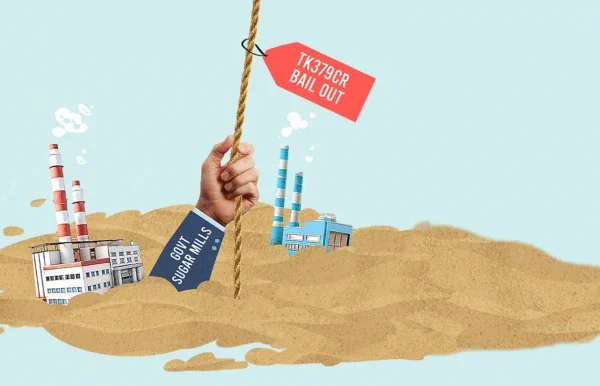
The latest example is that after receiving Tk100 crore in September to purchase sugarcane, the industries ministry has sought from the finance ministry another Tk379 crore for the mills this fiscal year to pay farmers and cover a widening “trade gap”, according to a letter seen by journalists.
Documents show that eight of the nine operational state-owned sugar mills incur average annual losses of around Tk400 crore. Production costs at the dilapidated factories approach Tk300 per kilogram – far exceeding sales revenue.
The revenue is insufficient to cover raw materials, operating expenses, or staff salaries. The crisis is compounded by more than Tk4,000 crore in outstanding loans, leaving each mill with average annual losses of about Tk50 crore.
Mahbub Ahmed, former senior secretary of the finance ministry, told journalists that state-owned sugar mills should be shut down as there is no realistic prospect of making them profitable.
“The mills have been kept running at a loss in the name of employment, which is economically unsound,” he said.
He added that while most countries have modernised or exited cane-based sugar production, Bangladesh’s state mills have neither upgraded their technology nor shown the capacity to do so.
“The mills control vast tracts of land, which could attract investment in other sectors and generate far greater economic returns. With surplus sugar production globally, Bangladesh could easily import sugar,” he said.
Even the government acknowledges the mills are now a burden. On 6 December, Industries Adviser Adilur Rahman Khan said subsidies alone cannot sustain them.
“There is no alternative to local and foreign investment. Talks with potential investors are under way, and progress is expected soon,” he said, adding that sugar imports would remain suspended until domestic stocks were cleared.
LETTER SEEKING TK380CR
In a letter seeking approval to release Tk379.69 crore, the industries ministry said the funds were needed to pay sugarcane farmers for the FY26 crushing season. The Bangladesh Sugar and Food Industries Corporation (BSFIC) is currently owed Tk8,130 crore in unpaid trade-gap subsidies.
BSFIC Secretary Mohammad Mujibur Rahman said the mills are forced to sell sugar at government-fixed prices, despite much higher production costs. “Because sugar is sold below cost, a trade gap arises, which the government covers each year,” he said.
Mujibur added that new investment is critical as most machinery is extremely old and, in some cases, manufacturers are defunct. As a result, mills rely on in-house repairs, which further depress recovery rates.
According to the latest crop survey, eight mills are expected to crush about 767,000 tonnes of sugarcane in the upcoming season. The Tk100 crore already released in September would cover only 20.85% of required payments, leaving a funding shortfall of Tk379 crore.
RECOVERY RATES STUCK AT 6%
Among state-owned mills, Zeal Bangla Sugar Mills usually has the best extraction rate. In FY25, the mill’s rate was 6.38%, internal documents show. The rate at mills hovers around 6%.
Zeal’s FY25 sales data show that the bulk of its 1,929 tonnes of sugar went to the government, with 1,311 tonnes supplied to the police and 292 tonnes to the defence.
ONLY CAREW TURNS A PROFIT
The BSFIC oversees the state-run sugar mills as well as a separate company responsible for repairing mill equipment. In an effort to stem losses, the government shut down six sugar mills in 2020. Of the nine currently in operation, eight remain loss-making.
The sole profitable enterprise is Carew & Company (Bangladesh) Limited in Darshana, Chuadanga. While its sugar unit posted a loss of about Tk62 crore in FY25, the distillery unit generated profits of roughly Tk190 crore during the same period.
FY25 audits for other mills are ongoing. However, audited figures for FY24 show combined losses of Tk422 crore at eight mills, with accumulated losses reaching Tk6,573 crore and total liabilities standing at Tk4,072 crore.
AVERAGE DEBT OF TK500CR
An analysis of FY24 accounts shows each mill carries an average debt of about Tk500 crore, largely from state-owned Sonali Bank, along with loans held by the parent corporation.
Mills borrowed heavily to meet operating costs and pay wages, but weak revenues left them unable to service debts, causing liabilities to rise annually.
North Bengal Sugar Mills has the highest debt, totalling Tk786 crore, including Tk517 crore in agricultural loans.
Among operational mills, Zeal Bangla Sugar Mills published its full FY25 financial report. Despite higher sugar output, losses deepened, with a Tk47.32 crore deficit, up from Tk44.63 crore a year earlier. Accumulated losses have reached Tk704 crore.
Acting managing director Md Tarikul Alam said the mill crushed 72,000 tonnes of sugarcane in FY25, producing 4,599 tonnes of sugar with a recovery rate of 6.38%.
“All sugar remains in stock as sales will begin only after government approval,” he said. A year earlier, the mill crushed 44,988 tonnes of sugarcane, producing 2,717 tonnes at a recovery rate of 6.08%.










Editor & Publisher: Golam Mostafa Jibon
News & Commercial Office:
Railgate, Sirajganj & 2 R. K Mission Road, Dhaka.
Hotline: 01715-319996, 01558-314179
E-mail : [email protected]