

UNESCO report: Bangladesh ranks lowest in free education in South, Central Asia
- Update Time : Monday, January 19, 2026
TDS Desk:
Education ranks among the most fundamental human rights. The United Nations Sustainable Development Goals codify this principle in SDG–4: to ensure inclusive and equitable quality education for all and to promote lifelong learning opportunities. Bangladesh, along with all 193 UN member states, unanimously adopted the SDGs in 2015 with the target to achieve these goals by 2030.
SDG–4.1 calls to ensure that all girls and boys complete free, equitable, and quality primary and secondary education by the end of the decade. In Bangladesh, however, free education is limited to the primary level. UNESCO’s 2024 Global Education Monitoring Report places the country among the world’s weakest performers on this measure, ranking it last in South and Central Asia.
Sri Lanka leads the region, with a legal framework that guarantees free education from pre-primary through twelfth grade. The Maldives, Nepal, Pakistan, Afghanistan, Turkmenistan, and Uzbekistan also provide free schooling from grades one to twelve. Kazakhstan, Kyrgyzstan, and Bhutan cover pre-primary through tenth grade; Tajikistan and Iran cover pre-primary through eighth; and India guarantees free education from first to eighth grade. Bangladesh’s provision extends only from first to fifth grade. This leaves it trailing not only regional neighbours but most of the world; only three countries globally now perform worse.
A similar picture emerges on compulsory education, where Bangladesh also ranks among the world’s laggards. UNESCO data shows 155 countries have made education compulsory from pre-primary through at least eighth grade. Across South and Central Asia, countries including Turkmenistan, Uzbekistan, and Pakistan mandate schooling from grades one to twelve; Sri Lanka requires it through tenth grade; Tajikistan, Kyrgyzstan, Iran, and Afghanistan enforce it from pre-primary through eighth grade; Nepal and India compel attendance from first to eighth grade; and the Maldives mandates it through seventh grade.
Meanwhile, Bangladesh relies on the Primary Education (Compulsory) Act of 1990, which makes only grades one to five mandatory. Bhutan, while providing free education from pre-primary to tenth grade, has no law requiring it to be mandatory at any level.
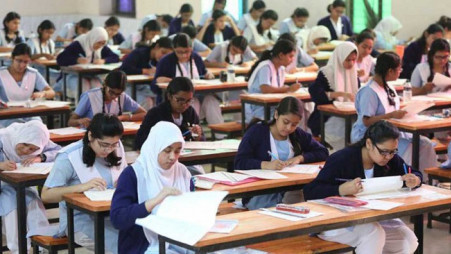
Education specialists attribute three decades of stagnation in extending free and compulsory education to weak government planning and a lack of sustained initiative. With secondary education not free and household costs rising, they warn of a deepening dual crisis: high dropout rates after primary school and widening social inequality.
Professor Dr. Md Abdus Salam of the Institute of Education and Research at the University of Dhaka told journalists, “Given Bangladesh’s current position on SDG education targets, the prospect of proper achievement by 2030 is virtually non-existent. The existence of multiple streams of education and the lack of effective government planning pose major challenges in this regard. In particular, costly secondary education and nearly 11 different streams at the primary level have made the overall education system inequitable.”
The 1972 Constitution of Bangladesh commits the state to providing free and compulsory education. Article 17 sets out this obligation, directing the state to adopt effective measures to establish a uniform, mass-oriented, and universal education system and to extend free and compulsory education to all children up to a certain grade set by law. However, the provision sits among the fundamental principles of state policy, not within the enforceable fundamental rights. Educators argue this omission has allowed the state to evade accountability for five decades, failing to build a universal system while leaving citizens without legal recourse to challenge that failure. Despite the launch of constitutional reform after the 2024 mass uprising, the process included no revision on this issue. While eleven reform commissions were formed across several sectors, none has been established for education.
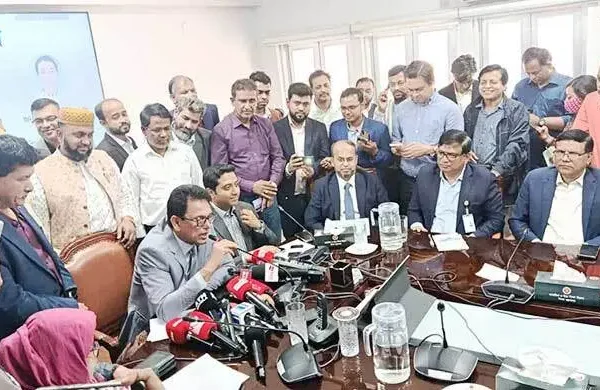
Rasheda K Choudhury, executive director of the Campaign for Popular Education (CAMPE) and a former caretaker government adviser, told journalists: “By excluding education from the third chapter of the 1972 Constitution, a loophole of sorts was created. The Constitution states that the state shall provide free and compulsory education to all boys and girls up to a certain grade to establish a uniform, mass-oriented, and universal education system. However, if the state fails to do so, citizens have no legal recourse. It is deeply regrettable that, even in terms of compulsory and free education, we lag behind some of Africa’s poorer countries. Many students still drop out due to financial constraints. UNESCO reports that 71 percent of secondary–level education costs in Bangladesh are borne by families, and these costs are steadily rising. Bearing such expenses is impossible for a large proportion of families in countries like ours. Unless the government increases the level of free education, social inequality will continue to grow.”
She added, “We have long argued for making education free and compulsory at least up to eighth grade, yet no effective initiative is in sight. With 93 percent of secondary institutions privately run, the government’s MPO scheme offers limited subsidies, but students benefit little. The MPO process is driven more by political patronage than educational merit.”
She further said, “Under the 2010 Education Policy, an initiative was taken to upgrade some primary schools up to the eighth grade. But that too has been cancelled. Where such opportunities should have been expanded, they have instead been further restricted. Steps have been taken to amend the Constitution yet education has been overlooked. Moreover, in the election manifestos of political parties, we have yet to see any encouraging commitments for the education sector. Overall, education seems to have slipped from its position as a priority sector.”





Editor & Publisher: Golam Mostafa Jibon
News & Commercial Office:
Railgate, Sirajganj & 2 R. K Mission Road, Dhaka.
Hotline: 01715-319996, 01558-314179
E-mail : [email protected]