

A LOOK BACK AT 2025: A year long yearned for
- Update Time : Monday, December 29, 2025
Sports Desk:
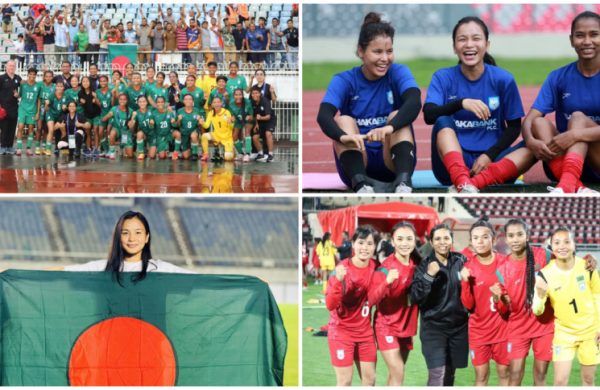
It would be easy to begin with cliches: underdogs, fairy tales, David and Goliath. However, the story of Bangladesh women’s football in 2025 refuses the comfort of familiar labels.
It began with whispers that became shouts, with footsteps that hesitated, with hearts that doubted. It ended with a quiet rewriting of history, the kind that does not announce itself loudly, but lingers.
Context matters. The men’s national team have reached Asia’s premier competition just once — back in 1979, a moment preserved like an old photograph. The women this year went further than any Bangladesh side had managed in nearly half a century. They qualified for the AFC Women’s Asian Cup for the first time, doing so as the lowest-ranked team (128) ever to enter the tournament. Rankings — which rose to a record 24 spots afterwards — like expectations, were politely ignored.
The year began in turbulence. February brought revolt. Senior players, led by Sabina Khatun, publicly called for the removal of head coach Peter Butler, citing grievances over favouritism, tone, and trust. The dispute unfolded not in hushed corridors but in full public view, with press conferences as tense as any monsoon-soaked district cup final. The team that had delivered back-to-back SAFF titles seemed to unravel in real time.
Butler remained unmoved, though, like a lighthouse amid storm and flood. The federation chose continuity. Contracts were honoured, compromises reached, and the noise gradually receded. However, some familiar faces did not return, leaving an unmistakable reminder that every rebellion carries its casualties.
What followed was a quiet revolution as the English coach continued to trust youth, demand discipline, and insist on a game that thought before it ran. May-June’s friendly draws against superior-ranked Indonesia and Jordan offered clues for what was in store.
In July, in Myanmar, the lessons were tested. Victories over Bahrain and Turkmenistan came with assurance, but in the decisive match against the hosts, Ritu Porna Chakma appeared as though conjured by the spirits of the riverbanks. She scored twice, with the lightness of a dancer and the precision of a hunter. Bangladesh qualified and did it with style: tactically sophisticated, emotionally resonant, and quietly audacious.
Ritu Porna’s year came to symbolise the shift. Both Ritu Porna and the national women’s team were rewarded with two of the nation’s highest civilian honours, with the forward earning the Rokeya Padak and the team being awarded the Ekushey Padak.
More subtly, the team’s thoughtful playing style began to change language itself. They were spoken of less as “women footballers” and more simply as footballers, practitioners of a shared craft.
The momentum ran deeper. The U-20 side lifted the SAFF Championship at home and qualified for their Asian finals, like their seniors. The U-17s, even in defeat, added their notes to a swelling chorus.
Success brought attention, sometimes in unexpected forms. The spotlight grew so bright that the head of the BFF’s women’s wing found herself publicly denying that players at the dormitories were being served low-priced pangash fish. Elsewhere, a men’s youth team coach admitted on record that the women’s achievements were putting pressure on the men — an unintended but telling compliment.
Yet setbacks remained. While Bangladesh played more international matches than in any recent year, straight losses to Thailand, Malaysia, and Azerbaijan underlined the distance still to be travelled before next year’s main event in Australia. Domestic structures lagged behind ambition, pushing players to seek minutes abroad, in Bhutan or on futsal courts. Eventually, the Women’s Football League saw daylight — starting on December 29 after nearly a one-and-a-half-year gap.
Butler, never one for diplomatic phrasing, spoke openly of the need to rise beyond South Asia, a standard he described as “terrible”, and towards Asia proper. It was clear that this team had stopped measuring themselves against neighbours, setting their sights on what was previously out of reach — like the Olympics and the World Cup.
The reception after qualification captured the paradox. There was pride, yes, but also insistence. Captain Afeida Khandokar spoke of the need for much better nutrition, facilities, and preparation. It was the language of a team that had outgrown novelty and begun to negotiate with the future.
2025 began in rebellion. It ended in belief. Amid limited facilities and modest coverage, Bangladesh women’s football became the country’s most successful national team of the year. They proved that progress does not always arrive with trumpets. Sometimes it comes quietly, like water finding its way through stone, reshaping the landscape without asking permission.








Editor & Publisher: Golam Mostafa Jibon
News & Commercial Office:
Railgate, Sirajganj & 2 R. K Mission Road, Dhaka.
Hotline: 01715-319996, 01558-314179
E-mail : [email protected]