

AL activity raises concern over ‘Insider Threat’ in police
- Update Time : Sunday, September 20, 2026
Golam Mostafa Jibon:
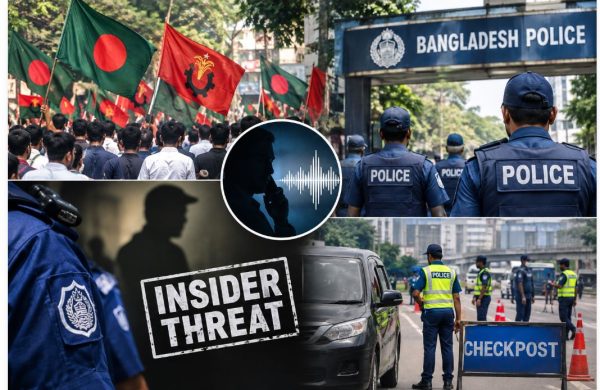
The recent emergence of public activities by the Awami League and its affiliated organisations has raised fresh concerns within the law enforcement agencies, particularly over the possibility of an “insider threat” involving members of the police who may still be sympathetic to the former ruling party.
A series of surprise processions, cocktail explosions and other activities allegedly involving the Awami League and its banned student wing, Bangladesh Chhatra League, have prompted questions about intelligence gathering, coordination among security agencies and the effectiveness of policing at the field level.
The issue has gained further attention following the circulation of an audio recording purportedly involving the officer-in-charge of Cantonment Police Station, in which a voice identified as that of the OC allegedly made remarks suggesting that former prime minister Sheikh Hasina could return to Bangladesh without facing significant resistance from the police.
The officer, Md Rakibul Hasan, was subsequently withdrawn from the police station and attached to the DMP headquarters. A three-member committee has been formed to investigate the matter. However, the authenticity of the recording and whether the voice actually belongs to the officer have yet to be conclusively established.
The episode has nevertheless fuelled concern among senior officials about whether individuals within the police may retain political loyalties or contacts that could compromise their professional responsibilities.
Questions over intelligence failure
The recent procession in the Gulshan area has also come under scrutiny. The appearance of a sizeable group of people in a highly sensitive diplomatic and commercial zone, followed by clashes and cocktail explosions, has prompted questions over whether intelligence agencies had prior information about the gathering.
Officials are examining whether the incident was the result of an intelligence failure, a lack of coordination among agencies, or a failure to act on information that may have been available.
Questions are also being raised over whether field-level intelligence officers had failed to collect information about the planned gathering or whether relevant information, if available, was not communicated to senior officials in time.
The incident has consequently triggered renewed discussions within the police over improving coordination among intelligence agencies and ensuring that information collected at the field level reaches operational units promptly.
Concern over political influence
A deputy commissioner-level police officer, speaking on condition of anonymity, said the police administration had undergone extensive politicisation over the past 15 years.
According to the officer, political considerations had influenced appointments to important positions in agencies such as the Special Branch, National Security Intelligence and the Detective Branch of the Dhaka Metropolitan Police.
Although major changes have been made at senior levels since the political changeover, a large number of inspectors, sub-inspectors and constables remain in field-level positions, the officer said.
“Whether any of them still maintain political allegiance or personal links with the former ruling party needs to be examined objectively,” the officer said.
Police officials, however, cautioned that political affiliation or sympathy should not be presumed merely on the basis of an individual’s past posting or professional association.
‘Silent inactivity’ under scrutiny
Several DMP officials, speaking informally, said a degree of psychological uncertainty may exist among some members of the force because of the possibility of further political changes.
According to them, some field-level officers may be reluctant to take aggressive legal action against banned organisations because they fear that the political situation could change again, potentially exposing them to reprisals.
Political analysts have described such alleged reluctance as a possible form of “silent inactivity”, arguing that a lack of decisive enforcement could create space for banned groups to return to the streets.
There is, however, no publicly available comprehensive data establishing the extent of such behaviour within the police force.
Internal monitoring stepped up
Sources said efforts were underway to determine whether any police personnel were leaking information or maintaining undisclosed contacts with former Awami League leaders.
Special monitoring teams are reportedly examining the activities of suspected officials, while discussions are underway over transferring some personnel to non-operational or less sensitive assignments.
Several police officials said further reshuffling could take place in important positions in the coming days.
At recent meetings of senior police officials, greater coordination among intelligence agencies was emphasised to prevent surprise processions and other activities by banned organisations.
Authorities have also called for greater use of technology-based policing, closer monitoring of tenant information and more systematic collection of information from guests staying at residential hotels.
DMP units given coordinated responsibilities
The Detective Branch, Counter Terrorism and Transnational Crime unit and local police stations have been assigned coordinated responsibilities to reduce gaps in intelligence and law enforcement, according to police sources.
DMP Commissioner Mosleh Uddin Ahmed has instructed officers to strengthen security at entry points and other sensitive locations in the capital.
Police have also been directed to collect and analyse intelligence in advance so that individuals involved in criminal or violent activities cannot enter Dhaka from other parts of the country and carry out offences.
At a recent meeting with officers-in-charge of all police stations in Dhaka, deputy commissioners of the eight DMP divisions and other senior officials, the commissioner stressed the need for every police officer to perform his or her assigned duties properly.
He directed the DB, CTTC and police stations to work in coordination and divide responsibilities geographically so that no area remained without adequate security coverage.
Police officials have also been warned that action could be taken against the relevant OCs and deputy commissioners if banned Awami League or Chhatra League activists manage to hold processions in their jurisdictions.
More checkpoints across the country
Following the recent incidents, the number of police checkpoints has been increased in Dhaka and elsewhere in the country.
According to information from the relevant police units, a total of 1,637 checkpoints are currently being operated at metropolitan and district levels, including 215 in Dhaka city.
The increased presence of police has become particularly visible at major entry points and other strategic locations in the capital.
The DMP has also ordered block checks and other security measures in selected areas as part of efforts to prevent criminals and suspected offenders from entering the city.
SRB steps up field and cyber surveillance
The Special Response Battalion (SRB), the successor to the Rapid Action Battalion in the current structure, is also conducting operations on two levels, according to its director, Wing Commander AZM Entekhab Chowdhury.
He said investigators were collecting field-level information about recent cocktail explosions and incidents of bus arson. CCTV footage is being collected and analysed, while investigators are also identifying motorcycles allegedly used in the incidents by tracing their registration numbers and owners.
At another level, SRB personnel in plain clothes are conducting surveillance in the field, he said.
The unit’s cyber-monitoring team is also collecting information around the clock, Entekhab said, adding that the recent incidents appeared to have involved a degree of organisation.
According to him, those planning such activities are increasingly using online platforms because direct telephone communication could expose their plans.
He said cyber monitoring had therefore been strengthened.
The SRB director also said the organisation had continued operations against extremist organisations, building on activities previously conducted by the Rapid Action Battalion.
Intelligence coordination remains key
The recent developments have placed two issues at the centre of law enforcement discussions: the ability of banned political groups to organise surprise street activities and the possibility that internal weaknesses within the police could undermine preventive operations.
However, allegations of political allegiance, information leaks or deliberate inaction by individual police officers need to be established through investigation rather than assumption.
For the law enforcement agencies, the immediate challenge is to ensure that intelligence is collected accurately, shared promptly among relevant agencies and translated into timely action at the field level.
The increased number of checkpoints and visible police presence may provide an immediate security response. But the longer-term effectiveness of the measures will depend on the quality of intelligence, inter-agency coordination, professional policing and accountability within the force.







Editor & Publisher: Golam Mostafa Jibon
News & Commercial Office:
2 R. K Mission Road, Dhaka & Railgate, Sirajganj.
Hotline: 01715-319996, 01558-314179
E-mail : editor.thedailysky@gmail.com
news.thedailysky@gmail.com